[Please forgive the acronyms in the title – it is the only way to avoid them becoming far too long. For those unfamiliar with the alphabetti spaghetti of Anglican life this blog may be helpful. In the meantime, here are a few relevent reminders:
- ACC – Anglican Consultative Council – an elected body of bishops, clergy, laity who make up one of the four ‘Instruments of Communion’ of the Anglican Communion
- ABC – Archbishop of Canterbury – another of the four ‘Instruments of Communion’
- IASCUFO – Inter-Anglican Standing Commission on Unity, Faith and Order. A permanent commission that offers advice to the Anglican Communion on matters of theology
- GSFA – Global South Fellowship of Anglicans – an orthodox group within the Anglican Communion, bound together by the Cairo Covenant. They have declared themselves to be in impaired communion with the Church of England, and therefore the Archbishop of Canterbury, but particpate in the structures in order to reform them.
- GAFCON – Global Anglican Futures Conference – an orthodox group within the Anglican Communion that came together in 2008 around the Jerusalem Declaration
- GAC – Global Anglican Council – formed at a meeting of GAFCON earlier this year in Abuja, Nigeria, where the decision was taken to re-order the Anglican Communion. The GAC declared that “full and public disengagement” from the Instruments of Communion was now necessary due to their failure “to exercise discipline and maintain the biblical witness and uphold fundamental Anglican doctrine.”]
Last week, the ACC met in Belfast for their 19th trienniel meeting – ACC-19. In accordance with their previously stated positions, members of GAFCON/GAC stayed away and the members of GSFA who were present, refused to share “eucharistic fellowship” with others, as a sign of their impaired communion.
Given the underlying doctrinal disagreements, some may think that the theme of this meeting, ‘Called to One Hope’, was somewhat optimistic . Yet, that spirit of possibility carried the day in most debates, including a very bullish target of planting or revitalising a million churches over the next ten years. A ‘million’ may be a nice round number, but it is not clear if anyone actually worked out what that would entail. It is either 274 churches a day, each and every day, for the next ten years or it requires 155 planted or revitalised churches every year by every diocese of every province represented at the ACC.
Amongst all this positivity, there was one major sticking point: the question of whether or not those gathered actually share in ‘one hope’. The most important debates at ACC-19 related to the Nairobi-Cairo Proposals – IASCUFO’s attempt to restructure and re-define the Anglican Communion, “in service of ‘seeking to walk together to the highest degree possible’.”
In IASCUFO’s own words:
“The first proposal offers an updated description of the Anglican Communion to both reflect its current structure and enable all Anglicans to ‘speak truly and honestly about the faith, ministry, and mission that we share.’ The second proposal calls for a broadening of leadership of the Anglican Communion, better to reflect the diversity of the Communion.”
To give a bit of context, at the last meeting of the ACC in 2023, IASCUFO were set the task of exploring the “theological questions around ‘structure and decision-making to help address our differences in the Anglican Communion’. This they did, publishing interim documents and consulting with the Primates Meeting to check they were on the right track. They published their initial proposals in December 2024, and a supplementary paper in 2025.
Since then, there have been a number of papers that have challenged the proposals.
- GAC member, the Rt Revd Dr Glenn Davies, believes the Nairobi-Cairo Proposals are inadequate and minimize, “the significance of the disagreement that has confounded the Communion for over 30 years, and avoids the inevitable question about the limits of orthodoxy.”
- Church of England scholar and ecumenist, Rev Dr Paul Avis disagreed. In his mind the issue was that the proposals were flawed because they, “neither challenged nor justified” GSFA’s declaration that they were in impaired communion with the See of Canterbury.
Despite this, it seemed likely that IASCUFO’s attempts to offer a description that, in the words of their Chair, the Rt. Rev. Dr. Graham Tomlin, “accurately captures the best of our historic legacy, who we are now, and who we aspire to be, seems important as a means of rebuilding trust and ensuring there is enough room for all of us,” would gain traction.
So, it came as something of a surprise when commentator, Revd Mark Michael described the response of the ACC to these proposals as “largely skeptical”.
Those who have followed the twists and turns of the Anglican debates about biblical authority and sexual ethics will not be surprised that the disagreement focused on what it means to be a member of the Anglican Communion. In particular, IASCUFO’s proposal to remove the need to be “in communion with the See of Canterbury” and replace it with a reference to a “historic connection with the See of Canterbury”.
The following quotes suggest that GSFA members seemed to be relatively content with the proposals.
“Whether we like it or not, there have already been many provinces who cannot accept being in full communion with Canterbury because being in full communion means a communion of faith, and communion of faith no longer exists because Canterbury has departed from ‘the faith once delivered to the saints.’ So, what remains is historic: historic connection with Canterbury. That’s why we say this is the way forward.”
Very Revd Berthier Lainirina, The Church of the Province of the Indian Ocean
“… the Anglican Communion would be rooted more in the apostolic tradition instead of the See of Canterbury.”
The Rev. Zablon Bundi of the Anglican Church of Kenya
“We consider that this wording appropriately recognises the historical, spiritual and relational importance of Canterbury within the life of the Communion, without making that relationship the sole constitutive criterion of belonging or communion. We understand that this description reflects more accurately the current reality of the Anglican Communion and offers an adequate basis for the future development of its common structures.”
Response of the Anglican Church of South America
However, those representing the revisionist provinces seemed particularly troubled by any change in the expected relationship with the See of Canterbury:
“If we take away what we understand about the See of Canterbury and the primacy of Canterbury, what is our rallying point; what binds us?”
The Most Revd Kay Goldsworthy, Anglican Church of Australia.
“The Archbishop of Canterbury is the parent, and when the offspring grow up and become independent, they still want that relationship with the parent. … Our whole identity is the connection with our parents, but that doesn’t mean the parent dictates to us.”
Canon Jane Evans, Church of England
“If we dilute the relationship with Canterbury, we take away the reason for being Anglican. We might as well be something else.”
This comment was unattributed.
“…seem to be an agenda to become individual churches. Every province goes its own way with no head church, and the concern is that this disperses authority and allegiance.”
The Rt Revd Riscylla Shaw, Anglican Church of Canada
There was something ironic about this sudden show of loyalty from those who have spent decades ignoring the warnings of previous Archbishops of Canterbury but there was plenty of time for them to make their views known before ACC debated an actual resolution two days later.
The initial text for the resolution was put forward by the Anglican Communion’s Standing Committee, which purported to reflect the feedback from table discussions.
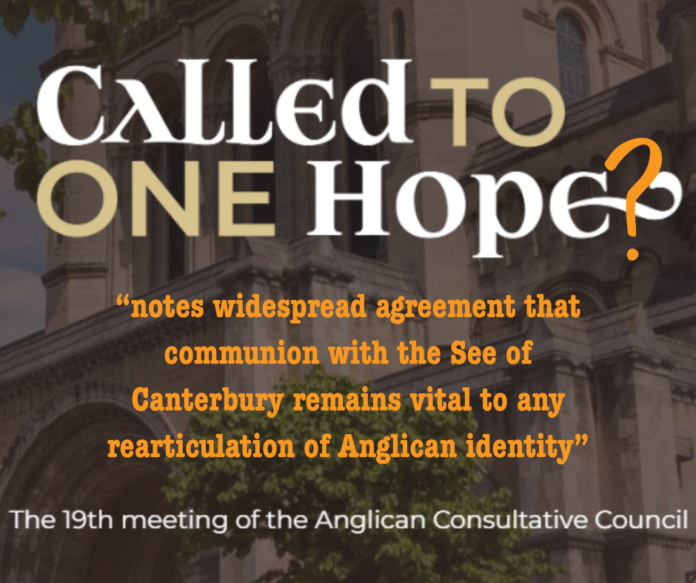
In short, the resolution politely rejected IASCUFO’s proposals. First, by reducing their significance, describing them as mere, “resources for the continuing discernment of the Anglican Communion concerning its life together and the development of the Instruments of Communion”. Second, by “welcoming a period of further dialogue..” and third, and even more importantly, by noting, “.. widespread agreement that communion with the See of Canterbury remains vital to any rearticulation of Anglican identity.”
The Revd Dr Andrew Atherstone, who was at ACC-19 reflected, “Delegates from conservative provinces, who disliked parts of the resolution, felt the cards were stacked against them by the executive, which undermined trust.” The GSFA attempted to amend the resolution but were only partly successful.
Mr Joaquin Philpotts, from the Anglican Church of South America, who spoke to Anglican Futures earlier this year, managed to add to the fifth clause of the resolution a recognition of the spiritual nature of the divisons facing the Communion. This clause then read:
“The Anglican Consultative Council…
5) rejoices that all God’s people are ‘called to one hope’ because there is ‘one body, one Spirit…one Lord, one faith, one baptism, one God and Father of all, who is over all and through all and in all’ (Ephesians 4:4-6) and acknowledges that our present divisions in the Anglican Communion are partly caused by disagreements about the ‘one faith’;
Nevertheless, this and the amendment setting a three-year timeline for the discernment process were of little comfort to those who believe the divisions in the Anglican Communion warrant impaired communion between Anglican provinces. Mr Carlos Romero, from the Anglican Church of Chile, fought hard to remove both references to membership of the Anglican Communion being identified by “communion with Canterbury.” He could not have been clearer about the significance of including this wording:
“…as they stand, they do not reflect the lived reality of many provinces today… as the Archbishop of Canterbury reminded us a few days ago, lasting unity is built on trust, and this proposal is intended to secure that trust across the Communion. … Retaining these phrases risks undermining both this resolution and the unity we are seeking to hold this week.”
Regardless, the vast majority of ACC-19 rejected his view. Both amendments were lost – with two-thirds of the ACC voting against Romero’s proposals.
The final wording of the resolution then went through on a show of hands.
Which seems to leave the GSFA in a difficult place.
The GSFA Statement on ACC-19 was relatively upbeat, concluding
“While we believe our presence at ACC-19 had a positive impact and we are open to continued engagement with IASCUFO about the development of the Nairobi-Cairo Proposals, we know that our identity as orthodox Anglicans does not ultimately depend upon decisions of the instruments of communion, but upon our common commitment to the Catholic and Apostolic faith as it is affirmed in the 2019 Cairo Covenant. This gives us a firm and hopeful place to stand within the Anglican Communion as we continue to bear faithful witness to the ‘one faith’.”
Yet, it is difficult to see a future for GSFA in the Anglican Communion if they cannot persuade the Instruments of Communion to reject the implications of the ACC’s resolution, that there was, “widespread agreement that communion with the See of Canterbury remains vital to any rearticulation of Anglican identity.”
There will surely be serious questions for GSFA in three years time if the Instruments of Communion determine, in line with that ACC-19 resolution, that membership of the Anglican Communion requires a province to be in communion with the See of Canterbury.
If this happens, it will mean that the provinces, who themselves have torn the fabric of the communion by, “blatantly reject[ing] the teaching of Scripture and the Book of Common Prayer in matters of human sexuality that jeopardize one’s salvation”, will in effect exclude those who are they have forced into impaired communion.
It is particularly depressing to think that while members of the GSFA were experiencing “the pain” of taking “a conscientious decision not to share in eucharistic fellowship,” the majority of the ACC were encouraging the drafting of a resolution that will, if carried through, exclude those who take similar actions, from membership of the Anglican Communion.
This is a stark conclusion, but one that should not surprise, as the theologian, Richard Neuhaus once wrote:
“Where orthodoxy is optional, orthodoxy will sooner or later be proscribed. Some otherwise bright people have indicated their puzzlement with that axiom but it seems to me, well, axiomatic. Orthodoxy, no matter how politely expressed, suggests that there is a right and a wrong, a true and a false, about things. When orthodoxy is optional, it is admitted under a rule of liberal tolerance that cannot help but be intolerant of talk about right and wrong, true and false. It is therefore a conditional admission, depending upon orthodoxy’s good behavior. The orthodox may be permitted to believe this or that and to do this or that as a matter of sufferance, allowing them to indulge their inclination, preference, or personal taste. But it is an intolerable violation of the etiquette by which one is tolerated if one has the effrontery to propose that this or that is normative for others.”