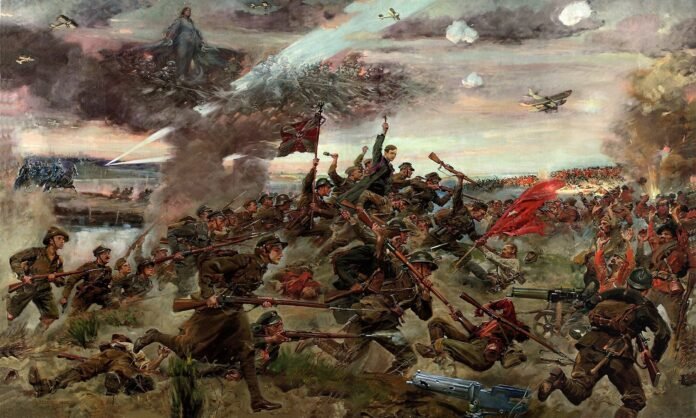
Pope Leo’s remarks to Polish pilgrims on August 12 raise a question Anglicans have never answered in one voice: how should Christians speak of God, Mary, and history? The issue is not whether God governs the nations. The Prayer Book assumes that he does, and Christians rightly pray for deliverance, justice, and peace. The issue is whether the Church may identify a particular military victory as the result of Marian intervention.
This essay argues that Anglican Evangelicals should decline to do so. The claim exceeds Scripture, sits uneasily with Article XXII and the Prayer Book’s Godward discipline of prayer, and risks converting national deliverance into a badge of divine preference. Anglo-Catholics may make a narrower claim: Mary, as part of the communion of saints, prays with and for the Church. But prayerful intercession is not the same thing as an independent heavenly agency, still less a warrant for sanctifying national victory.
According to reports of the Pope’s audience, he told Polish-speaking pilgrims that “through Mary’s intercession” victory was achieved at the Battle of Warsaw on August 15, 1920, an event that changed the history of Poland and Europe. For Polish Catholic devotion, this is familiar language. The battle, often remembered as the “Miracle on the Vistula,” helped preserve the newly reconstituted Polish state against the Red Army. It did not give Poland its independence—that had been restored in 1918—but it helped prevent the loss of that independence almost as soon as it had been regained.
For Anglicans, the question is not whether gratitude is proper. It plainly is. The question is what the Church is entitled to say in gratitude. There is a difference between thanking God for deliverance and publishing an account of how heaven achieved it.
Anglicanism, at least in its healthier moments, has never imagined that God is a ceremonial ornament wheeled out for coronations, funerals, and public emergencies, then packed away again with the silver. The Prayer Book tradition assumes divine providence. It bids Christians pray for rulers, peace, justice, and the relief of human misery. Episcopal liturgical texts speak freely of God’s providence in the raising up of prophets, martyrs, and servants of the Church.
J. I. Packer gave the doctrine its familiar evangelical formulation in the New Bible Dictionary. Providence, he wrote, is the Creator’s continuing activity: God upholds creatures in ordered existence, governs events and free acts, and directs all things to their appointed end for his glory. This is not the theology of a church that believes history is spiritually inert. God has not abandoned the world to chance, bureaucrats, or the editorial pages.
Yet providence is not a communiqué from heaven. To say that God rules history is not to say that the Church can identify the divine chain of causation behind every historical result. Christians may say that God overruled evil for good. They may say that a people under threat were preserved. They may say that prayer was heard. But a further claim is being made when a saint’s intercession is identified as the explanation for a battlefield victory.
The Prayer Book tradition is restrained for a reason. Its public prayers are addressed to Almighty God, through Jesus Christ, in the unity of the Holy Spirit. They seek justice, repentance, wisdom, concord, and peace. They do not provide a liturgical script for canonizing military outcomes. This is not because war lies outside God’s concern; it is because war exposes human motives at their most mixed and human judgments at their least reliable.
The Blessed Virgin Mary is not an Anglican embarrassment, nor ought she to be. She is the mother of the incarnate Lord, the handmaid who received God’s word in faith, and the one whom all generations call blessed. Episcopal liturgical resources honor her as the mother of Christ and as a model of faithful discipleship.
Yet honoring Mary is not the same thing as making her responsible for military results. The classic Anglican treatment of Mary praises God for her, acknowledges the unique grace of her vocation, and asks that Christians may imitate her faith and obedience. Mary points to Christ. The question is whether the Church should also address Mary in prayer, and whether that language can bear the much heavier weight of a national military legend.
Scripture calls Mary blessed. It does not depict her as the patroness of Polish uhlans or a heavenly director of emergency geopolitics. That does not settle every theological question, but it establishes a proper presumption: the Church should not assert more than Scripture has taught it to assert.
For classical Anglicans, the principal difficulty is Article XXII of the Thirty-Nine Articles.. It rejects “the Romish Doctrine” concerning purgatory, pardons, images, relics, and “also invocation of saints” as “a fond thing vainly invented, and grounded upon no warranty of Scripture, but rather repugnant to the Word of God.”
The wording is not subtle. Nor is it a historical curiosity. Article XXII belongs to the Anglican doctrinal inheritance. Its target was not merely bad taste or exaggerated medieval decoration. It was a system in which devotion to the saints could become a practical alternative route of access to divine favor.
The post-Reformation Prayer Book reinforces the Article’s direction. Its public prayers are Godward. It does not train the faithful to petition Mary or the saints. This was a theological judgment, not a clerical oversight.
That does not end the argument. Anglo-Catholic writers have long contended that Article XXII condemns appeals to saints for benefits as though they exercised an independent power, while leaving open a more limited request that they pray for the Church. One may think that distinction fails, as Evangelicals do, but it is not a frivolous distinction and should not be treated as one.
Still, it sharpens the present issue. A cautious request that Mary pray for the Church is one thing. A declaration that Mary obtained victory for an army is another. The latter is not merely private devotion. It is a public theological explanation of history—and one that the formularies do not supply.
The Evangelical case is not a matter of anti-Roman irritation or parish-hall folklore. It is embedded in Anglican history. J. C. Ryle’s Knots Untied, first published in 1874, was written as a defense of the evangelical religion of the Church of England. In his discussion of the Thirty-Nine Articles, Ryle urged Churchmen never to be ashamed of the doctrines “so nobly set forth in the Articles,” calling them “the religion of the Bible and of the Church of England.”
Ryle’s point was not that Mary should be ignored. It was that Christian confidence must not drift from Christ toward a network of saintly patrons. Article XXII, in his hands, was not an antiquarian insult to Rome. It was a warning about the way devotion, once detached from scriptural discipline, can become a substitute theology.
JI Packer supplies the needed balance. His doctrine of providence does not produce an absentee God. On the contrary, it confesses the Creator’s active rule over all things. But Packer’s account of prayer remains resolutely Godward: Christians pray as children to their heavenly Father, in and through Christ. That is the proper Anglican Evangelical grammar. God governs; Christians pray; the Church gives thanks; and no one assumes that she has acquired access to the minutes of the heavenly war council.
This matters because battle language curdles quickly. Once the Church attributes military victory to a saint’s intervention, a nation can become not merely grateful but providentially flattered. Its cause is retrospectively purified. Its enemies become more than political opponents; they become foils in a sacred drama. The Church begins to serve, almost without noticing, as chaplain to national legend.
Poland’s history gives every reason for memory, gratitude, grief, and patriotic devotion. The Battle of Warsaw was consequential. But historical importance is not revealed interpretation. A decisive event may be worthy of commemoration without furnishing the Church with a prophetic explanation of why God permitted it or how he brought it about.
War should make Christians slower, not faster, to assign heavenly motives. Even a just defense is fought by sinners. A necessary victory may leave moral wreckage. A people may be preserved from conquest and still have no warrant to imagine itself morally ratified. The Church may thank God for deliverance without canonizing the battlefield.
The Anglo-Catholic reply begins with the communion of saints. The faithful departed are not absent from Christ, removed from his life, or severed from the Church’s fellowship. If Christians on earth ask one another to pray, why should the Church in glory be presumed silent?
There is Anglican evidence for this position. The Episcopal Church’s glossary includes the familiar petition of the Hail Mary: “Holy Mary, Mother of God, pray for us sinners now and at the hour of our death.” The Anglican–Roman Catholic International Commission’s Mary: Grace and Hope in Christ seeks to describe Mary as exemplar and sign of grace in a way that advances ecumenical understanding. Contemporary Anglo-Catholic defenders of invocation argue that asking a saint to pray is not the same thing as requesting benefits from an independent supernatural power.
On this account, Mary’s intercession is subordinate to Christ’s unique mediation, not competitive with it. She does not become a second redeemer, a source of grace alongside Christ, or a celestial minister of defense. She prays, as the Church prays, for mercy, peace, and the deliverance of the afflicted.
That is a coherent argument, even if Evangelicals remain unconvinced. It permits an Anglo-Catholic to say that Mary intercedes for peoples at war without claiming that she manages campaigns. The difficulty begins when a theology of prayer turns into a theology of national destiny.
Archbishop Rowan Williams helps clarify the distinction. In his reflections on the saints, he describes holy lives as lives in which Christ becomes visible—lives “immersed in, soaked in the life of Jesus.” Sanctity is not an alternative spiritual power operating beside Christ. It is Christ’s life becoming credible in particular human beings.
In a 2009 All Saints sermon at All Saints, Margaret Street, Williams reflected on Hebrews 11:40: “apart from us they should not be made perfect.” Francis of Assisi, John of the Cross, and Mother Teresa, he said, do not possess holiness as private spiritual property. Their witness reaches its intended end as the rest of Christ’s Body receives and embodies the life of God made visible in them.
This account of the communion of saints is important. The saints are neither a detached heavenly elite nor spiritual subcontractors to whom believers assign work that Christ cannot manage. Their glory is bound to the glory of the whole Body. They make Christ credible in their lives; that credibility comes alive as the Church is drawn into the same faith and obedience.
The homily given at the Marian Shrine at Lourdes by Williams is often invoked in this debate as it contains explicit Marian intercessory language. Williams called Mary “mother of the Church and of Church unity, because she is our restless intercessor to her Son,” adding: “To her we can trust our prayers.” The force of the statement is clear. Mary’s role, as Williams describes it, is prayerful, ecclesial, and directed to Christ.
Williams therefore gives no basis for treating Mary as an independent cause of Poland’s military victory. At most, his theology supports the narrower Anglo-Catholic claim that Mary, as part of the glorified communion of saints, prays with and for the Church in danger, grief, and need. God remains the actor in providence. Mary’s role, if one accepts it, is derivative rather than executive.
An Evangelical Anglican may still object that even this restrained invocation sits uneasily with Article XXII and with the Prayer Book’s settled practice of addressing prayer to God through Christ. That disagreement remains. But Williams helps keep the categories clear. The question is not whether Mary may be turned into a heavenly patron of national success. The question is whether the Church may ask her to pray that God will show mercy.
Anglicans need not choose between providence and sobriety. They may thank God for Poland’s preservation in 1920, mourn the dead, condemn tyranny, and pray for peoples threatened by war. Anglo-Catholics may also, on their theological premises, ask Mary to pray for the Church.
But the Church should resist declaring that Mary secured a military victory. That language exceeds the restraint of the Anglican formularies and confuses gratitude for deliverance with certainty about God’s hidden purposes. God governs history; the Church does not possess his campaign diary.