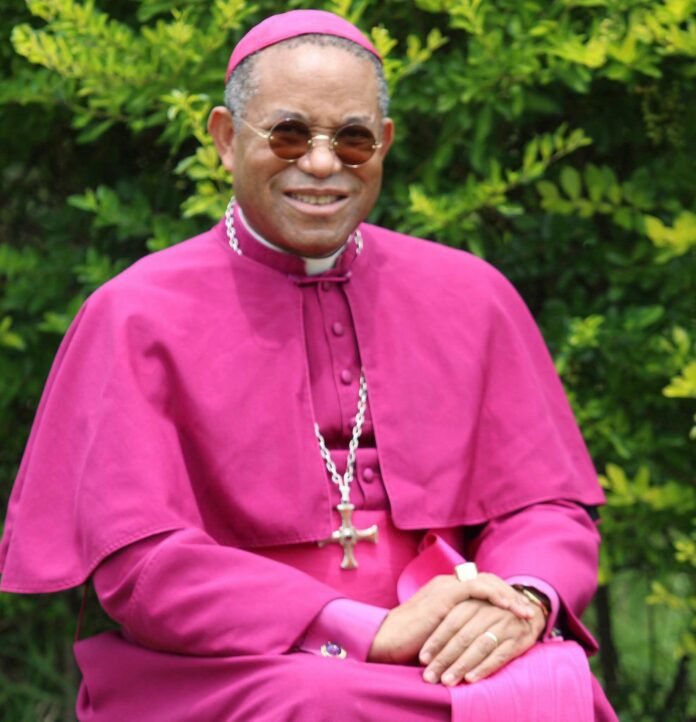
The Zambian government has confirmed that the Rt Rev Trevor Mwamba, the retired Bishop of Botswana who for the past five years has led a faction of one of Zambia’s oldest political parties, is among eleven people arrested and charged following a violent security operation carried out at the Lusaka home of the country’s leading opposition presidential candidate.
The confirmation, given on 17 August by Secretary to the Cabinet Patrick Kangwa, came two days after the government had publicly denied that Bishop Mwamba and several other opposition figures had been detained at all, and one day after the bishop’s wife, a former senior Botswana diplomat, made a public appeal for his safe return, saying the family had had no word of his whereabouts since he vanished on 14 August. Mr Kangwa told the state broadcaster ZNBC that police, acting on a tip-off and what he said had been years of surveillance, apprehended “suspected militia” and “persons of interest” connected to “military plans involving foreign nationals and illegal military training camps” that posed a threat to state security, and that those detained had been found in possession of “high-grade military weapons, ammunition and other materials for use in armed insurrection,” according to a report on the arrests carried by the Zambian Observer and Anadolu Agency.
Bishop Mwamba, 68, was consecrated Bishop of Botswana in the Church of the Province of Central Africa in February 2005 and resigned in 2013, going on to serve as Team Rector of Barking in the Diocese of Chelmsford and as an honorary assistant bishop there until his retirement from parish ministry in 2019. Zambian by birth, born in Mansa in Zambia’s Luapula Province, he trained in law at the University of Zambia before reading theology at Oxford, and received an honorary Doctor of Divinity from Yale in 2009. He is married to Mmasekgoa Masire-Mwamba, a former Botswana ambassador to Germany and Commonwealth Deputy Secretary-General from 2008 to 2014, and the daughter of Botswana’s second president, the late Sir Ketumile “Quett” Masire, reports a tribute published by Pan African Visions.
In April 2021, having returned to Zambia, Bishop Mwamba was elected president of the United National Independence Party, the party founded by Zambia’s first president, Kenneth Kaunda, at a national congress in Lusaka. That leadership has been contested ever since by a rival faction under a former army officer, Lt Henry Muyoba, who was declared party president at a disputed congress the following month, Zambia Monitor reported. The High Court and the Court of Appeal have both since barred the Muyoba faction from interfering in UNIP’s affairs, and as recently as May 2025 the Lusaka High Court again affirmed Bishop Mwamba as the party’s lawful president, notwithstanding an intervening decision by the Registrar of Societies to recognise Muyoba’s group. Under Bishop Mwamba, UNIP joined the Tonse Pamodzi Alliance, the coalition of opposition parties that backed Brian Mundubile’s bid for the presidency in this month’s general election.
Zambians voted on 13 August for a president, members of the National Assembly, and local officials, in a 14-candidate presidential race pitting incumbent President Hakainde Hichilema of the United Party for National Development against Mr Mundubile, standing under the National Reconciliation Party for Unity and Prosperity as the Tonse Pamodzi Alliance’s candidate. The vote followed months of warnings from Amnesty International and independent observers that Mr Hichilema’s government had been tilting the field against the opposition — restricting rallies under the colonial-era Public Order Act, reshaping the judiciary, and prosecuting opposition figures, journalists, and activists. Days before the vote a businessman known to support the opposition was murdered, and Mr Mundubile had to be rushed from a campaign rally after police used tear gas on the crowd, the New York Times reported.
Official counting has since been slow and contested. The Electoral Commission of Zambia’s staged tally showed Mr Hichilema leading 1,544,140 votes to 1,030,662 for Mr Mundubile after 135 of 226 constituencies had reported as of 17 August, but the count was suspended at one point amid reports of violence against poll workers, and Mr Mundubile at one stage declared himself the winner on the basis of his party’s own parallel vote tabulation — prompting accusations from the ruling party of an attempt to subvert the process. Both camps have alleged irregularities, including stolen ballot boxes and disputed constituency totals.
It was against this backdrop that, on the night of Friday 14 August — the day after the election — heavily armed personnel, described by Mr Mundubile and his allies as Zambia Army special forces working alongside police, stormed his residence in the Kabulonga area of Lusaka. In a telephone account given live on the EMV podcast after his release, Mr Mundubile said more than thirty armed men broke down the gate, smashed windows and fired shots as they forced their way into the house; he said he hid in a bedroom wardrobe before being found, beaten, and dragged to a waiting vehicle, and that his wife and young twin daughters were caught up in the violence. He said his ally, former Transport Minister Mutotwe Kafwaya, was shot twice during the operation, and that he did not know the fate of several others present, including his spokesman George Chisanga and Patrick Mwansa, son-in-law of former President Edgar Lungu — an account echoed by IOL’s reporting on the raid.
Bishop Mwamba, who had been accompanying Mr Mundubile, was among those unaccounted for in the raid’s aftermath. On 15 August a government spokesman publicly dismissed reports that Mr Kafwaya had been shot or that Mr Mwansa had been detained or killed, calling the claims false. With still no word of her husband the following day, Ambassador Masire-Mwamba wrote to former Botswana President Mokgweetsi Masisi, who is leading a regional election observer mission in Zambia, appealing for help in securing the bishop’s “immediate and unconditional return.” She described him as “a man of peace and gentleness who has devoted his entire life to preaching love and reconciliation,” and warned that Zambia’s standing as what she called “the last bastion of democracy and peace” in the region was now in peril, according to the letter published by the Zambian Observer, which a day earlier had carried the government’s denial that anyone had been detained.
The government’s account shifted again the next day, when Mr Kangwa named Bishop Mwamba among the eleven apprehended and charged, alongside Mr Chisanga, Mr Mwansa, and three others identified as Simon Phiri, Richard Banda and Francis Mulenga — all said to be held in lawful custody at various police stations in Lusaka, with access promised to their families and lawyers. Mr Kangwa said Mr Mundubile himself had also been found at the scene, though the government did not say whether he too had been arrested.
No formal charges have yet been made public, and independent Zambian media have been unable to verify either the government’s account of a counter-insurgency operation or Mr Mundubile’s account of an attempt on his life carried out to disrupt a disputed election. There has as yet been no statement on Bishop Mwamba’s arrest from the Church of the Province of Central Africa, the Diocese of Botswana, or the Anglican Communion Office. Investigations, the Zambian government says, are continuing.