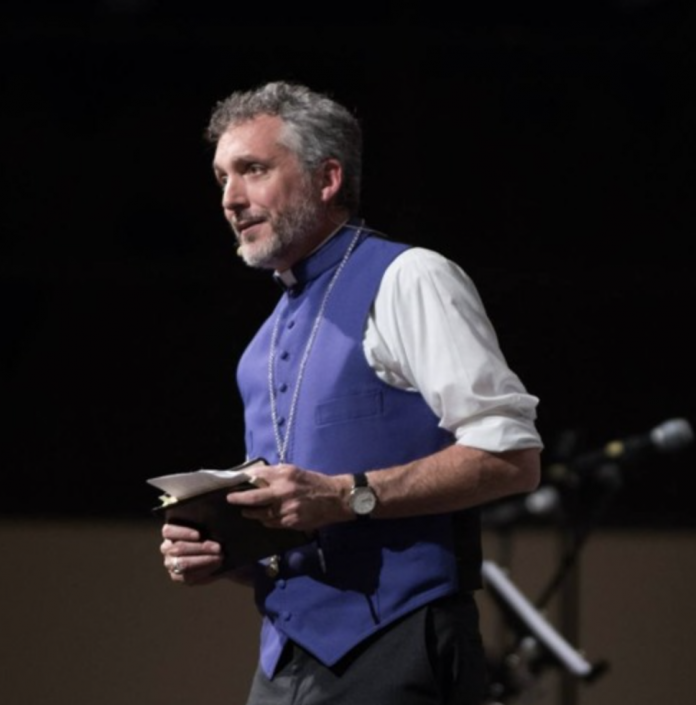
An independent review commissioned by the Anglican Church in North America has found that the provincial office ran the disciplinary case against the Rt. Rev. Stewart Ruch III without a defined process, producing unclear roles, duplicative investigations and blurred decision-making that contributed to “distrust of the process, as well as inefficiencies, increased costs, and delays that further undermined confidence in the disciplinary system.”
The findings are set out in a four-page executive summary dated 16 November 2026 and addressed to the ACNA Executive Committee by Kathryn Nash and Tana VanGoethem of the law firm Lathrop GPM. The summary names no individuals and assigns no personal responsibility. Lathrop states that it “was not charged with making specific factual findings” and that the focus of the review was to make “forward-looking recommendations.”
A process “developed ad hoc”
The review covers the period from July 2021, when the province assumed oversight of the Upper Midwest investigation at the request of the diocese’s Bishop’s Council, through June 2025, when Bishop Ruch’s trial began. Lathrop said many of its concerns stemmed from the canons then in force, which “did not address how the Province should respond to initial reports involving a bishop, gather information before a presentment, or share information with the bishops considering a presentment. As a result, the process was developed ad hoc.”
The province relied on “several formal and informal groups” whose responsibilities “were unclear or overlapped, and in certain respects did not align with what had been publicly communicated,” and individuals “without a defined role in the process were sometimes involved in making recommendations and influencing decisions.”
The decision to engage two investigative firms at the same time “resulted in overlapping work and duplicative interviews,” requiring some witnesses to recount their experiences more than once, “an approach that was not fully trauma-informed.” Oversight of the investigations was not assigned to a single person or body but was “handled informally by overlapping groups of Provincial staff.” The summary does not name the firms. The trial court’s final order records that the diocese commissioned Grand River Solutions in April 2021 and that, after taking over that investigation, the province retained Husch Blackwell and Telios Law.
On presentments, Lathrop found that individuals “without formal decision-making authority controlled what information was provided to those reviewing the investigation reports and, at times, attempted to influence their deliberations,” and that asking several groups for recommendations “blurred responsibility for the decision.” The circumstances, it said, “raised questions about the independence and neutrality of both the process and its leadership and eroded trust.”
Provincial communications “created expectations, including among survivors, that did not always align with how the process ultimately unfolded.” Budget expectations and tracking “were not always clear to those with governance responsibility,” and Lathrop was told that document access and retention “were not governed by established protocols.”
Lathrop recommends defined roles and a single point of contact, trauma-informed training, a separate process for reports of sexual misconduct or abuse of a minor, centralized oversight of investigations by investigators who “serve as information gatherers rather than decision-makers,” decision-making authority vested “in a clearly identified person or body,” and communications commitments made “only when the Province is in a position to fulfill them.”
What the summary does not say
When the Executive Committee announced Lathrop’s engagement in March, it said the review would “specifically explore” the 2022 resignations of members of the Provincial Response Team and “allegations that current provincial staff members inappropriately shared secure case files with the Court in the spring of 2025.” The summary lists both matters within its scope but reports no conclusion on either. On the case files it says only that the questions raised “underscore the importance of a defined process for maintaining the Province’s records.”
The case-file allegation was made by Rachel Thebeau, assistant counsel to the provincial prosecutor, in an open letter of 25 July 2025. She wrote that the province’s chief operating officer, “with the ACNA Chancellor’s approval,” had given a member of the court access to her files on 23 June, “without any disclosure to the parties.” The College of Bishops and the Executive Committee responded on 29 July 2025 that they found “no evidence to suggest that the Archbishop or members of his staff acted in any way that violates or compromises the proceedings that are active before the court.”
The three response team members — Autumn Hanna VandeHei, the Rev. Gina Roes and Christen Price — wrote on resigning that “the entire process never felt survivor-centered.” The remaining members said they disagreed with “assertions in their resignation letter.”
The summary’s stated scope is also narrower than the one announced in March. The Executive Committee said then that the review would cover the provincial office’s administration “from summer 2021 through December 2025,” including its “interactions with the Board of Inquiry and the Court for the Trial of a Bishop.” The summary ends its review in June 2025 and states that, at the subcommittee’s direction, it did not examine the work of the Board of Inquiry or the conduct of the trial.
The summary also describes limits on its evidence. The Executive Committee’s subcommittee identified the people to be interviewed and the topics to be addressed, and reviewed documents supplied by interviewees, though it ultimately forwarded all of them; Lathrop says the subcommittee did not restrict its questions or its access to further witnesses. Lathrop contacted 20 people, and 12 agreed to be interviewed. Several of those “most closely involved in the Province’s handling of the matter, and in some cases the only people with first-hand knowledge of particular decisions,” declined or set conditions Lathrop would not accept. The summary does not identify them. It concedes that “there was certain information that could not be confirmed,” but says this did not affect its recommendations.
Echoes of the trial court
The findings restate, in more measured language, criticisms made by the Court for the Trial of a Bishop, which unanimously found Bishop Ruch not guilty on every count on 16 December 2025. The court found that the province’s takeover of the investigation “set off a proliferation of overlapping and, at times, inconsistent inquiries.” It found that the bishops who signed the first presentment “lacked firsthand knowledge of the factual basis for the charges” and “relied almost entirely on summaries or representations provided to them.” It also concluded that while a Board of Inquiry “may have existed nominally or declaratively,” the investigative function “was in fact absorbed and controlled by a provincial group.”
Lathrop’s finding that individuals without authority “controlled what information was provided” to decision-makers points in the same direction. Unlike the court, however, Lathrop does not weigh the presentments; its engagement excluded any re-examination of “the merits of the charges.”
The choice of Lathrop was disputed from the outset. ACNAtoo, the advocacy group formed in 2021 over abuse in the Upper Midwest, called it “an inappropriate investigation firm,” citing its investigation for the International House of Prayer Kansas City and its representation of Roman Catholic dioceses in abuse cases.
Disclosure and Title IV
How much of the report will be made public remains unsettled. At a provincial online office-hours meeting on 16 September 2026, Chancellor Bill Nelson said that after the Executive Committee and the College of Bishops reviewed the report with Lathrop, “the summary will be posted on the ACNA website.”
At Provincial Council in June, the dioceses of South Carolina and the Mid-Atlantic had proposed a resolution calling on the Executive Committee to release “the full written report of the investigation” to the church and the public, with redactions to protect those named. The dioceses withdrew it; the province acknowledged that the review’s findings and recommendations “will be made available to any diocesan Standing Committee upon request,” and the parties agreed the resolutions may be reintroduced at a later Council.
Lathrop also reviewed the revised Title IV canons. It called them “a meaningful improvement,” but cited concerns about “complexity, the number of individuals and decision points involved, and the potential for inconsistent outcomes at different stages,” and said it had recommended targeted revisions, which the summary does not describe. Provincial Council approved the revisions unanimously in June. They take effect on 1 January 2027.
Before then, the same court that tried Bishop Ruch must rule in the case of the Most Rev. Steve Wood. His trial concluded on 11 September 2026, and the court has said its opinion is due no later than 21 December 2026.