
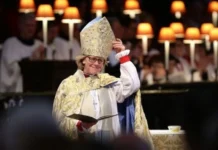
The Anglican Bishop of Newcastle, Peter Stuart, has today issued a Pastoral Letter that seeks to chart a course forward for the diocese on the vexed question of marriage.
In his letter, issued to leaders across the diocese, he draws attention to the current tensions in the Anglican Church of Australia over the debate, noting the following key points:
- That the position of many in the diocese is contrary to that established by the General Synod
- That “LGBTIQ+ people” have “shown restraint”
- That he found conversations at the recent Bishops’ meeting “deeply troubling”
He goes on to compare the current debate with that in the 1970s over the remarriage of divorcees.
In a frank observation he states:
Each year the bishops’ meeting seems to edge closer to the possibility of a deep breach in episcopal relationships within the Anglican Church of Australia.
Rather than seeking to work against such a breach, Stuart now appears to be prepared to accept the reality and even no longer avoid it. He asks “Can we find a way of accommodating this difference?” and then offers his suggested accomodation:
Within the law of the land and under the Constitution and applicable Canons of the Anglican Church of Australia, the Bishop together with the Synod and Diocesan Council is responsible for the good order and government of this Diocese. In our Diocese of Newcastle, we have many perspectives. My desire is that we find a loving way to express our shared life. It is of the Gospel that we continue to welcome and affirm LGBTIQ+ people as fellow members of the Body of Christ and welcome their use of their gifts for the service of God, his people and his cosmos. I have diminishing confidence that the national church is going to help us find a way forward. I have some confidence that together we might be able to find a ‘Newcastle Way’ which will incorporate living with strong difference in an open and Godly way.
Given that Bishop Stuart argued at the most recent General Synod that the doctrine of marriage was “not yet fixed” it is hard to not read this as a suggestion that he is open to approving liturgies for the blessing of same-sex relationships and even marriage and is now preparing for the Diocese of Newcastle to act on its own in this matter, independent of the national church.
At Bishop Peter’s own invitation we have asked him the following question:
You write that “the Bishop together with the Synod and Diocesan Council is responsible for the good order and government of this Diocese” and “I have some confidence that together we might be able to find a ‘Newcastle Way’ which will incorporate living with strong difference in an open and Godly way”,
1. Does the Diocese have the right and authority to act unilaterally in legislating for liturgy for the blessing of same-sex relationships or same-sex marriage even when such a position has repeatedly been rejected by the General Synod?
and
2. Are you willing to give your assent to such motions or legislation so that the “Newcastle Way” effectively means accomodating in “a loving way to express our shared life” such a move and the tensions it will bring?
Bishop Peter’s reply is as follows:
Q: Does the Diocese have the right and authority to act unilaterally in legislating for liturgy for the blessing of same-sex relationships or same-sex marriage even when such a position has repeatedly been rejected by the General Synod?
A: The legal situation in the Australian Church around liturgy and order is not clear. The Archbishop and Diocese of Sydney have set a significant precedent for unilateral action by authorising liturgies additional to the Book of Common Prayer, An Australian Prayer Book and A Prayer Book for Australia. Those liturgies not being authorised by the General Synod. They have also set significant precedent with the Archbishop unilaterally authorising Diaconal Administration of the Holy Communion. The latter not being authorised by the General Synod.
In this church, a resolution about doctrine by the General Synod is not determinative. Ultimately if doctrine is contested, the disagreement must be resolved by the Appellate Tribunal. That was the situation with the marriage of persons who have been previously married while their former spouse is still alive, the ordination of women and the order of the administration of the Holy Communion.
There were no proposals before the Newcastle Synod in 2018 of this kind. The Synod has shown a cautious but genuine desire to listen very attentively in the spirit of Lambeth 1:10.Q: Are you willing to give your assent to such motions or legislation so that the “Newcastle Way” effectively means accomodating in “a loving way to express our shared life” such a move and the tensions (“strong difference”) it will bring?
A: In the Province of New South Wales the Bishop is not a member of the Synod meaning that a motion is an expression of the House of Clergy and the House of Laity as assembled at that time. The Bishop has no role in assenting to motions and motions do not bind the Bishop, unless moved in accordance with an Ordinance that has established such power.
In relation to legislation, the question significantly preempts any conversation or deliberation in which the Synod may engage. The Synod has heard my desire that the Diocese of Newcastle will be an expression of comprehensive Anglicanism. The next step for the Synod will include exploring how Christians who have theological differences live together. The work of the General Synod Doctrine Commission and the Diocesan Faith and Order Commission will be important parts of ensuring that the Synod and the Diocese continues to give prayerful, biblical and theological reflection to the life of the Diocese.
In relation to legislation, the role of the Diocesan Bishop is to listen to the Synod, the National Church and the Anglican Communion in exercising his or her mind around assent.
Here at davidould.net we would say that doesn’t really look like a “no” answer. Only time will tell.
The full letter is set out below:


Editor: The typography of the site needs some work. The overlarge, ALL CAPS, centered-justification style for block quotes is difficult to read and is an unnecessary distraction.
If the Bishop would simply affirm that sexual activity of the homosexual type is sinful and that people who indulge in it need to repent I will take note of what he says. As I sit here I’m less that 100 kilometres from his diocese and feel that I’m not far from the very border of Anglican heathenism (with an exception or two such as one southern parish).
This surely reveals the predicament faced by a denomination which accepts the authority of Scripture and also Church traditions.
The Bible has to be our yardstick.
We recognise the differences between the Old Covenant which bound the nation of Israel to the worship and obedience of the God of Israel; and we recognise the New Covenant that through the obedience and sacrifice of our Lord Jesus Christ grafts believers into the Commonwealth of Israel.
Yet our Lord makes clear that the Moral Law (as opposed to the Oral Law), guides the Body of Christ, and it is through Him our great High Priest we confess our failings and receive forgiveness.
The Church aka the Body or Bride of Christ, has no authority to water down that which our Lord has commanded we observe.
What we should do is recognise that homosexual and heterosexual sin is equally abhorrent to a holy God.
Therefore the Church preaches repentance, therefore the Church hates the sin but loves the sinner, because we too are sinners saved by faith.
When I were a lad, sexual sin such as adultery and immorality were roundly condemned from the pulpit. Homosexual sin was rarely mentioned probably because not many knew much about it. Sadly the Church has made a dichotomy of the two forms of sexual sin, and obsesses over the one (homosexuality), whilst ignoring the sins of heterosexuals…
“the predicament faced by a denomination which accepts the authority of Scripture and also Church traditions.”
In fairness, that is not what has led to this. Whilst I follow Scripture as the supreme rule of faith, the Liberal push towards homosexuality doesn’t come from church tradition, but from a secularist viewpoint that ignores or spins both tradition and scripture.
Yes, but the acceptance of church tradition, the toleration of opinions that have no Scriptural precedent and which may disagree with what Scripture clearly states, can lead to a watering down of Scriptural authority.
Then because of our natural desire for Christian unity, it can lead to an acceptance of faulty or harmful teaching.
Given time those who accept the overall authority of Scripture may find themselves under pressure to accept non Christian teaching “for the sake of unity in the Body of Christ..”
That’s where the danger lies, and as you water down Biblical doctrine you find the Church attracting more liberal minds and more destructive doctrines..
I went to a Royal Naval boarding school and there I learnt two things..
#1, That trusting or obeying a person simply because of the position of authority they held was not necessarily a good idea, and could lead to abuse and corruption and worse.
And #2,
An organisation will tolerate all kinds of betrayal of purpose or abuse of individuals, as long as it doesn’t expose wrongdoing or harm the
immediate future of the organisation.
We need a leadership structure, but those in leadership need to be men or women of integrity and their loyalty must be to the absolute morality upon which that organisation was founded, rather than the traditions and connivance
of men..
The Body of Christ should accept nothing less.
Bad bishop. Yawn. Another bad bishop. This bishop at best is overhead; just another expense to be paid.
???. So true, ReebHerb ???
What a pathetic situation to be in to claim that the doctrine of marriage is “not yet fixed” in the diocese of Newcastle. ? I guess it’s a way of saying the doctrine of marriage in the diocese is an open book.
This said, I feel very sorry for this guy who’d been chosen to be the bishop of a diocese that doesn’t have its doctrine of marriage fixed yet. Isn’t this very sad?
The pastoral letter of the Bishop, which is crafted in all the pastorally-flowery language, is just a cop out of the real issues. At best, it’s a prelude to ”fix” the doctrine of marriage in the diocese in the very near future with the Marriage Canons revised or rewritten altogether. I guess this is what the bishop is hinting at with his slogan: ”the Newcastle way”! I wouldn’t be surprise at all if this Newcastle way is light years away from the Way (Acts 9:2; 18:6, 25; 22:4; 24:14 etc).
It looks as if the Anglican Church of Australia is about to break apart. How long would you give it before extinction – maybe 40 years
Maybe. The old High Church and Anglo-Catholic men who could be trusted to uphold orthodoxy and biblical morality (part of orthodoxy of course) have mostly gone but the number of genuine evangelicals at the head of dioceses has increased in recent years from (doing a quick count in my fuzzy head) five to seven. That of course includes Sydney, by far the largest diocese in Australia. When I wax a boy (I am pre-WW2) I think Sydney was the only recognisably evangelical diocese, but in those days we could say the creeds with confidence with a number of diocesans further up the candle stick, as the saying goes. If any bishops or archbishops, active or retired, see any error in my ramblings. please say so.
That’s not really possible. The right of each of the 23 dioceses to own their property and be the ACA within their diocesan boundaries is enshrined in legislation.
Liberal dioceses are certainly shrinking in numbers, but that doesn’t mean they will disappear.
Recently we have seen one case where a Liberal diocese (Bathurst) has effectively had to seek the financial assistance of the senior diocese in that State (Sydney) on terms that include allowing orthodox clergy to take vacant parish positions. But it wasn’t merely liberal shrinkage that led to that situation, but some disastrous financial dealings by Bathurst diocese more than a decade ago.
So although that is very encouraging, I would not expect it to happen in many other liberal dioceses, if they avoid financially dubious dealings.
As David points out below, a number of dioceses now tend to be orthodox evangelical in orientation, and that number does seem to be growing, albeit very slowly.
[…] can read the full article here. It is interesting to reflect that the divisions that we see in England are reflected clearly all […]