Home Blog Page 5

New York man sentenced to prison for Hate Crime against Episcopal rector

A 32-year-old New York man has been sentenced to one-and-one-third to four years in prison for stalking and threatening an Episcopal priest in what prosecutors described as an anti-LGBTQ hate crime.

Jacob Bender of Hyde Park was sentenced on May 12 following his conviction by a Dutchess County jury on April 13 on charges of felony first-degree criminal contempt, misdemeanor second-degree criminal contempt, and misdemeanor fourth-degree stalking as a hate crime. The victim, the Rev. Meredith Sanderson, rector of St. James Episcopal Church in Hyde Park, was targeted because of her church’s acceptance of the LGBTQ+ community.

According to trial evidence, Bender engaged in a course of threatening conduct between November and December 2024. Between November 10 and November 13, 2024, he sent emails to Sanderson with the subject line “repent,” causing her to fear for her physical safety. Bender’s grandparents are members of St. James Episcopal Church.

On December 6, 2024, in violation of an order of protection, Bender sent an email telling Sanderson she had no authority to preach the gospel and that she and her congregation would “burn in hell”. Five days later, he violated the protective order again by walking past her residence.

The jury deliberated for more than three hours after hearing two days of testimony before returning guilty verdicts on all charges.

Dutchess County District Attorney Anthony Parisi emphasized the seriousness of bias-motivated crimes in announcing the sentence. “Today’s sentence reflects the seriousness of the defendant’s deliberate and escalating pattern of conduct, which demonstrated a complete disregard for the authority of the court, the safety of the victim, and the community,” Parisi said.

“When individuals are targeted because of their identity, their beliefs, or the communities they represent, the harm reaches well beyond the immediate victim—it threatens the sense of safety, dignity, and mutual respect that holds communities together,” he added.

St. James Episcopal Church, located on Albany Post Road in Hyde Park across from the Vanderbilt Mansion National Historic Site, was originally built in 1811 and is a parish of the Episcopal Diocese of New York. The church has historic significance as the congregation attended by President Franklin D. Roosevelt and First Lady Eleanor Roosevelt, and its cemetery contains the graves of FDR’s parents, James and Sarah Roosevelt.

The Rev. Meredith Kadet Sanderson began serving as rector in October 2025, according to her LinkedIn profile.  Neither St. James Episcopal Church nor the Episcopal Diocese of New York appears to have issued public statements regarding the case as of our going to press. Anglican.Ink was unable to locate any official comment from Bishop Matthew Heyd of the Diocese of New York.

Analysis: The Abuja “Contradiction” That Isn’t

Jay Thomas’s recent First Things essay “Anglicans and the Abuja Contradiction” purports to expose fatal logical flaws in GAFCON’s Jerusalem Declaration. In reality, it reveals something far more interesting: how easily appeals to “Anglican tradition” can mask fundamentally un-Anglican premises. Thomas’s argument doesn’t just fail—it fails instructively, demonstrating precisely why orthodox Anglicans found GAFCON necessary in the first place.

Thomas’s thesis is straightforward: GAFCON stands guilty of rank hypocrisy. The movement condemns the Canterbury-centered communion for treating sexuality disagreements as legitimate “good disagreement” while simultaneously treating women’s ordination as a tolerable “secondary issue”. This, Thomas insists, exposes GAFCON’s fundamental incoherence — an “overthrow” of traditional Anglican authority in favor of “corporate evangelical polity based in Protestant confessionalism”.

The smoking gun? Michael Nazir-Ali’s departure for Rome, which Thomas wields like a prosecutorial exhibit. If even GAFCON’s former champion couldn’t stomach its contradictions, the argument goes, perhaps the whole project is bankrupt. Thomas’s prescription: reject the Abuja Affirmation, embrace the authority of “the church’s historic and magisterial tradition,” and return to an Anglican prima scriptura that balances Scripture with natural law and ecclesiastical tradition. It sounds compelling. It’s also nonsense.

Thomas’s entire argument rests on a sleight of hand: treating all theological disagreements as fungible. Women’s ordination, human sexuality, the filioque, baptismal regeneration, episcopacy—all just data points on an undifferentiated spectrum of “disputes.” Agree to disagree on one, you must agree to disagree on all. Draw a line anywhere, and you’re arbitrary.

This won’t do and is not a sophisticated analysis of the issues.

Classical Anglicanism has always recognized hierarchies of doctrine. The Thirty-Nine Articles themselves distinguish between matters “necessary to salvation” and things indifferent (adiaphora). The Caroline Divines debated vigorously which questions fell into which category, but none—not Hooker, not Andrewes, not even Laud—imagined that uniformity on all questions was either possible or necessary.

GAFCON’s position is that sexuality touches core doctrines of creation, incarnation, and the moral law in ways that ministerial ordering does not. One can dispute this theological judgment. But to call it incoherent requires ignoring the entire Anglican tradition of theological triage. Thomas doesn’t refute GAFCON’s distinctions; he simply pretends they don’t exist.

Thomas repeatedly invokes “the church’s historic and magisterial tradition” as though this settles the matter. But whose tradition? Interpreted how? Adjudicated by whom?

Here’s where Thomas’s argument reveals its true colors. His appeal to natural law and magisterial tradition as co-equal authorities with Scripture sounds Anglican—until you remember that the English Reformers explicitly rejected precisely this formulation. Article VI doesn’t say Scripture is prima inter pares among authorities; it says Scripture “containeth all things necessary to salvation” and that nothing not found there or provable thereby may be required as doctrine. Article XX forbids the Church from ordaining “any thing that is contrary to God’s Word written.”

Thomas’s prima scriptura isn’t classical Anglicanism—it’s Anglo-Catholicism’s attempted rehabilitation of the dual-source theory of revelation that the Reformation rejected. No wonder he favorably cites Nazir-Ali’s swim across the Tiber. The logic is impeccable: if you genuinely believe ecclesiastical tradition possesses independent magisterial authority, Rome is the only honest destination for Western Christendom. At least they have a mechanism for adjudicating which traditions are binding.

Most tellingly, Thomas never specifies what alternative he’s proposing. “Reject Abuja’s affirmations,” he cries. And then what?

Submit to Canterbury’s authority—the same Canterbury that has spent decades systematically dismantling biblical teaching on sexuality, blessing what Scripture condemns, and disciplining those who maintain orthodoxy? Return to an “authority structure” that has proven itself utterly incapable of maintaining doctrinal integrity?

Thomas gestures vaguely toward “going back,” but back to what, precisely? The 1998 Lambeth Conference, whose clear affirmations on sexuality the Communion’s leadership spent the next quarter-century undermining? The Windsor Report’s failed attempts at managed decline? The Primates’ meetings that issued stern warnings Canterbury promptly ignored?

Orthodox Anglicans didn’t abandon the Canterbury-centered Communion on a whim. They have been forced out—or came to understand they were participating in an institution fundamentally committed to theological revisionism. Thomas’s essay reads like it was written in 2008, blissfully unaware of everything that’s happened since.

Thomas assumes confessional integrity requires absolute uniformity on all interpretive questions. By this standard, the Augsburg Confession was incoherent (it allowed diversity on ceremonies), the Westminster Standards were contradictory (they accommodated multiple church polities), and even Rome is hypocritical (Dominican and Jesuit theological schools disagree substantially within supposed magisterial unity).

The Elizabethan Settlement itself embodied comprehensive orthodoxy—maintaining doctrinal boundaries while permitting ceremonial and interpretive diversity. GAFCON’s approach mirrors this pattern: communion despite disagreement on women’s ordination, boundaries on sexual ethics. This isn’t contradiction; it’s classical Anglicanism.

Unless, of course, you believe classical Anglicanism is itself incoherent—in which case, why remain Anglican at all?

Thomas deploys Michael Nazir-Ali’s conversion like a trump card, as if the former bishop’s departure proves GAFCON’s incoherence. But this proves exactly the opposite of what Thomas intends.

Nazir-Ali left Anglicanism because he became convinced that legitimate ecclesial authority requires visible, juridical continuity centered in a magisterial office. Fair enough. Many thoughtful people reach this conclusion. But it’s a Roman Catholic conclusion, not an Anglican one. Nazir-Ali’s trajectory demonstrates that certain premises about authority and tradition lead inexorably to Rome—which is why the English Reformers rejected those premises.

If Thomas thinks Nazir-Ali’s logic is sound, he should follow him across the Tiber. But he can’t invoke Nazir-Ali’s departure as evidence of GAFCON’s failure while simultaneously claiming to articulate an Anglican position. The Reformers made a decisive choice: doctrinal faithfulness to Scripture over institutional continuity with a corrupted authority structure. GAFCON is simply making the same choice in different circumstances.

Here’s the actual contradiction: Thomas appeals to Anglican identity while advocating for an authority structure that Article VI, Article XX, and the entire trajectory of the English Reformation explicitly rejected.

He’s stuck. Submit to Canterbury, and you abandon orthodoxy. Embrace his magisterial-tradition theory, and you’re functionally Roman Catholic without the honesty of conversion. Demand absolute uniformity on all questions, and you’ve rendered classical Anglicanism impossible.

GAFCON’s “contradiction” amounts to this: they’ve made theological judgments about which hills are worth dying on. They’ve decided sexuality is a first-order issue, women’s ordination second-order. One can disagree with these judgments. But calling them incoherent requires either ignorance of the Anglican tradition of theological triage or a bad-faith refusal to engage with GAFCON’s actual reasoning.

Thomas writes as though GAFCON’s “wholesale dissolution of the Anglican Communion” were a bug rather than a feature. But the Communion was already dissolved—by Canterbury’s systematic abandonment of biblical authority, by the consecration of Gene Robinson, by the blessing of same-sex unions, by the discipline of orthodox bishops who maintained traditional teaching.

GAFCON didn’t dissolve the Communion. It created an alternative structure for those who refused to participate in heresy dressed as comprehensiveness. Thomas’s essay never grapples with this reality. Instead, it fantasizes about “going back” to an institutional unity that existed only because the orthodox hadn’t yet realized how thoroughly the game was rigged.

The “contradiction” Thomas identifies isn’t GAFCON’s problem—it’s his own. He wants Anglican identity without the Protestant commitments that made Anglicanism possible. He wants confessional boundaries without the hard work of deciding where to draw them. He wants the authority of tradition without specifying whose tradition or how it’s adjudicated.

GAFCON’s confessionalism may be imperfect. Its attempts to maintain communion across the women’s ordination divide may create tensions. But at least it’s attempting to navigate real questions in a real ecclesial situation—not retreating into abstract appeals to “tradition” that functionally mean submission to either a revisionist Canterbury or an honestly magisterial Rome.

For orthodox Anglicans who wish to remain both orthodox and Anglican, GAFCON’s “contradictions” look less like fatal flaws than like the necessary untidiness of maintaining biblical faithfulness within the Anglican tradition. Thomas offers no alternative except nostalgia for an authority structure that failed and implicit capitulation to authorities that explicitly reject biblical teaching.

That’s not a contradiction worth solving. That’s a clarity worth defending.

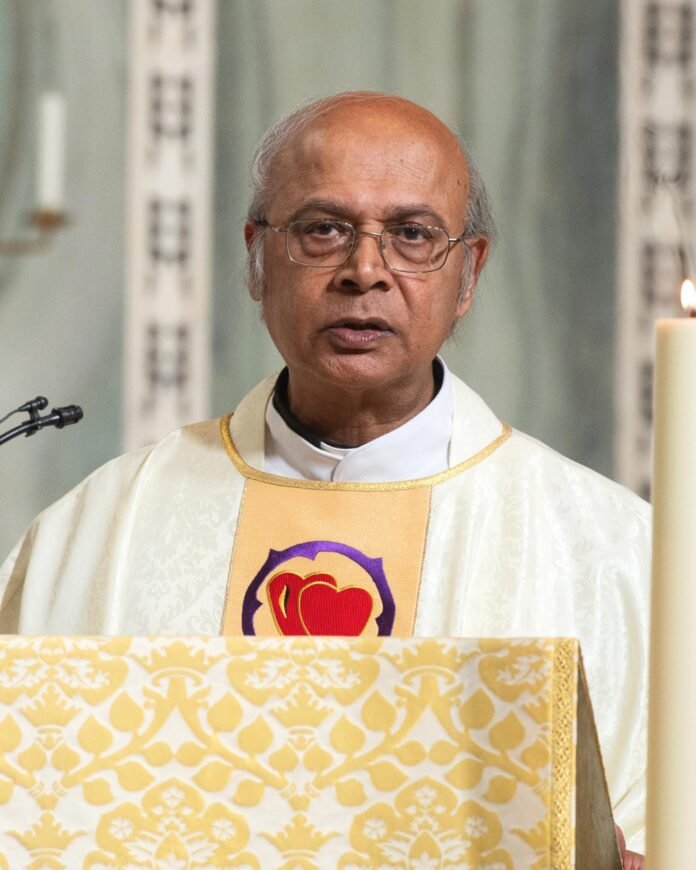
Anglicans and the Abuja contradiction

Michael Nazir Ali 2025

he Abuja Affirmation marks the end of an era. The third largest Christian communion, Anglicanism (behind only Catholicism and Orthodoxy), has splintered. While its demise has been a drawn-out affair, the church has reached an inflection point. A crisis of authority has existed for over fifty years, a crisis that conservative Anglicans had long sought to resolve by returning Anglicanism to its scriptural roots. At a meeting in Abuja, Nigeria, this March, bishops from around the communion declared that the crisis had been resolved; the authority of the Scriptures had been restored. Their announcement was triumphant. But it contradicted reality.

Bishops of the Global Anglican Future Conference (GAFCON) gathered in Abuja from March 3–6 ostensibly to  replace the hegemonic and symbolic power of the archbishop of Canterbury by electing a new primus inter pares (first among equals) for the (newly branded) Global Anglican Communion. However, instead of reorganizing the traditional authority structure within Anglicanism, they overthrew it, setting up their own institution with a corporate evangelical polity based in Protestant confessionalism. While GAFCON denies that it has split the Anglican Communion, for all intents and purposes there are now two communions: one institutional, centered around the See of Canterbury; the other confessional, centered around the Jerusalem Declaration of 2008. 

The ecclesial conflicts within the historic Anglican Communion are well known; but what about the new Global Anglican Communion? Its Abuja Affirmation stridently forms a new communion nested within the old while rejecting the ecclesial authority of apostate provinces or dioceses. And yet, the true cost of this new communion is not so much the schism it portends as the contradiction at its root. 

Read it all at First Things

New Bishop of Brixworth Announced

The next Bishop of Brixworth will be The Venerable Dr Alex Hughes, currently Archdeacon of Cambridge in the Diocese of Ely, Downing Street has announced today.

Today (Friday 8 May) we welcome Alex to the Diocese starting at Bishop Stopford School in Kettering where students will interview Alex and discuss his hopes and aspirations for his new role. Following this, Alex will meet with clergy from Wellingborough and Kettering deaneries before visiting the Nine Bridges Benefice in Peterborough to hear about community engagement in a rural benefice on the edge of the city. The day will conclude with evensong at Peterborough Cathedral. 

Alex brings a wide breadth of experience from across the Church of England, having served in parish ministry, diocesan leadership and episcopal support roles. He was ordained in the Diocese of Oxford in 2000 and served his curacy at Headington Quarry before becoming Chaplain to the Bishop of Portsmouth. From 2008 to 2014 he was parish priest of St Luke’s and St Peter’s in inner-city Portsmouth and since 2014 has served as Archdeacon of Cambridge.

Speaking about his appointment, Alex said: ‘I am really drawn to this particular moment in the life of the Diocese of Peterborough. It is a time of change and possibility and I am excited to be part of shaping what comes next.  I am convinced that this vital work is deeply spiritual: it is about clearing paths and building channels for the Spirit to move.’

As Bishop of Brixworth, Alex will hold responsibility for different ministry areas, including education, something that Alex describes as being ‘in my DNA’. Both his parents were teachers, and he has held significant governance roles within church schools, including chairing governing bodies at both primary and secondary level and holding the role of Chair of the Diocesan Board of Education in Ely Diocese for 12 years. 

Alongside his work in education, Alex has experience of both urban and rural ministry. As Archdeacon of Cambridge he has oversight of a large and diverse area, including the city and its rural surroundings. ‘My favourite day of the week is Sunday’ he says, ‘I love being out among the parishes, whether it’s a big service with hundreds of people or just a tiny little village church with 3 or 4 faithful worshippers and a cat.’

Having been born into a Christian household Alex does not have a ‘moment’ of conversion but remembers feeling a very strong confirmation of his Christian identity during a camp in Peterborough in the summer before he started secondary school;

‘I didn’t have a dramatic conversion experience,” he said, “but at that moment I knew clearly that I was a Christian, and that was the identity I was taking with me into the next stage of my life. It feels quietly significant to be returning to Peterborough many years later in this way.’

Throughout his life and ministry Alex has enjoyed the full range of church traditions, including visiting 3 different churches across the week whilst at university, which alongside his varied roles he describes as giving him ‘an unusually wide appreciation of the Church of England’.

Welcoming Alex to his new role, Bishop Debbie said; ‘I am delighted to welcome Alex to the Diocese and look forward to working closely with him. His deep sense of God’s call was clear throughout the process, and I am grateful to everyone who prayed for us. It will be a joy to get to know him better and to discern together God’s will for our life and mission.’

Alex is married to Sarah, a psychotherapist, and they have two sons, Thomas and Joseph. A keen musician, Alex finds joy in listening to live music in all its forms, from rock and roll to classical orchestral pieces.  An enthusiastic runner, his other favourite mode of transport is his beloved motorbike.

Alex will be consecrated in July and will take up his role in the Diocese in the autumn. 


Pakistan’s Christians Still Waiting for Justice After Lahore Bombing

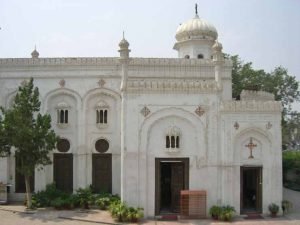
Pakistan’s Christian community is again drawing attention to the long shadow of the 2016 Easter Sunday bombing in Lahore, after Khyber Pakhtunkhwa province finally began distributing compensation to victims more than a decade after the attack. The payments revive painful memories of the March 27, 2016 blast at Gulshan-e-Iqbal Park, which killed more than 70 people and wounded over 300, with the Taliban faction Jamaat ul-Ahrar claiming responsibility and saying Christians were the target.

The 2016 bombing drew immediate condemnation from church leaders around the world. The Archbishop of Canterbury, the Most Rev. Justin Welby, described the attack as “utterly contemptible” and prayed for the dead and wounded. Pope Francis called it “reprehensible” and appealed to Pakistan’s authorities to protect vulnerable religious minorities. In Pakistan, the Moderator of the Church of Pakistan, Bishop Samuel Azariah, said he had personally seen children, women, and elderly victims and warned that such attacks damage efforts to build peace between Christians and Muslims.

Thirteen years on, the latest compensation drive underscores how slowly justice has moved. According to UCA News, the provincial government has begun handing out checks to widows, orphans, and other minority victims of terrorism, some of them connected to the 2013 All Saints Church bombing in Peshawar. Families and advocates say the gesture, while welcome, comes far too late for many who have already endured years of grief, poverty, and medical hardship.

Michelle Chaudhry, president of the Cecil and Iris Chaudhry Foundation, said the delayed payments amount to “a mockery of justice.” Her criticism captures the frustration of many Pakistani Christians, who have seen repeated promises of redress, but little timely relief. For them, the new compensation is not just a financial matter; it is a reminder of how slowly the state has responded to violence against religious minorities.

Taken together, the Lahore bombing and the delayed compensation in Khyber Pakhtunkhwa tell a familiar story: the recurring vulnerability of Pakistan’s Christians, the courage of church leaders in naming the violence, and the long struggle for justice after the cameras have moved on

Statement by the Bishop of the Western Gulf on the Rev. Sam Allberry

The Rev. Sam Allberry served as a Canon Theologian of the Anglican Diocese of the Western Gulf Coast from May 26, 2021, until his resignation on March 1, 2026, as part of a transition of Episcopal leadership within the Diocese.

During this time, he also served as an Associate Pastor at Immanuel Church-Nashville, a non-denominational congregation not affiliated with the Anglican Church in North America. On May 2, 2026, the leadership of Immanuel Church decided to disqualify Pastor Allberry from ministry following new information about an inappropriate relationship disclosed before his ministry at the church. The Rev. Allberry subsequently resigned from his role at Immanuel Church. He was still canonically resident with the Anglican Diocese of the Western Gulf Coast. On May 4, 2026, Bishop Clark WP Lowenfield, Bishop Ordinary of the Diocese, inhibited The Rev. Allberry from all ministry within the Anglican Church.

On May 5, 2026, Sam Allberry submitted his confession that he has committed conduct giving just cause for scandal or offense under Title IV, Canon 2, section 1 of the Canons of the Anglican Church in North America, and willingly submitted himself to the discipline of the Church pursuant to Title IV, Canon 3, section. On the same date, Bishop Lowenfield deposed him from sacred ministry.

“We are deeply grieved and broken-hearted for and with our brother in Christ, Sam, “Bishop Clark said. “And we are committed to see him through a Godly season of repentance, reconciliation, and restoration within the Body of Christ.”

The Rt. Rev. Clark Lowenfield is the Anglican Bishop of the Diocese of the Western Gulf Coast

Anthony Pierce: Appeal for victims to come forward from the South Wales Police

South Wales Police is appealing for victim-survivors to come forward following the conviction of Anthony Pierce for multiple child sex offences.

84-year-old Anthony Pierce, the former Bishop of Swansea and Brecon from Swansea Vale, pleaded guilty to five counts of indecent assault on a child under the age of 16 at Swansea Crown Court in February 2025.

He was sentenced to four years and one month in prison. Upon release, he will be made subject of a Sexual Harm Prevention Order. He will be on the sex offenders register for life.

Since sentencing, South Wales Police has received three further reports of offences dating back to the 1970s and 80s which are under investigation.

Detective Inspector Tom Richardson of Swansea CID said:

“We know how difficult it must be for anyone to have suffered abuse in the past to come forward now. It was the bravery of the victim who reported Pierce’s actions which was instrumental in bringing him to justice.

“Since the conviction and sentencing of Pierce we have received reports from three people who have taken that first step in coming forward.

“We believe that there may be others who have been subject to Pierce’s crimes and we want to provide reassurance that any reports will be fully investigated and dealt with sensitively and with compassion.

“We recognise that coming forward can be daunting but would encourage victim-survivors to speak with us so they can get the support and help they deserve.”

Call South Wales Police on 101 quoting occurrence number 2600140999.

Archbishop McDowell’s Migration Myths: Ignoring Islam’s European Reality

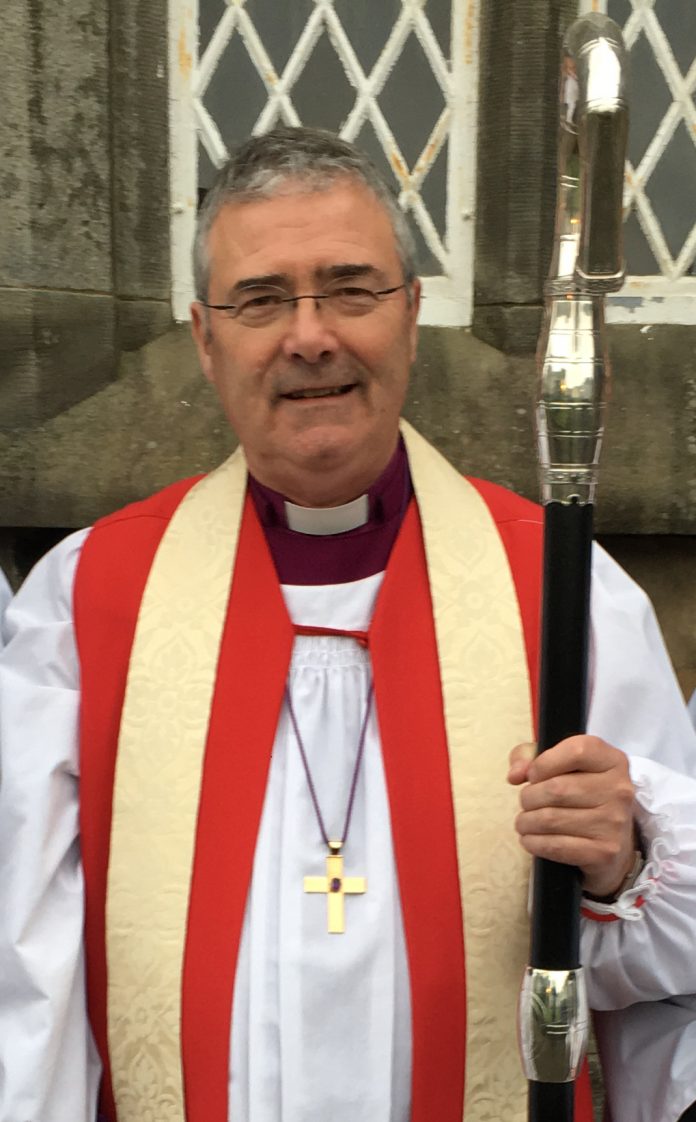
The Most Reverend John McDowell, Archbishop of Armagh and President of the General Synod, delivered his presidential address to the Church of Ireland’s General Synod in 7 May 2026 with a sweeping condemnation of those expressing concerns about migration to Ireland—particularly Muslim immigration. While cloaking his remarks in biblical language about welcoming the stranger, the Archbishop made factual claims about Muslim immigrants’ intentions that deserve rigorous scrutiny.

Archbishop McDowell dismissed concerns about Islamic immigration with remarkable confidence, declaring that migrants “want what we all want—to bring up children in security and decency; to provide them with a good education and the chance of a stable future”. He went further, characterizing fears of Islamisation as myths propagated by “the extreme right,” insisting that migration is neither “an attempt at creating a Muslim majority or a Muslim state”.

This reassurance stands in stark tension with evidence from across Europe. Ireland’s Muslim population has grown explosively—from 3,875 persons in 1991 to 81,930 in 2022, representing a staggering 1,000% increase over two decades. While the Archbishop portrays this demographic transformation as benign, research on Muslim integration in Europe paints a more complex picture.

The Archbishop’s confident assertions about Muslim immigrants’ desire to assimilate sidestep the documented integration challenges plaguing European nations. Studies consistently show that Muslim immigrants in Europe “tend to have worse labor market outcomes, are less well educated, and less socially integrated” than their counterparts. The Brookings Institution identifies fundamental value conflicts between European societies and Muslim communities, noting “a clash of values due to differing views of where religion belongs, the public or private sphere”.

Notably, Muslim community leaders themselves have explicitly rejected the Archbishop’s framing. Research on Ireland’s Muslim community documents that they “express interest not in assimilation but rather in integration”—a crucial distinction the Archbishop glosses over. Integration without assimilation can mean maintaining separate cultural and religious identities that may conflict with host society values.

Archbishop McDowell’s claim that there is no Islamic agenda to convert Ireland ignores the active dawah (Islamic missionary) work occurring within Ireland and across Europe. The Islamic Foundation of Ireland operates a dedicated Dawah department with the stated objective of “educating both Muslims and non-Muslims” about Islam. UK Islamic Mission explicitly describes Dawah as “inviting others to understand and embrace Islam” and celebrates its efforts in “supporting new brothers and sisters who are embracing the Islamic faith”.

While individual Muslims may not harbor designs on converting Ireland, organized Islamic groups actively pursue religious expansion. Recent reports indicate “more Irish are converting to Islam” with “Celtic Muslims” reshaping Ireland’s religious landscape. Conversions to Islam across Western countries have “generally risen in tandem with the growing presence of Muslim communities,” with women comprising 60-70% of converts.

More troubling still is the Archbishop’s silence on political Islam’s presence in Europe. The Muslim Brotherhood, founded on the principle that “there is no separation between religion and politics,” maintains substantial operations across Europe with “the Islamist goal of undermining the foundations of Western nations”. Austria has banned the organization as part of its anti-terrorism law, recognizing it as a threat to liberal democracy.

European security services document how Brotherhood-affiliated organizations exploit “the growing number of Muslim immigrants in Europe” while “employing ‘underground’ tactics aimed at shaking up the liberal order”. This is not “extreme right” conspiracy theory—it is the considered judgment of European intelligence agencies.

The Archbishop dismisses concerns about Muslim demographic growth as unfounded fear-mongering. Yet Pew Research projects that even under a zero-migration scenario, Europe’s Muslim population would rise from 4.9% to 7.4% by 2050 due to higher fertility rates alone. Under continued migration scenarios, projections show Germany reaching 19.7% Muslim by 2050, the United Kingdom 17.2%, and France 18.0%.

Ireland’s trajectory mirrors this pattern, with Muslim population growth far outpacing overall population growth—a 29.1% increase between 2016 and 2022. These are not imaginary trends but documented demographic shifts with profound cultural implications.

Archbishop McDowell invokes the parable of the Good Samaritan and Christ’s words about welcoming the stranger to buttress his position. These are indeed powerful biblical imperatives. But Christian charity does not require bishops to make factually dubious claims about sociological realities or to dismiss legitimate concerns as bigotry.

The Archbishop’s pastoral responsibility includes truth-telling. When he declares that Muslim immigrants have “no desire to convert Ireland to Islam,” he contradicts the stated missions of Islamic organizations operating in Ireland. When he portrays integration as unproblematic, he ignores Europe’s well-documented struggles with Muslim assimilation.

The Church of Ireland’s witness would be better served by acknowledging these tensions honestly while still advocating compassion for refugees and migrants. Christians can welcome the stranger without pretending that mass migration from Islamic societies poses no cultural or religious challenges. The Archbishop’s address, for all its biblical eloquence, fails this test of candor.

Text of Presidential Address by Archbishop John McDowell at 2026 General Synod

Brothers and sisters in Christ,

I would like first to thank the Diocese of Down and Dromore for acting as our hosts for this Synod and particularly to thank the bishop and all those who have been involved in planning and preparing for our Synod Eucharist earlier this morning.

I suspect like many people in the General Synod over the years, I have sometimes been a little bit wary of the term “Presidential Address”. The words are, of course, constitutionally accurate. The Archbishop of Armagh is indeed the President of the General Synod and, as a privilege and as a responsibility, I wouldn’t want that to be otherwise. And it’s not even that the word “President” has lost some of its lustre in recent times on the world stage. It is more to do with the fact that my calling, and the calling of any bishop, or indeed priest, is a calling to the work of a shepherd. If you like, it is a vocation of care and of solidarity to be lived out in the manner of the Good Shepherd; I hope it is in that manner that I have addressed the General Synod in the past and will do so today.

So, although I may refer to it from time I do not intend to go into the business – the Bills and Motions – of this Synod in any detail. Each will be handled by very capable members of the General Synod and, as always I will rely on the good sense of the Synod to weigh the arguments and to think of what is best for this Church in its witness to the Gospel of Jesus Christ and in its searching out of the will of the Father. For it is His will and not our own that is to be done. In fact that is the great issue of all life: the life of individuals, the life of churches, the life of communities and the life of nations.

I am, I think, in the unique position of having been the only Archbishop of Armagh to have presided over a General Synod in the season of Advent – the online Covid Synod of 2020 – which, you might say, is the season of accountability. And that is a good reminder of our accountability and to whom we are ultimately accountable for what we do and say –including the way that we do and say it here, where the mountains of Mourne sweep down to the sea.

It is the vocation of the Church of Ireland to witness to Ireland as it is today of the love, the holiness, the goodness and the power of God as revealed in His Son. That has never been an easy vocation. It is not that Ireland is a particularly wicked and resistant place but that the People of God find it as difficult as anyone else to set aside our self interest in the interests of God. In some senses it is even more difficult for us because we easily make the assumption that God is already on our side and thus avoid doing the work – the prayer and reflection – that will make sure that we are on His side.

The structural manner in which we go about this work is fairly straightforward. We do it in parishes. In terms of the Church of Ireland, that is where the work of God is largely carried out. It is where the Scriptures are expounded, where the sacraments of the New Covenant are duly administered, where children are catechised, where believers become disciples, where the sick are visited and cared for, and where the community is evangelised. Although Churches may be severely damaged in the eyes of the world by adverse headlines; they break the heart of the Good Shepherd by falling short in the work of parishes.

It is for these reasons that most of our resources, both centrally and locally, are focused on parish life and why the tab labelled “Parish Resources” opens into the largest section of the Church of Ireland website. It is also why we are so deeply committed to safeguarding in our parishes – making them safe and welcoming places. You will see from the Book of Reports that we continue to review and revise, and we trust improve, our Safeguarding procedures and structures.

In a world which is dominated in almost all its doings by the often sinister ambitions and networks of a very small number of very rich men who are infinitely more powerful than any Celtic chieftain or medieval magnate or elected Chief Minister, we have both the structures and the resources to march to a different beat and to create different societies. The parish is the place that is big enough to require everyone to pull their weight and small enough for that mutual giving and receiving which is at the heart of communion; to be places that stand out in the world and which can change the landscape and the horizon

That is why it can be very painful, and indeed scandalous, when parishes go badly wrong for whatever reason; and because of the relational nature of our structures, such damage can be very difficult to mend.

Although parishes cannot be little earthly paradises, they can be the tiny leaven in the rude lump of a subtly-manipulated world; the parish can be where true wisdom and truth may still be found and true friendship flourish.

Parishes can do much – and in our polity they do most of the heavy lifting – but they cannot do everything, particularly in an age of a very rapid change in attitudes to God and His Church. It is partly for that reason that we have devoted substantial human and financial resources to supporting our vocation and mission with Pioneer Ministry- to reach those who have lost any contact with the promises of God in the Gospel. Parishing and Pioneering go hand in hand and I commend to you the work of the Pioneer Ministry Council, which we shall hear about later.

AI

I have said that it is our vocation as the Church of Ireland to witness to an alternative truth and to march to the different drum beat in a world which has a very wayward set of priorities. It is a world which has become more atomised and angry through the new forms of digital communication and networking. Social media was the phenomenon which was to have democratised the world but instead it has concentrated power in the hands of the few grotesquely rich men I referred to earlier. Its centralising tendencies and amorality are a much more effective means of dividing and conquering than any Roman Emperor had at his disposal.

Currently their great emphasis is on the development of AI which is being heralded as another great leap forward in the liberation of humankind. The truth is, of course, that such ‘liberation’ only binds us further: we are increasingly dependent on technology, especially digital technology, and thus on the electricity necessary to keep it going and on the global corporations extending its reach into every aspect of human life.

I say this is ‘the truth’ on purpose: for we should be confident in the very existence of ‘truth’ and ‘fact’ – neither of these things can be artificially generated. Artificial Intelligence may relay information to us based on incredible calculations of probability and suitability, but we should not allow efficiency and convenience to become the primary values against which we measure whether this information is worth the resources expended to generate it. The costs are human and social as well as environmental, of course.

Writing sixty years ago, the philosopher Hannah Arendt (Truth & Politics, 1967), learning from the experience of totalitarianism in Europe, explained how it is that we might find ourselves becoming comfortable in a so-called ‘post-truth’ world. “Lies”, she wrote, “are often much more plausible, more appealing to reason, than reality, since the liar has the great advantage of knowing beforehand what the audience wishes or expects to hear.”

This is precisely how digital technologies, such as generative AI and social media algorithms, work and appeal to us; they are founded on inordinate masses of data which enables accurate prediction of what it is we wish or expect to hear. Thus, their efficiency can only take us so far – and with enormous risks.

For, as Arendt argued, “reality has the disconcerting habit of confronting us with the unexpected, for which we were not prepared.”

How easily we can collectively fall, from complacency into dependence, and thus into extreme vulnerability. The process of AI-integration is all the more dangerous not because it is manipulated by the powerful but because it is increasingly accepted by us as a logical choice. As Arendt warned, what is false can seem more rational than reality.

You would have thought that there were certain things which the Church does that are safely away from the digital world and thus unaffected, such as personal accompaniment of the sick or of those in difficulties. However in a presentation to the Celtic bishops last week in Wales, Mark O’Toole, the Catholic Archbishop of Cardiff-Menervia was able to tell us about the huge number of young people who have “companion bot” apps on their phones. These are AI generated “people” who can be turned to for advice in times of sickness or relationship breakdown or in any crisis. Again, this can seem a rational thing to do in times of weakening social bonds and grossly inadequate support for mental wellbeing, especially for younger people.

However we need to remember that AI Large Language Models do not actually “know”, much less feel, anything or experience empathy. They merely convert data into numbers and, in super fast time, identify patterns within those numbers which will then generate language. But – it hardly needs to be said – what people need in times of crisis and in terms of companionship is more than empty words.

Since the time of St Paul, Christianity has been understood as an individual’s relationship with God, lived out in community. Being “in Christ” through baptism and faith is the believer’s fundamental identity and all other roles – parent, worker, priest, politician etc. – are subordinated to that identity.

Rooted in the Trinity, Christian belief and communion is wholly personal and unreproduceable. That said, its message and outcomes can probably be counterfeited or distorted by AI, and I have no doubt that in the near future we will all be offered a very attractive and cheap range of resources to enhance and strategise our efforts at evangelisation.

But we need to remember the most effective of means of all, summed up in one short sentence: “Many were gathered together… and he preached the word to them”.

We have many challenges and opportunities in the future to resist the homogenising of knowledge and the eroding of local autonomy. And the decisions we will need to make will simply make no sense on the grounds of efficiency and convenience: to stick to the difficult path of deep and costly human relationships, sustained by a closeness to God in prayer and in the wearying but essential task of moral discernment.

Migration

Just while we are on the subject of St Paul, there is one other concept which philosophers of thought attribute to him. The Roman world in which St Paul moved was characterised by a sense of radical inequality. It was a strong conviction at that time that the world – individuals, roles in society, gender – were unequal and were meant to be unequal. In the view of the people of the time, that was how the world was made and how it worked best.

Paul was the first thinker to overturn this idea. “There is neither Jew nor Greek, slave nor free, male nor female; for all are one in the Messiah Jesus”. That word “one” signalled a new transparency in human relations. Because of what he understood the Christ to be, Paul insisted on the moral equality of all humans, on a status shared by all and, of course, the possibly of creating a new “self”- everyone who is in Christ is a new creation.

The Church, never mind the world, has never quite learned those lessons about human equality that Paul so assiduously worked out. This is nowhere more painfully clear than in our attitude to racial equality and migration. It is my own view that our attitude to migration in Ireland, both north and south, is one of the great touchstones and tests of our Christian authenticity. It is possible to take a wide range of views on immigration policy which may be broadly consistent with belief in Christ and in the particular form of human equality which is articulated in the New Testament.

But it seems to me that there is a fairly simple imperative when it comes to the “stranger that is in your midst”, and that is to welcome him or her and to care for him or her. It is also time to put a few myths to bed. Migration is not some form of organised conspiracy aimed at the colonial dispossession of the Irish people, as has been claimed by the extreme right in Ireland. Nor is it an attempt at creating a Muslim majority or a Muslim state, as has been called by many on the British extreme right. Migrants to this island are motivated by exactly the same desires which motivated the Irish immigrants to the USA in the eighteenth century – a desire for civic and religious freedom – or which motivated many Irish people to the emigrate to the USA and Britain in the nineteenth century: hunger and destitution.

Migrants to this island want what we all want-to bring up children in security and decency; to provide them with a good education and the chance of a stable future. And to contribute to the communities in which they live. They bring with them enormous energy and fortitude and very often scarce skills. For these and other reasons there is every rational reason to welcome them. Instead what we find as recorded in PSNI statistics in Northern Ireland is, in 2024-25, the worst recorded levels of racist violence since monitoring began in 2004, and an increase of almost 50% on the year before. And in the Republic of Ireland Garda hate crime data show a sustained multi year increase in racially-motivated incidents. But you and I are called to a much more demanding way of life. To care for the stranger within our midst regardless of ethnic differences is the principal lesson of the parable of the Good Samaritan and defines for us what we mean by the word “neighbour”.

But perhaps the most sobering of all are the words of the Lord Jesus when all the nations of the earth stand before him as Shepherd and Judge “…I was a stranger and you welcomed me…as you have done unto the least of these my brothers and sisters you have done unto me”.

When he ascended to the Father he left his disciples in every generation and with the representatives of his weakness – the sick, the poor, the destitute and the stranger – and the promise that he will gather with his right arm those who have cared for them with the words, “Well done good and faithful servant…” And because they are so terrifying, it is almost unbearable to consider what he will say to those on his left hand “Depart from me…”

That increases in migration should be seized on by the extreme right who are bereft of any other ideas is not surprising, although it is less edifying when mainstream parties equivocate in the face of the horrendous violence which migrants suffer. However from the Churches’ point of view, the more worrying development is the rise of the so called Christian Right. These groups emphasise what they claim to be the undermining of “Christian civilisation” or “Judeao-Christian” values and the discrimination which they say Christians are subjected to. And they use the Cross – the very epitome of powerlessness, and what a very advanced “civilisation” inflicted on Jesus – as some kind of symbol of their dominance and superiority.

The Christian Church, and to a much lesser extent, Christian civilisations have indeed given great deal to the world. The first hospitals, the first schools, heroic women and men who lived with and cared for the world’s outcasts and for the wretched of the earth. Exactly which aspect of discipleship in Jesus Christ is being exercised by baying outside a hostel while terrified children are inside? How is parading around the streets draped in a national flag representing the mind of the God of all the nations, who said: “For my thoughts are not your thoughts and my ways are not our ways… for as the heavens are higher than the earth, so are my ways higher than your ways and my thoughts than your thoughts”. As I said earlier I have dwelt on these matters because I believe they will be the test of our discipleship and our faithfulness in the days and years to come.

ACC-19 and Unity

As with most General Synods, the Feast of Pentecost is not far off. That was the day when, as St Luke tells us “…they were all gathered together in one place…” Insofar as this is an assembly representative of every diocese of the Church of Ireland and as we are joined by a number of our ecumenical friends with whom we share a common baptism into Christ we might, with a little stretch of the imagination, be said to be altogether in one place. It is an enormous joy and privilege to be here and even greater to have worshipped with you. I am very grateful to the Bishop of Meath to have reminded us of our vocation of unity in her sermon.

However it would be remiss of me not to mention a gathering which we in the Church of Ireland are hosting a little later in the summer, called ACC-19. The Anglican Consultative Council is one of the Four Instruments of Unity of the Anglican Communion. It meets in a Province of the Communion once ever three years and is made up of episcopal, clerical and, uniquely, lay representatives from each of the Provinces of the Communion. As its title-ACC-19- suggests this is its nineteenth meeting and we in the Church of Ireland will be represented by a lay person and a clergy person in the form of Archdeacon Katherine Poulton of the Diocese Meath and Kildare and Mr Glenn Moore of the Diocese of Clogher. I am also a member of ACC, not strictly speaking as a representative of the Church of Ireland but as a member of the Primates Standing Committee and the Standing Committee of the Anglican Communion. ACC-19 will debate and discuss many issues but probably the most significant will be some suggestions known rather grandly as the Nairobi-Cairo Proposals. These offer a modestly updated description of Anglicanism (the current description hasn’t been revised since the definition offered by the Lambeth Conference of 1930) and also some suggestions around the relationship of Provinces with the Archbishop of Canterbury, together with ways of supporting and assisting the holder of that office in their impossibly diffuse role.

As with all Anglican bodies the ACC Resolutions cannot bind any Province of the Communion and will be sent to all Provinces, including the Church of Ireland for further discussion and any action which a Province may think desirable and edifying.

At the very least I would urge you to keep the members of ACC-19 in your prayers, especially the Chair Canon Maggie Swinson and the Vice Chair Archbishop Hosam Naoun, Primate of Jerusalem and the Middle East.

Bishop of Meath and Kildare

I hesitated for a moment or two before adding theses concluding remarks to this Address as I would not be usual to remark on the retirement of a member of the Synod in either the House of Representatives or the House of Bishops. But as her retirement will come so soon after this meeting of the General Synod, I am going to use the considerable latitude afforded to the President of the Synod to offer the Synod’s best wishes to the Bishop of Meath and Kildare as she prepares for the next stage in her life and discipleship. Pat has been a hardworking and very encouraging episcopal colleague and has enriched the proceedings of the House of Bishops and of the Church in general with her wit and wisdom. It has been a genuine privilege to have known Pat for many years and to have served alongside her. Pat, our heartfelt thanks and good wishes go with you and with Earl for the years to come.

I hope and pray that what I have said provides some sort of context for our gathering here over the next few days . So now let us move onto the real business of the General Synod.

+John Armagh

May 2026
Independent audit report of the Church of England National Safeguarding Team

The first independent audit of the Church of England’s National Safeguarding Team (NST) has been published today.

The audit was carried out by the INEQE Safeguarding Group and commissioned by the Archbishops’ Council, following a recommendation from the National Director of Safeguarding. It assesses the work of the NST against the National Safeguarding Standards.

The report highlights areas of good practice as well as identifying 66 recommendations for further improvement. Some of these relate to the wider Church’s safeguarding structures, while others are specific to the NST.

You can read the full report here.

Areas of good practice

The audit recognises that the NST has undergone significant transformation in recent years and is now a professional national function focused on improving safeguarding practice across the Church of England.

It highlights a strong internal culture, supported by confident leadership and a senior team with a wide range of expertise. Staff reported feeling able to raise concerns and contribute to ongoing development.

The report recognises the significance of the development of the National Safeguarding Standards. These now shape policy, training, supervision and day-to-day practice in churches and cathedrals:

“The National Safeguarding Standards establish a critical framework that constitutes good safeguarding practice. The NST defined and built this collective understanding to support parishes, dioceses, and cathedrals locally in developing a consistent, high-quality approach to safeguarding practice and culture.”

The audit also commends the NST’s shift towards safeguarding based on evidence and information, and it states that the casework team’s triage system functions well.

“The audit saw evidence of good practice by the NST, with caseworkers effectively receiving referrals, collating information and analysing cases. There was evidence of escalation to senior managers as appropriate, swift triage and allocations being accompanied by a written brief from the casework manager.”

Recommendations and next steps

The audit identifies several areas where further work is needed to strengthen safeguarding arrangements. These include:

  • improving communication around survivor participation
  • strengthening feedback mechanisms with dioceses and cathedrals
  • clarifying the circumstances in which the National Director of Safeguarding can intervene in local cases
  • developing specialist HR safeguarding expertise
  • ensuring resilience and contingency planning for case management systems
  • further developing national safeguarding training and learning infrastructure

The NST will now consider the recommendations in detail and set out how these will be taken forward.

Alexander Kubeyinje, the National Director of Safeguarding, said: “As the National Director of Safeguarding for the Church of England, I approach this vital work not just as a leader, but as a registered social worker. I view everything we do through a steadfast, safeguarding-first lens.

“Critically, the Church must confront the uncomfortable truth: victims and survivors have been let down. We cannot simply move past these failures; we must own them, address them head-on, and ensure that the lived experience of survivors informs how the church reforms and rebuilds.

“Real change requires the courage to look in the mirror. It demands deep reflection and the willingness to improve. That is why I commissioned the independent safeguarding audit of the NST.

“The report rightly recognises the significant transformation the NST has undergone in recent years. We have introduced National Safeguarding Standards, developed an intelligence-led research and evaluation function, and embedded greater survivor participation into our core processes. These are vital steps forward on our improvement journey.

“However, the report is unequivocally clear: there is still work to be done. We must urgently strengthen the NST’s operational independence so that safeguarding is delivered with the clarity, authority, and unwavering consistency that is rightfully expected of a national body.

“I will now work alongside the Archbishops’ Council to consider the audit’s recommendations in their entirety and, where appropriate, deliver the structural changes necessary to reinforce operational independence across the Church.

“My commitment to victims and survivors, to our dedicated volunteers and staff, and to all who worship in our churches, is absolute: we will use this audit as a catalyst to accelerate our improvement journey. We will not rest until the Church of England is unequivocally a safer place for everyone.”