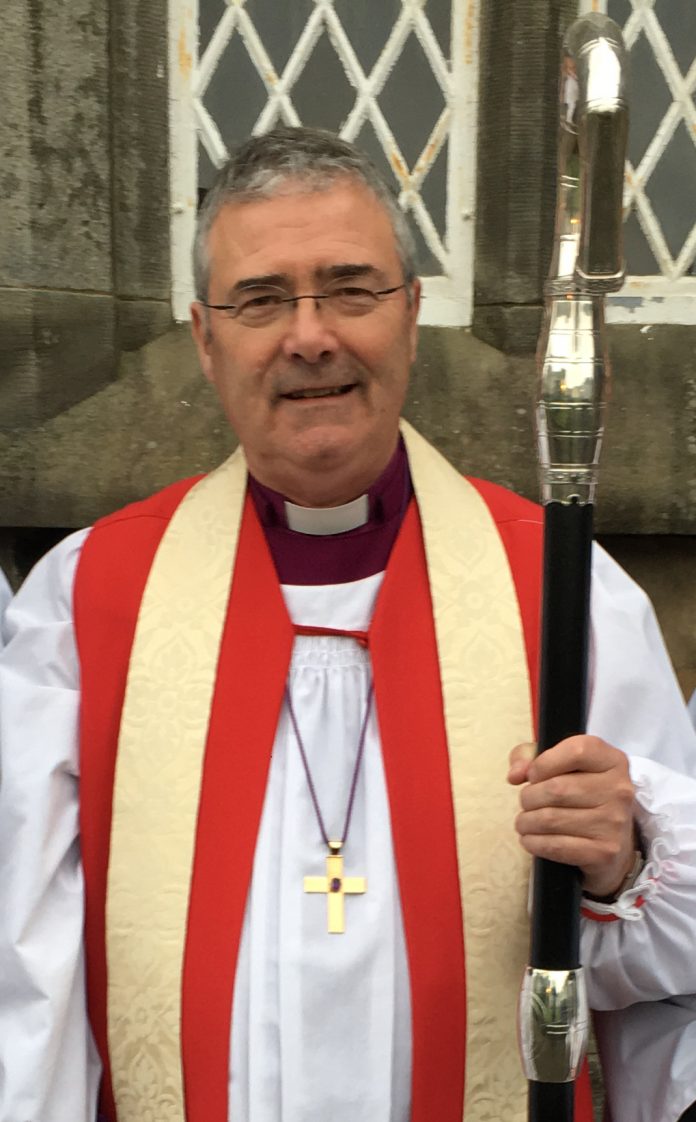
The Most Reverend John McDowell, Archbishop of Armagh and President of the General Synod, delivered his presidential address to the Church of Ireland’s General Synod in 7 May 2026 with a sweeping condemnation of those expressing concerns about migration to Ireland—particularly Muslim immigration. While cloaking his remarks in biblical language about welcoming the stranger, the Archbishop made factual claims about Muslim immigrants’ intentions that deserve rigorous scrutiny.
Archbishop McDowell dismissed concerns about Islamic immigration with remarkable confidence, declaring that migrants “want what we all want—to bring up children in security and decency; to provide them with a good education and the chance of a stable future”. He went further, characterizing fears of Islamisation as myths propagated by “the extreme right,” insisting that migration is neither “an attempt at creating a Muslim majority or a Muslim state”.
This reassurance stands in stark tension with evidence from across Europe. Ireland’s Muslim population has grown explosively—from 3,875 persons in 1991 to 81,930 in 2022, representing a staggering 1,000% increase over two decades. While the Archbishop portrays this demographic transformation as benign, research on Muslim integration in Europe paints a more complex picture.
The Archbishop’s confident assertions about Muslim immigrants’ desire to assimilate sidestep the documented integration challenges plaguing European nations. Studies consistently show that Muslim immigrants in Europe “tend to have worse labor market outcomes, are less well educated, and less socially integrated” than their counterparts. The Brookings Institution identifies fundamental value conflicts between European societies and Muslim communities, noting “a clash of values due to differing views of where religion belongs, the public or private sphere”.
Notably, Muslim community leaders themselves have explicitly rejected the Archbishop’s framing. Research on Ireland’s Muslim community documents that they “express interest not in assimilation but rather in integration”—a crucial distinction the Archbishop glosses over. Integration without assimilation can mean maintaining separate cultural and religious identities that may conflict with host society values.
Archbishop McDowell’s claim that there is no Islamic agenda to convert Ireland ignores the active dawah (Islamic missionary) work occurring within Ireland and across Europe. The Islamic Foundation of Ireland operates a dedicated Dawah department with the stated objective of “educating both Muslims and non-Muslims” about Islam. UK Islamic Mission explicitly describes Dawah as “inviting others to understand and embrace Islam” and celebrates its efforts in “supporting new brothers and sisters who are embracing the Islamic faith”.
While individual Muslims may not harbor designs on converting Ireland, organized Islamic groups actively pursue religious expansion. Recent reports indicate “more Irish are converting to Islam” with “Celtic Muslims” reshaping Ireland’s religious landscape. Conversions to Islam across Western countries have “generally risen in tandem with the growing presence of Muslim communities,” with women comprising 60-70% of converts.
More troubling still is the Archbishop’s silence on political Islam’s presence in Europe. The Muslim Brotherhood, founded on the principle that “there is no separation between religion and politics,” maintains substantial operations across Europe with “the Islamist goal of undermining the foundations of Western nations”. Austria has banned the organization as part of its anti-terrorism law, recognizing it as a threat to liberal democracy.
European security services document how Brotherhood-affiliated organizations exploit “the growing number of Muslim immigrants in Europe” while “employing ‘underground’ tactics aimed at shaking up the liberal order”. This is not “extreme right” conspiracy theory—it is the considered judgment of European intelligence agencies.
The Archbishop dismisses concerns about Muslim demographic growth as unfounded fear-mongering. Yet Pew Research projects that even under a zero-migration scenario, Europe’s Muslim population would rise from 4.9% to 7.4% by 2050 due to higher fertility rates alone. Under continued migration scenarios, projections show Germany reaching 19.7% Muslim by 2050, the United Kingdom 17.2%, and France 18.0%.
Ireland’s trajectory mirrors this pattern, with Muslim population growth far outpacing overall population growth—a 29.1% increase between 2016 and 2022. These are not imaginary trends but documented demographic shifts with profound cultural implications.
Archbishop McDowell invokes the parable of the Good Samaritan and Christ’s words about welcoming the stranger to buttress his position. These are indeed powerful biblical imperatives. But Christian charity does not require bishops to make factually dubious claims about sociological realities or to dismiss legitimate concerns as bigotry.
The Archbishop’s pastoral responsibility includes truth-telling. When he declares that Muslim immigrants have “no desire to convert Ireland to Islam,” he contradicts the stated missions of Islamic organizations operating in Ireland. When he portrays integration as unproblematic, he ignores Europe’s well-documented struggles with Muslim assimilation.
The Church of Ireland’s witness would be better served by acknowledging these tensions honestly while still advocating compassion for refugees and migrants. Christians can welcome the stranger without pretending that mass migration from Islamic societies poses no cultural or religious challenges. The Archbishop’s address, for all its biblical eloquence, fails this test of candor.