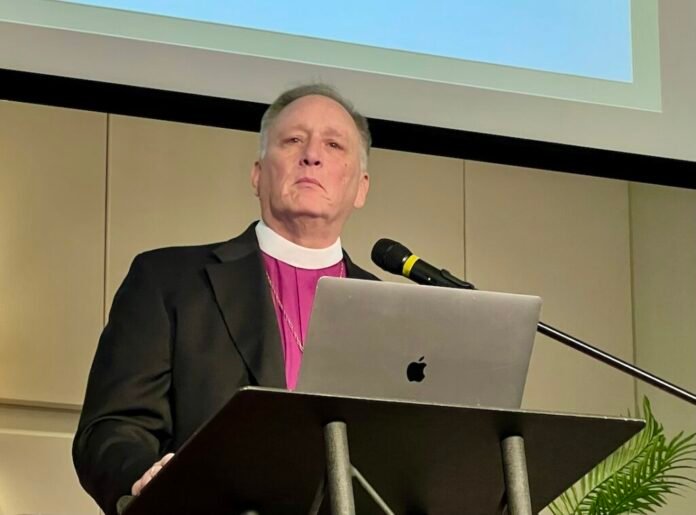
A letter from Tasmania’s Anglican Bishop, Richard Condie
Dear Brothers and Sisters,
As many of you will know, over the past couple of decades we have been dealing with the sins of historic child sexual abuse that were committed in the Diocese of Tasmania. Sadly many young people became victims of abuse and have suffered terrible personal consequences. We have been determined to provide restorative justice, recognition and support for survivors through the National Redress Scheme and through civil financial settlements.
To date we have made payments to survivors amounting to $20 million. Some of these funds were allocated through the sale of underutilised property in the Diocese that included 50 churches and other properties. Other funds were identified through capital that was supporting some of our ministries, and through a levy on property investments held by parishes.
Recently, the Trustees and Diocesan Council received an update on our potential liability for outstanding claims. Due to the greater proportion of civil settlements, the potential for more survivors than we initially anticipated, and higher average settlement amounts and costs, our potential liability for claims has risen sharply. The current estimate of our outstanding liability could be very high, and the Trustees have adopted a figure of $60 million over the next 15 years to ensure we are able to meet our obligations. We have already identified the funding for $14 million and now need to identify the funding for a further $46 million.
This is an extraordinary amount of money for a small diocese like ours and will cause many of us to feel anxious and afraid. However, we believe that providing redress is our responsibility and the right thing to do. The sins committed by the perpetrators were evil and have had lasting and irreparable effects on survivors. As Jesus bore the cost for sins he did not commit, we willingly bear the responsibility and therefore the cost of the sins of our forebears.
We also believe that God is our provider and that we can trust him to provide the funds to meet our needs. We have formed a team of people to look at how we do this. None of thesolutions before us are desirable or easy. We will not be able to meet this responsibility without bearing an impact on our parish operations, especially where they are reliant on investment income. We will likely need to access our income-generating assets, many of which support our ministry day to day. This will be a season of pruning, but remember that pruning, while painful, leads to greater growth. We are not making any immediate decisions or changes, but I wanted to let you know where this is heading, so you can be prepared.
We could see this as a financial challenge, but I think it is better to view it as a discipleship challenge. We will need to move from reliance on the legacy capital of past generations to spiritual generosity in the present to support our ministries and to see the gospel of Jesus proclaimed across our state.
We are soon to adopt an updated Vision and Strategic plan with a number of priorities identified for the next 5 years. I am excited about our plans for ministry in parishes, in leadership development, with youth and young adults, and extending our reach into the community all undergirded by a deeper commitment to prayer. God has been faithful to us in the past and is calling us to follow him confidently into the future as we continue to be a Church for Tasmania, making disciples of Jesus.
I would like to invite you to pray: To pray especially for the survivors of abuse that through our redress response they will experience restorative justice, recognition and support. To pray for the team that is charged with identifying the funds to meet our obligations. To pray to the God of all provision to supply all our needs. To pray that the church will grow, and more disciples will be made, and that we would be faithful to the Lord who calls us onwards.
The Standing Committee of The Episcopal Diocese of Hawaiʻi (the Episcopal churches in Hawai’i, Guam, and Saipan) joyfully announce that your Diocesan Convention has elected the Rev. Elizabeth “Libby” Berman as its sixth diocesan bishop. The election took place today, Saturday, May 16, 2026, at ‘Iolani School in Honolulu.
She was elected on the second ballot (the first was cancelled due to technical issues) after receiving the required majority in both the clergy and lay orders, in accordance with The Constitution and Canons of The Episcopal Church and the Special Rules of Order adopted for this electing Convention.
Message from the bishop-elect
Aloha,
I am the Rev. Libby Berman. I am privileged to have come to know many of you while serving on O`ahu for the last six years as Rector of the Church of the Holy Nativity. I am honored by the Standing Committee’s decision to include me on this slate.
I grew up having already fallen in love with Hawai`i. Three generations of my mother’s family have lived on O`ahu. When I first visited at age ten, I was enchanted by the beauty of this place and also deeply moved by what I now have come to know as mana, the spirit of God expressed in the land, sea, and people here. Having been blessed to come to live in Hawai`i, I have relished all the time I have had to experience God’s creation in this place.
As a young person in South Dakota, I participated regularly in activities at my Episcopal parish. I most valued the quiet time I spent pondering words in the prayer book, though, wondering about the meaning of the Eucharist as I helped our priest set the table, and experiencing delight in the lighting of fire in a dark church at the Easter Vigil. During those early years, I was drawn quietly into the Mystery of God.
After high school, I left home to attend college on the East Coast. I attended church at the Episcopal Chaplaincy every Sunday. During summers, I returned home to serve at Thunderhead Episcopal Camp as counselor and program director. Those summers opened me to a deeper call. God was in the campfire and singing, in opened eyes as Lakota and Anglo kids truly saw one another, and out in the empty fields, where God spoke through the prairie grasses. In discernment for ordination, I described TEC as a significant place where I had experienced connection with God.
After college, I worked in higher education and joined a local, progressive Episcopal Church in the Boston area. We had frank conversations about inequality and about compelling ways of working across differences in ethnicity and class. In my late twenties, I answered God’s call to ordination. I attended Episcopal Divinity School, where I knew I could explore justice ministry more deeply.
Over the last twenty years, I have served in parish ministry in several capacities. For seven years, I served as Canon for Congregations in the Diocese of Massachusetts. Throughout these years, I have always been engaged in projects that involve budgets, buildings, and strategy. But my best work always comes after I find that deep connection to God and others with whom I am working.
I have been blessed by beloved family and friends. My husband, Mark, and I have two daughters in their mid-20s; our older daughter is a teacher on O`ahu and our younger works in London. Our parents on both sides gave us incredibly solid grounding, particularly in our Christian and Jewish traditions, and we love our two brothers and their families very much.
14 women were ordained on May 17, 2026, at a service at the Anglican Holy Cross Cathedral in Gaborone, Botswana. The first women priests to be ordained in the Province of the Church in Central Africa
The first women to be ordained as priests has been held in the Province of the Church of Central Africa. 14 women were ordained on May 17, 2026, at a service at the Anglican Holy Cross Cathedral in Gaborone, Botswana.
Present at the service were Dr Tshepo Motsepe (the First Lady of South Africa), the Most Revd Albert Chama (Archbishop of Central Africa, Bishop of Lusaka and Primate of the Church of the Province of Central Africa) as well as Bishops from the Dioceses of Matlosane (South Africa), Harare (Zimbabwe), Pretoria (South Africa), Botswana and from the Dioceses of North Carolina (The Episcopal Church) and Newcastle (Church of England), both of which are link dioceses with Botswana. There was also representation from the Evangelical Lutheran Church of Botswana.
Over many years, numerous motions to ordain women have been presented to the Provincial Synods of the Church of the Province of Central Africa (CPCA). In November 2023, a motion submitted by the Diocese of Botswana and seconded by the Diocese of Harare, that dioceses ready to ordain women should be allowed to proceed, was finally passed.
The first woman to be ordained in the Diocese of Botswana and the Church in the Province of Central Africa was Revd Beauty Autlwetse (St Augustine, Serowe), followed in quick succession by Revd Lesedi Bahayesi, Revd Florence Bogopa, Revd Lesego Bosimele, Revd Onicah Lentshikang, Revd Ethel Matlala, Revd Margaret Mere, Revd Mercy Molefe, Revd Precious Tonny Mosarwe, Revd Dr Dijeng Motsepe-Lebatha, Revd Hildah Ncaagae-Tshabadira, Revd Gasetoro Ncube, Revd Bosinki Matlapeng-Ndzinge and Revd Mosetsanagape Sepora.
Anglicans respond to the ordination of women priests in the Province of the Church of Central Africa
Addressing the women ordained, the Most Revd Albert Chama (the Archbishop of Central Africa and Bishop of Lusaka) said, ‘God’s time is the best time…. thank you for your patience. You have been waiting for a long time, but today that has been fulfilled… Today, history has been made and I’m happy, particularly in myself, that I’ve seen this happen during my time in office as Archbishop.’
The Rt Revd Metlhayotlhe Rawlings Beleme (Bishop of Botswana), who was celebrant at the service, shared ‘It is a milestone indeed for the Anglican Church in Botswana in terms of growing the church. A remarkable day as the Ordination of Women was the first in the diocese and in the Province of Central Africa’.
The Rt Revd Vicentia Kgabe, Bishop of Pretoria in the Church of Southern Africa and one of the ‘Africa Six’ women bishops in the continent, delivered the address at the service. ‘Priesthood is not a reward, or a spiritual achievement,’ she said. ‘Priesthood is an invitation into servanthood… The world often associates leadership with power, status and visibility but the Church must never forget that its saviour washed feet before he carried the cross… May you, my sisters, become shepherds after the heart of Christ.’
Bishop Vicentia later posted to social media: ‘Today at the Cathedral of the Holy Cross, in Gaborone, Botswana, we witnessed a historic and grace-filled moment in the life of the Church as 14 women were ordained to the priesthood. The first for the Diocese of Botswana. With an Archbishop, 8 bishops present, alongside clergy, families, friends and visitors from different parts of the world, the Cathedral became a place of joyful celebration, thanksgiving and renewed hope for God’s mission.
‘I was deeply humbled and honoured to serve as the preacher at this sacred service. May these newly ordained priests minister with love, integrity and boldness as they lead God’s people in worship, justice and hope.’
The Revd Canon Dr Rachel Mash (environmental Coordinator of the Anglican Church of Southern Africa) was also at the service, which she described as an ‘amazing day’. Revd Rachel shared: ‘Praise God that doors are now opening. Some of these sisters have been waiting for 10 years and some have reached retirement age. Nothing is impossible with God!’
Revd Cathrine Ngangira is the Priest-in-Charge of a rural benefice in the Diocese of Canterbury, and formerly lived in Zimbabwe. Commenting on this important moment for the Province of the Church of Central Africa, she said: ‘We celebrate and rejoice in what the Lord has done, and we look forward to more female ordinations in other dioceses in the months to come. God’s ways are not our ways, nor are His thoughts our thoughts. Regardless of human decisions and processes, God’s appointed time — different for every person, diocese and province — will surely come.’
Bad bishops are not a new problem. Bad doctrine promoted by those charged to guard the faith is not a new problem either. What is new, at least for many traditionalists in the Episcopal Church, is the exhaustion that follows years of controversy, litigation, decline, and the wearying sense that every General Convention or episcopal election will bring another test of conscience.
The temptation is understandable: walk away. Find a purer body, a safer jurisdiction, a parish where the fight is over. But the Anglican answer should be slower, sterner, and more catholic. The first duty of a faithful Episcopalian is not escape, but fidelity. One may have to resist. One may have to protest. One may even have to disobey a particular command that contradicts the Word of God. But one should not make separation the default proof of seriousness.
This is not an argument for staying no matter what. That would be servility, not Anglicanism. Fidelity is owed first to Jesus Christ, to the Holy Scriptures, and to the apostolic gospel.
If remaining in a particular parish, diocese, or institution requires the denial of Christ, complicity in sin, or the surrender of the gospel, then conscience has reached a grave boundary. My own journey through the Episcopal Church over the past thirty years has brought me hard up against this boundary, compelling me to leave the Diocese of Pennsylvania, denying me parish calls, blocking preference, promotion and prestige as it is measured among clergy in the church
Charles E Bennison, Jr., 15th Bishop of Pennsylvania
But many traditionalist Anglicans are not yet being asked to deny Christ. They are being asked to endure a confused and often faithless ecclesiastical environment while continuing to preach, pray, teach, baptize, absolve, feed, and bury in the name of Christ.
The Anglican formularies give us a better grammar. Article XIX defines the visible Church not by the personal quality of its rulers, but as “a congregation of faithful men, in which the pure Word of God is preached, and the Sacraments be duly ministered according to Christ’s ordinance”. That definition is bracing. It tells us to look first for Word and Sacrament. It does not tell us to flee whenever ecclesiastical authority becomes confused, compromised, or cowardly.
An Evangelical Anglican will rightly say that Article XIX cuts both ways. If the pure Word of God is not preached and the Sacraments are not duly administered, then ecclesiastical branding cannot make a church healthy. But the Article requires concrete judgment, not abstract denunciation. One must ask whether, in this parish, at this altar, in this pulpit, Christ is still preached and given. The Episcopal Diocese of Central Florida remains a place where Christ is still preached and given. The sins of General Convention or the folly of a bishop do not automatically erase the Church’s marks wherever the Creed is confessed, the Scriptures are read, and the Sacraments are administered according to Christ’s ordinance.
Article XX is just as important, because it refuses both anarchy and ecclesiastical absolutism. The Church has “power to decree Rites or Ceremonies, and authority in Controversies of Faith,” yet it is “not lawful for the Church to ordain anything that is contrary to God’s Word written”.
That is classical Anglicanism in miniature. The Church has real authority, but it is ministerial, not magical. Its authority is bound by Scripture. Therefore the faithful Episcopalian owes the Church reverence, patience, and obedience, but not surrender of conscience to false teaching.
Article XXVI speaks even more directly to our moment. It says that “in the visible Church the evil be ever mingled with the good,” and that sometimes “the evil have chief authority in the Ministration of the Word and Sacraments”. Yet the Article concludes that the ministry may still be used, because ministers act not “in their own name, but in Christ’s,” and the grace of God’s gifts is not diminished when the sacraments are received by faith. That is not an excuse for wicked clergy. It is a warning against making our access to Christ depend upon the moral or doctrinal heroism of every bishop.
Here again the Evangelical warning must be heard. Article XXVI protects the efficacy of Christ’s ordinances; it does not command believers to sit passively under a false gospel. A wicked minister does not invalidate the sacrament, but a false teacher can still imperil souls. Therefore the faithful Episcopalian must hold two truths together: Christ’s gifts are not nullified by unworthy ministers, and Christ’s sheep must not be fed poison.
The Prayer Book deepens the same point. In the Baptismal Covenant, Episcopalians promise to “continue in the apostles’ teaching and fellowship, in the breaking of bread, and in the prayers”. The order matters. Apostolic teaching is not separable from fellowship, Eucharist, and prayer. To remain is not to approve every error. To remain is to keep one’s baptismal post: learning, praying, receiving, repenting, serving, and bearing witness.
The Ordinal also tells us what bishops are for, and therefore what we may rightly expect of them. In the Episcopal Church’s rite for the ordination of a bishop, the bishop is charged “to guard the faith, unity, and discipline of the Church” and to “proclaim Christ’s resurrection and interpret the Gospel”. The newly ordained bishop receives the Holy Scriptures with the charge: “Feed the flock of Christ committed to your charge, guard and defend them in his truth, and be a faithful steward of his holy Word and Sacraments”. When bishops fail, faithful Episcopalians are not imagining a grievance. We are measuring bishops by the Church’s own vows.
But that same Ordinal also prevents us from treating the episcopate as a personality cult. Bishops are to obey Christ and serve in his name, and their office exists to feed Christ’s flock and steward Christ’s Word and Sacraments. They are not owners of the Church. They are not creators of doctrine. They are not authorized to replace the apostolic faith with the ideology of the hour.
Bishop John Bauerschmidt of Tennessee reminds us that Richard Hooker helps here. Hooker gives Scripture “the first place both of credit and obedience,” then what can be concluded by reason, and only after that “the voice of the Church”. Hooker’s hierarchy does not make the individual Christian a law unto himself. It does, however, forbid the Church from demanding that Christians call darkness light simply because a synod, bishop, or commission has said so.
The Church of England homiletic tradition says much the same thing in a more severe register. A Church Society edition of the Homily against Disobedience and Wilful Rebellionsays Christians may not obey rulers or any authority, “even our own fathers,” if commanded to do anything contrary to God’s commandments, and in that case must say with the apostles, “We must obey God, rather than human beings”. But the same tradition rejects violent, disorderly, or rebellious resistance and calls Christians to patient suffering rather than sedition. Transposed from civil to ecclesial life, this is a demanding discipline: refuse falsehood, but do not make rebellion your spirituality.
This is also a missionary discipline. Evangelicals are right to ask whether institutional confusion damages evangelism. It does. A church that speaks with two voices about sin, grace, repentance, and salvation harms both the faithful and the seeker. But it does not follow that departure is always the best missionary act. A parish that remains, preaches Christ crucified, catechizes children, visits the sick and prisoners, buries the dead, and celebrates the Eucharist reverently may be a clearer evangelical witness than another separation announced in the language of purity. In my rural county in north central Florida, the Episcopal Church does this work without hindrance.
This is where the French Dominican Roger-Thomas Calmel is unexpectedly useful for evangelical Episcopalians. Calmel wrote from within a Roman Catholic framework and spoke about the pope in ways we cannot simply adopt. Yet his central spiritual insight is profoundly catholic: Christ is the Head of the Church, and all visible authority is derivative, limited, and accountable to him.
In the Rorate Caeli essay “The Pope is Just the Vicar,” Calmel is presented as teaching that “the Head of the Church is one, our Lord Jesus Christ,” who is “always infallible, always sinless, always holy”. That premise should be even easier for Anglicans than for Roman Catholics. We do not confess an infallible diocesan bishop, presiding bishop, General Convention, Lambeth Conference, or archbishop of Canterbury. We confess Jesus Christ as Lord, and every office in the Church is judged by its conformity to him.
Calmel’s next move is equally valuable. He does not say that bad leadership abolishes visible order. Rather, he says the Christian’s interior life must be directed to Jesus Christ and not to the pope, while still embracing “the Pope and the hierarchy” in their proper place.
A faithful Episcopalian can translate this readily: our spiritual life is directed to Christ, not to bishops, conventions, parties, networks, pressure groups, or online polemics. We do not remain because bishops are reliable. We remain because Christ is.
Calmel also gives us a way to resist without despair. The Rorate essay quotes him to the effect that “the Church … is not the mystical body of the Pope,” but “with the Pope, is the mystical body of Christ”.
For Episcopalians, the equivalent is clear. The Church is not the mystical body of the Episcopal Church, the House of Bishops, Canterbury, GAFCON, or any continuing jurisdiction. The Church is the Body of Christ. That conviction allows us to resist errors in our own household without pretending that Christ has abandoned his people.
Calmel’s teaching is especially strong on obedience. He insists that obedience is real, but “far from being unconditional,” and that it must be practiced “in the light of theological faith and natural law”. This is close to Article XX’s Anglican principle that the Church may not decree anything contrary to God’s written Word. Obedience is Christian when it is ordered to truth. Obedience becomes servility when it requires complicity in falsehood.
Calmel therefore distinguishes fidelity from compliance. The Rorate essay gives his severe but necessary line: “We are docile children of the Pope, but we refuse to enter into complicity with the papal directives that lead to sin”.
An Anglican version would say: we are loyal children of the Church, but we refuse complicity with episcopal or synodical directives that lead away from Christ, Scripture, and the apostolic faith.
The positive force of Calmel’s teaching is ascetical as much as ecclesiological. In the same Rorate essay, the faithful are told to orient the interior life more strongly to Christ, feeding on apostolic tradition, dogma, catechism, prayer, and penance.
That is not the program of a crank. It is the program of a penitent. The faithful do not overcome bad bishops by becoming ecclesiastical consumers. They overcome by becoming saints.
For traditionalist Episcopalians, then, remaining faithful should mean at least seven things.
First, stay where Word and Sacrament remain available. Article XIX gives the marks: the pure Word preached and the Sacraments duly ministered according to Christ’s ordinance. If those gifts are present, do not despise them because the wider institution is confused.
Second, refuse false teaching clearly but lawfully. Article XX says the Church may not ordain anything contrary to God’s Word written. That means clergy and laity may say no when conscience and Scripture require it, but they should do so as Christians under discipline, not as ecclesiastical free agents.
Third, recover the Prayer Book as a school of resistance. The Baptismal Covenant calls the faithful to continue in apostolic teaching, fellowship, Eucharist, and prayer. A parish that says the daily office, teaches the Scriptures, celebrates the Eucharist reverently, and forms children in the faith is already resisting the acids of the age.
Fourth, hold bishops to their vows without hating them. The Ordinal charges bishops to guard the faith, unity, and discipline of the Church and to defend the flock in the truth of Holy Scripture. Faithful Episcopalians should quote those vows, pray them over their bishops, and appeal to them when bishops fail.
Fifth, distinguish staying from surrendering. Calmel’s great contribution is the insistence that the faithful can remain attached to the visible Church while refusing complicity in falsehood. That is not cowardice. It may be harder than leaving.
Sixth, refuse quietism. Remaining faithful is not sitting still. It means forming clergy and laity, teaching doctrine, writing and speaking publicly, voting in convention, strengthening orthodox clergy and lay networks, appealing to the Church’s own formularies, withholding cooperation from falsehood, and building parishes where the faith is actually practiced.
Seventh, protect the vulnerable. Families, seminarians, ordinands, and wounded parishioners should not be sacrificed to institutional loyalty. Sometimes the right answer is to move to a faithful parish or diocese, seek safer pastoral oversight, find better theological formation, or refuse a diocesan program that corrodes faith. Remaining in the Episcopal Church does not require remaining in every spiritually dangerous setting.
There may be extreme cases in which a Christian concludes that remaining in a particular parish, diocese, or jurisdiction is no longer possible. Conscience is not a theatrical prop, and no one should pretend that every institutional situation is spiritually safe. But departure should be a grave last resort, not the badge of seriousness. Too often we have treated separation as proof of orthodoxy, when the harder proof may be long obedience in a compromised communion.
Nor should “schism” be used as a club against every troubled conscience. There are times when those who leave a corrupt body are not the authors of division but witnesses against it. Still, the catholic instinct is to preserve communion where communion can be preserved without denying Christ. The burden of proof rests on those who would make separation ordinary.
The faithful Episcopalian who stays should not stay because the Episcopal Church is healthy. He should stay because baptism is not a mood, because the Eucharist is not a political reward, because the parish still needs fathers and mothers in the faith, because children must be catechized, because the dead must be buried, because the Scriptures must be read, because the Creeds must still be said, and because Christ has not resigned his headship over his Church.
Bad bishops may test the Church. Bad doctrine may wound the Church. But they do not become lord of the Church. The answer to bad shepherds is not always to scatter the sheep. Sometimes the answer is to remain at one’s post, keep the prayers, teach the faith, refuse the lie, receive the Sacrament, protect the vulnerable, and wait upon the Lord of the Church, who remains faithful when his ministers do not.
The Bishop of Oxford, the Rt. Rev. Dr. Steven Croft, and Imam Monawar Hussain have issued a joint statement asking the Oxford Union to reconsider and withdraw its invitation to Tommy Robinson to speak on 28 May.
The two faith leaders, who serve as co-chairs of the Oxfordshire Faith and Civic Leaders Forum and the Thames Valley Faith and Civic Leaders Forum, said on 21 May 2026 the invitation came “at a time of rising tensions between communities” and described it as “untimely and divisive”.
The Oxford Mail reported the motion for the Oxford Union debate as: “This house believes the West is right to be suspicious of Islam”.
Croft and Hussain said they recognized the importance of free speech and the right to protest, but argued that these rights must be balanced with the need for citizens to live without hatred or physical danger.
Oxford Union president Arwa Elrayess told Middle East Eye that inviting controversial speakers did not confer moral legitimacy on them, but allowed their views to be scrutinized.
The text of the original statement is appended below.
Faith leaders’ statement on Oxford Union invitation to Tommy Robinson
As faith and civic leaders in Oxfordshire and the Thames Valley we were very disturbed and saddened to learn that Tommy Robinson has been invited to speak to the Oxford Union on 28 May.
This invitation comes at a time of rising tensions between communities. It follows the Unite the Kingdom rally in London on 15 May and the terrible tragedy of the shooting at the mosque in San Diego on 19 May. The Muslim community is acknowledging a rise in Islamophobia. The Jewish communities have seen antisemitic rhetoric which has had tragic consequences in terms of attacks on people and property.
As faith and civic leaders across Oxfordshire and the Thames Valley we stand together against hatred, racism and those who would divide our communities. In order to build a strong, stable and safe society, we need all our institutions to do all they can at this time to work for peace and understanding and to resist division and racism. Everyone needs to play their part.
In this present context we believe the invitation by the Oxford Union is untimely and divisive. We understand, of course, that the Oxford Union is outside the direct control of the University of Oxford. We understand the need to protect freedom of speech and the right to protest. But these rights sit alongside the rights of every citizen and their children to go about their daily lives free of hatred and physical danger.
Those who have issued this invitation need to be mindful not only of the University of Oxford but of the city in which they live and study as students – a city which has a long tradition of hospitality to migrants and the poorest sections of society. This is a city in which there is no room for hatred. The faith and civic leaders across the city have worked closely together for many years now to combat hate and division. Those who are temporary residents in our world-leading university and who lead the Oxford Union have a duty of care to the many thousands of Muslims, Jews and others of different faiths in the city.
We make a strong appeal in these weeks and months of global tension that this invitation should be reconsidered and withdrawn for the sake of this city and its peace.
The Rt. Revd. Dr. Steven Croft, Bishop of Oxford Imam Monawar Hussain
Co-chairs of the Oxfordshire Faith and Civic Leaders Forum and the Thames Valley Faith and Civic Leaders Forum
We rejoice with thanksgiving as Rear Admiral Carey H. Cash, an ACNA chaplain, has been appointed Chief of Chaplains for the United States Navy Chaplain Corps. Rear Admiral Cash officially assumed the role during a Change of Office Ceremony held May 15, 2026, in Washington, D.C.
In this significant leadership position, Rear Admiral Cash will provide spiritual leadership and pastoral oversight for Sailors, Marines, Coast Guardsmen, and their families around the world. His ministry will help strengthen spiritual readiness, moral courage, and compassionate care for those serving amid the unique demands of military life.
Please join us in giving thanks for Rear Admiral Cash’s faithful witness and in praying for wisdom, strength, and grace as he begins this important new chapter of leadership and ministry.
Anglican Bishop Keith Dalby of the Diocese of The Murray in South Australia has appealed the finding of the Anglican Church’s Episcopal Standards Board finding that the bishop should be deposed from Holy Orders and given three weeks to resign.
The case concerns Bishop Dalby’s failure to disclose to his Diocesan Council and others a romantic relationship with and subsequent marriage to Ms Alison Dutton (now a priest) at a time when he participated in decisions involving her advancement in the Diocese.
The Episcopal Standards Canon 2007 (the Canon or church law ) under which the finding was made by the board, provides an opportunity for the respondent to appeal a “reviewable decision”.
In a statement following the board’s decision being made public, Dalby said, “I acknowledge that this constituted a significant error of judgment and a failure to meet the standards expected of me as a Bishop of the Church. I accept the seriousness of the Board’s findings and the weight of its conclusions; however, I consider the judgment harsh and disproportionate.”
The penalty imposed on Dalby was the most severe option available. The Episcopal Standards board is able to impose several levels of penalty.
A bishop can be
• counselled • made subject to conditions or restrictions. • told to cease duties for a period determined by the board • told to resign • directed to be deposed from Holy Orders.
A review tribunal consists of a barrister of “not less than 5 years standing appointed by the President of the appropriate State professional body,” or if the President declines to appoint, then the appointment will fall to the Primate’s Chancellor.
Dalby has not stated the grounds of his appeal. Available grounds include a denial of natural justice, the board not following proper procedures or that no reasonable board could have made their decision.
One measure of something important being announced is whether people are still talking about it afterwards. The conservative Anglican network Gafcon’s conference in Abuja in March passes that test because it is still being talked about.
Debate 1: Do we need a Pope-Lite?
The big surprise from the conference – not for the Aussies there – was for the conservative provinces formed into a Global Anglican Communion not to have a figurehead like the Archbishop of Canterbury. In other words, Sarah Mullally was not going to have a rival. No Pope or pope-lite figurehead.
Instead, an expanded council would lead the reset Anglican communion. Locally, Kanishka Raffel, Archbishop of Sydney, has now joined the Global Anglican Council.
An intriguing response came from retired Theology Professor Paul Avis, who argued churches have geography so need worldwide leaders, while commenting on other proposals to downgrade Canterbury, writing in the Church Times (but I link to a non-paywalled version): “Any form of presidency or primacy, however constrained, needs to be recognisable and findable. It needs to have ‘a local habitation and a name’, if it is not to be ‘an airy nothing’. Rome is the locus of the papacy and Constantinople the locus of the Ecumenical Patriarchate. Their faithful know where to look. Anglican primacy or presidency (different as it is particularly from that of Rome, though not so different from that of Constantinople) is located at Canterbury and so is recognisable and findable; it has its local habitation and its name. A floating Primates Council, which exercises the functions of primacy/presidency but has no home in the world does not do it.”
Similar objections to the Gafcon move have come from within Gafcon’s Anglican Church in North America, which has a strong Anglo-Catholic wing.
But there’s scant evidence in the Bible that there should be one strong leader of the multinational church. If there was a recognisable and findable locus for the early church, it was in Jerusalem. Yet in Acts 15 we read of a council – the Jerusalem Council – which made the decision that gentile Christians did not have to observe the Jewish ceremonial laws.
Christian Jews could keep the laws; Gentiles did not have to. There was no one supreme leader, no Pope, there to ensure that everyone had to follow his (unlikely to be her at the time) way of doing things.
Debate 2: two ways to do church
This ability to have more than one way in the church is reflected in Gafcon’s embrace of Anglicans who have differing views on women’s ordination.
This treatment of the women’s ordination has been attacked in the conservative magazine First Things, by Jay Thomas a minister from Georgia, who identifies with the ACNA’s Anglo Catholic wing. He argues that if Gafcon rejects homosexuality, it should also reject women’s ordination.
And for Australians, the question might be asked, why does the strongly complementarian Sydney Diocese want to be in Gafcon, which includes women priests and bishops?
“[Gafcon’s]Jerusalem Declaration states that ‘the Bible is to be translated, read, preached, taught and obeyed in its plain and canonical sense, respectful of the church’s historic and consensual reading,’ Thomas writes. But the general secretary of the newly formed Global Anglican Council states that the ordination of women (or lack thereof) is “a secondary issue” that Anglicans can agree to disagree on, GAFCON claims that it has reordered the Global Anglican Communion around a confessional identity, and yet on the second article of its confession—the plain and canonical authority of Scripture—it refuses to hold the line.”
“Classical Anglicanism has always recognised hierarchies of doctrine. The Thirty-Nine Articles themselves distinguish between matters “necessary to salvation” and things indifferent (adiaphora). The Caroline Divines debated vigorously which questions fell into which category, but none—not Hooker, not Andrewes, not even Laud—imagined that uniformity on all questions was either possible or necessary.
“GAFCON’s position is that sexuality touches core doctrines of creation, incarnation, and the moral law in ways that ministerial ordering does not. One can dispute this theological judgment. But to call it incoherent requires ignoring the entire Anglican tradition of theological triage. Thomas doesn’t refute GAFCON’s distinctions; he simply pretends they don’t exist.
“Thomas repeatedly invokes “the church’s historic and magisterial tradition” as though this settles the matter. But whose tradition? Interpreted how? Adjudicated by whom?
“Here’s where Thomas’s argument reveals its true colours. His appeal to natural law and magisterial tradition as co-equal authorities with Scripture sounds Anglican—until you remember that the English Reformers explicitly rejected precisely this formulation. Article VI doesn’t say Scripture is prima inter pares among authorities; it says Scripture “containeth all things necessary to salvation” and that nothing not found there or provable thereby may be required as doctrine. Article XX forbids the Church from ordaining “any thing that is contrary to God’s Word written.”
“Thomas’s prima scriptura isn’t classical Anglicanism—it’s Anglo-Catholicism’s attempted rehabilitation of the dual-source theory of revelation that the Reformation rejected.”
Image: Anglican Compass Rose (right) and Gafcon or Global Anglican Communion Logo (left)
For 25 years, Peter Hollingworth, who died this week aged 91, combated poverty working with the Brotherhood of St Laurence in Melbourne, rising to lead the agency. When he became Australian of the Year in 1991, he was hailed as “Australia’s foremost spokesman for social justice.” It was a justified claim, with Hollingworth campaigning for Aboriginal welfare and against youth unemployment and famously clashing with Bob Hawke over child poverty. But Hollingworth will not be chiefly remembered for his social justice campaigns.
Hollingworth became the Anglican Archbishop of Brisbane in 1989 and Governor General in 2001. But his time as Archbishop laid the seeds of his downfall, and he resigned as Governor General in 2003, as his mishandling of sexual abuse cases in the diocese came to haunt him.
“Bishop Hollingworth resigned from Vice-Regal office in 2003 after a Church Board of Inquiry found that, as Archbishop, he failed to act on knowledge of sexual abuse and allowed two clergy to remain in the Church, despite knowing they had sexually assaulted children,” Bishop Mark Short, Primate (leader) of the Anglican Church of Australia, wrote in an announcement of Hollingworth’s death. “The Board of Inquiry also found that Bishop Hollingworth had not handled a complaint from Beth Heinrich regarding the conduct of retired bishop Donald Shearman ‘fairly, reasonably or appropriately.’ In 2023, Bishop Hollingworth surrendered his permission to officiate and apologised after the Professional Standards Board of the Diocese of Melbourne found he should be reprimanded.
“In reflecting on Bishop Hollingworth’s career I am reminded both of God’s call to do justice and speak for the vulnerable, and the harm caused when as leaders of God’s church we fall short of that calling. I encourage us to pray for Bishop Hollingworth’s family and to pray for all survivors of abuse, recognising that in Jesus we have a Lord who holds us to account and a Saviour who is abundant in grace and mercy.”
Archbishop Jeremy Greaves of Brisbane rightly stated that the “Anglican Church of Southern Queensland apologises unreservedly to those who have suffered abuse, distress, isolation, and harm caused by the Church’s failure to respond with integrity and care when it was needed most.” Greaves made an emotional apology to an 86-year-old Beth Heinrich at St John’s Cathedral in March this year.
The ABC reports “In a 2002 interview with the ABC’s Australian Story, the then-governor-general suggested Ms Heinrich was the instigator: ‘My belief is that this was not sex abuse. There was no suggestion of rape or anything like that, quite the contrary. My information is that it was rather the other way round.’
“What went to air sparked calls for his sacking.”
Beth Heinrich was 14 years old when the grooming began and 15 years old when the sexual abuse by Shearman began.
Shearman was one pedophile priest whom Hollingworth refused to remove from the ministry. The other was John Elliot.
Hollingworth’s letter
Hollingworth’s lack of insight into the depth of offending of these ministers was revealed in the Royal Commission into the Institutional response to Child Sexual Abuse in 2016, in a letter he had earlier written to the brother of a victim survivor.
“It would not be true to say with regard to the priest concerned ·that nothing has happened in relation to what he did many years ago. He has been brought under the discipline of the church, made his confession and, under my direction, has been attending psychiatric treatment and assessment.
“At the end of the day, I made the judgment that he is now getting close to retirement and the disruption and upset that would be caused to the whole parish, as well as to him and his family, would be in nobody’s best interests. He is profoundly penitent and deeply conscious of what he has done. I can assure you that he has had to pay for the consequences of his actions, as has his dear wife.
“The issue is really whether he is likely to behave in the same way again, and I have a guarantee from him that he will avoid involvement with young children and when he does so, be there in the presence of another adult at all times.
“It is also incorrect to say that he is comfortably ensconced in his parish, because the situation there is very difficult indeed, being in the middle of a drought and a continuing rural recession.
“While appreciating your deep anger on behalf of your brother, I am bound to say that at the end of the day, the Christian rule is one of forgiveness and reconciliation. That is no easy thing to achieve in this instance and it will be my continuing task to help in the process of reconciliation in any way. that I can. This in no way exonerates him for what he has done, but is simply to say that God’s last word is one of forgiveness for those who are truly sorry for their sins and who then seek that forgiveness.”
Hollingworth at the Royal Commission
Hollingworth’s testimony to the Royal Commission was not impressive, but he had come to see his error with regard to the pedophile priests: he was questioned about a letter he wrote to John Elliot stating that “no good purpose” would be served in sacking the pedophile.
Q. What do you mean by that, “no good purpose”?
A. Well, I disagree with that now. Today, knowing everything, I would never have written it like that, and I apologise for that.
Q. And to be fair to you, you say expressly and categorically in your witness statement that the approach you took to Mr Elliot was a serious error of judgment?
A. Yes, and it was, I think I’d have to say, it was not a good purpose that would have been served for [BYB]and his family, it would have been served, and that’s- I regret that word.
Q. You’ve accepted in your written statement that, at the time, you focused overly on Mr Elliot’s needs to the exclusion of the needs of[BYB]?
A. I’m sorry to say so.
Q. And to the exclusion of the needs of his family? A. Not to the exclusion, but yes.
Q. But you didn’t get the balance right?
A. I did not, and I don’t think you could.
Q. I take it that at the time of dealing with this complaint, you gave no consideration to initiating a Diocesan Tribunal process with respect to Mr Elliot?
The Most Revd Georges Titre Ande, Archbishop of the Democratic Republic of the Congo and Bishop of Aru, has stressed the need for ‘prayers and practical action’ in response to the Ebola outbreak in DRC and Uganda in central Africa. The situation has been declared a ‘Public Health Emergency of International Concern’ by the World Health Organization (WHO).
The outbreak is thought to be caused by Bundibugyo virus, a type of Ebola strain which currently has no approved therapeutics or vaccines. WHO said the outbreak does not currently meet the criteria of a pandemic emergency, but said international coordination is needed to help contain the spread of the disease. WHO has also urged the importance of early diagnosis and supportive care with Bundibugyo Ebola, given that previous outbreaks have had case fatality rates of between 30 and 50 per cent.
As of 16 May, WHO reported eight laboratory-confirmed cases, 246 suspected cases and 80 suspected deaths in Ituri Province, in north-eastern DRC, across at least three health zones: Bunia, Rwampara and Mongbwalu. Two laboratory-confirmed cases, including one death, have also been reported in Kampala, Uganda, among people travelling from DRC.
WHO said the situation is of particular concern because of suspected community transmission, deaths among health workers, uncertainty about the true number of infected people and the geographic spread of the outbreak. The affected areas are also experiencing insecurity and population movement, increasing the risk of further spread. The outbreak also comes at a particularly challenging time, as it is the first time the DRC has faced Ebola since the dismantling of USAID, which had previously invested more than $300 million in fighting Ebola in the country and played a central role in outbreak surveillance and response. (CBS News)
The Province de L’Eglise Anglicane Du Congo (the Anglican Church in DRC), led by the Most Revd Georges Titre Ande, Archbishop of Congo and Bishop of Aru, serves communities in eastern DRC, including areas affected by conflict, displacement and previous outbreaks of Ebola.
Speaking about the latest outbreak of Ebola, Archbishop Ande said: ‘For years, living in the east of the DRC has been possible by God’s amazing grace. The rhythm of life for the population is marked by suffering upon suffering and misfortune upon misfortune. As if that were not enough, whilst efforts are being made to bring about peace, a new epidemic known as Ebola has just emerged, with no treatment or vaccine in sight, already claiming many victims in Bunia and the surrounding area, even amongst healthcare workers.
‘Given that population density is so high, particularly in towns, with massive movements of people, even from province to province, there is a risk that the spread of infection will accelerate. However, practical measures are being taken swiftly, with an international alert in place. This is what gives the population hope.’ He urges: ‘It is important to combine prayers with practical action.’
A newsletter issued by the Rt Revd Martin Gordon, Bishop of the Diocese of Goma in DRC, relayed while the Congolese are ‘the world’s experts’ at dealing with Ebola because of the previous outbreaks, the disease has already spread to neighbouring Uganda and he acknowledges the ‘fears that this is a strain for which there is no vaccine’, pointing out that ‘this will be the first time DRC has tackled Ebola since the massive cuts in US aid.’
Bishop Martin has urged people of goodwill to pray for the containment of the Ebola outbreak, for peace to return to eastern DRC and that the churches in the Diocese of Goma would continue to be beacons of hope.
In previous Ebola outbreaks in DRC, Anglican churches have helped to share accurate health information, challenge misinformation and encourage communities to follow public health guidance. Churches can play an important role in health emergencies because they are embedded in the life of local communities and hold positions of respect in the communities they serve.
A church resource from 2020 developed during a previous Ebola outbreak in DRC has now been reshared with bishops and church leaders in the region. The Faith in Time of Ebola digital resource is available in French, Swahili and English and is designed to support churches as they play their part in controlling an outbreak.
The resource was prepared by Isaac Muyonga, Health Department Director in the Baptist Church in Central Africa (Communauté Baptiste au Centre de L’Afrique), and the Rt Revd Michael Beasley, now Bishop of Bath and Wells and Co-Convenor of the Anglican Health and Community Network, whose background includes work as an epidemiologist on infectious diseases. It combines practical health information with Bible studies, pastoral guidance and advice for church leaders.