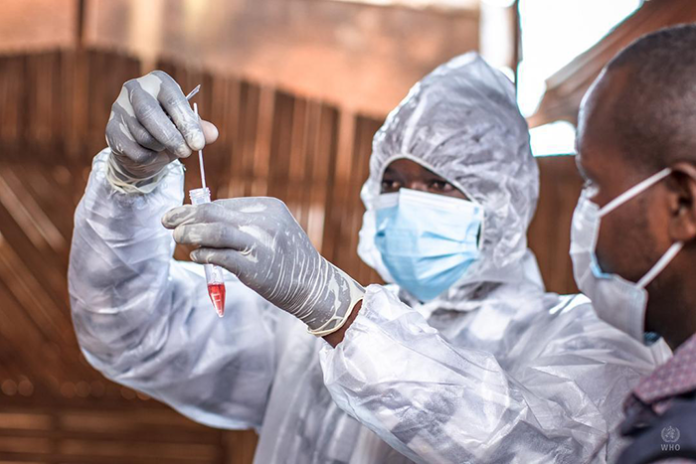
The Most Revd Georges Titre Ande, Archbishop of the Democratic Republic of the Congo and Bishop of Aru, has stressed the need for ‘prayers and practical action’ in response to the Ebola outbreak in DRC and Uganda in central Africa. The situation has been declared a ‘Public Health Emergency of International Concern’ by the World Health Organization (WHO).
The outbreak is thought to be caused by Bundibugyo virus, a type of Ebola strain which currently has no approved therapeutics or vaccines. WHO said the outbreak does not currently meet the criteria of a pandemic emergency, but said international coordination is needed to help contain the spread of the disease. WHO has also urged the importance of early diagnosis and supportive care with Bundibugyo Ebola, given that previous outbreaks have had case fatality rates of between 30 and 50 per cent.
As of 16 May, WHO reported eight laboratory-confirmed cases, 246 suspected cases and 80 suspected deaths in Ituri Province, in north-eastern DRC, across at least three health zones: Bunia, Rwampara and Mongbwalu. Two laboratory-confirmed cases, including one death, have also been reported in Kampala, Uganda, among people travelling from DRC.
WHO said the situation is of particular concern because of suspected community transmission, deaths among health workers, uncertainty about the true number of infected people and the geographic spread of the outbreak. The affected areas are also experiencing insecurity and population movement, increasing the risk of further spread. The outbreak also comes at a particularly challenging time, as it is the first time the DRC has faced Ebola since the dismantling of USAID, which had previously invested more than $300 million in fighting Ebola in the country and played a central role in outbreak surveillance and response. (CBS News)
The Province de L’Eglise Anglicane Du Congo (the Anglican Church in DRC), led by the Most Revd Georges Titre Ande, Archbishop of Congo and Bishop of Aru, serves communities in eastern DRC, including areas affected by conflict, displacement and previous outbreaks of Ebola.
Speaking about the latest outbreak of Ebola, Archbishop Ande said: ‘For years, living in the east of the DRC has been possible by God’s amazing grace. The rhythm of life for the population is marked by suffering upon suffering and misfortune upon misfortune. As if that were not enough, whilst efforts are being made to bring about peace, a new epidemic known as Ebola has just emerged, with no treatment or vaccine in sight, already claiming many victims in Bunia and the surrounding area, even amongst healthcare workers.
‘Given that population density is so high, particularly in towns, with massive movements of people, even from province to province, there is a risk that the spread of infection will accelerate. However, practical measures are being taken swiftly, with an international alert in place. This is what gives the population hope.’ He urges: ‘It is important to combine prayers with practical action.’
A newsletter issued by the Rt Revd Martin Gordon, Bishop of the Diocese of Goma in DRC, relayed while the Congolese are ‘the world’s experts’ at dealing with Ebola because of the previous outbreaks, the disease has already spread to neighbouring Uganda and he acknowledges the ‘fears that this is a strain for which there is no vaccine’, pointing out that ‘this will be the first time DRC has tackled Ebola since the massive cuts in US aid.’
Bishop Martin has urged people of goodwill to pray for the containment of the Ebola outbreak, for peace to return to eastern DRC and that the churches in the Diocese of Goma would continue to be beacons of hope.
In previous Ebola outbreaks in DRC, Anglican churches have helped to share accurate health information, challenge misinformation and encourage communities to follow public health guidance. Churches can play an important role in health emergencies because they are embedded in the life of local communities and hold positions of respect in the communities they serve.
A church resource from 2020 developed during a previous Ebola outbreak in DRC has now been reshared with bishops and church leaders in the region. The Faith in Time of Ebola digital resource is available in French, Swahili and English and is designed to support churches as they play their part in controlling an outbreak.
The resource was prepared by Isaac Muyonga, Health Department Director in the Baptist Church in Central Africa (Communauté Baptiste au Centre de L’Afrique), and the Rt Revd Michael Beasley, now Bishop of Bath and Wells and Co-Convenor of the Anglican Health and Community Network, whose background includes work as an epidemiologist on infectious diseases. It combines practical health information with Bible studies, pastoral guidance and advice for church leaders.