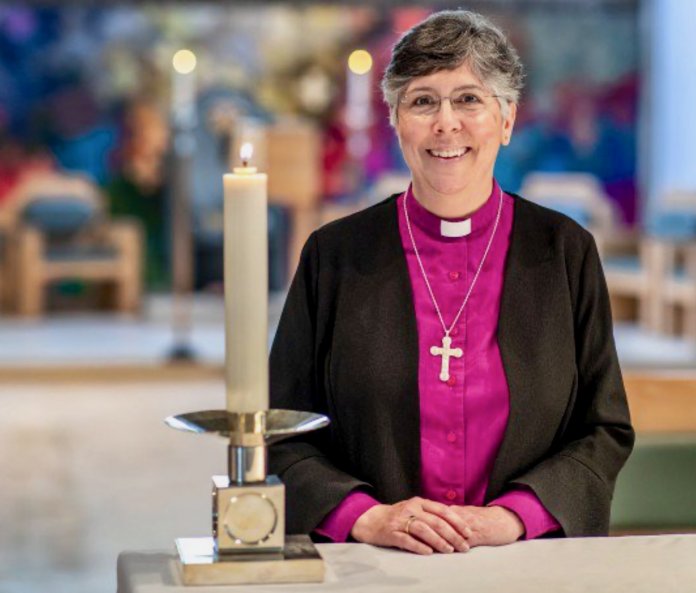
An exchange of open letters between a group of 40 Iranian Christians living in Britain and the Bishop of Chelmsford, the Rt. Rev. Guli Francis‑Dehqani, has exposed a sharp disagreement over the US–Israel war against Iran’s regime and raised questions about how Anglican leaders speak for persecuted believers. The letters, published by Article18 and the Diocese of Chelmsford, set one organised group of Iranian Christians in the UK—who describe the war as a possible “means of rescuing the Iranian nation from a repressive regime”—against a single Iranian‑background bishop who has denounced the same war as “unjust and illegal”. Behind their exchange lies a deeper issue: whether church leadership will continue to give priority to international law and just‑war theory, or allow the testimony of those who have lived under the regime to reshape its judgments.
The first letter is signed by 40 Iranian Christians now resident in Britain, many of them converts and refugees, writing in response to Bishop Guli’s public opposition to the war. They root their case in the last four decades of Iran’s history: repeated protest movements, mass arrests and killings, and the imprisonment and execution of dissidents and Christians. They describe the Islamic Republic’s slogans—“Death to Israel” and “Death to America”—as tools of internal control in a system whose main victims are Iranians themselves.
From their vantage point in the UK, they argue that the current US–Israel campaign is aimed at the regime’s instruments of repression, not at the people. They highlight strikes on Revolutionary Guard facilities and other regime infrastructure as attacks on the very organs that have enforced the state’s authority. On that basis, they reject the language of a war “against Iran” and instead describe an external shock that may, for the first time in decades, weaken a security state that has proved immune to internal protest and to years of international diplomacy.
They frame this in explicitly Christian terms. Drawing on the biblical example of Cyrus as an outsider used by God for liberation, they suggest that God may now use external force to loosen the regime’s grip. They speak of hoping for a future where no one is jailed or executed for Christian faith, where house churches are no longer forced underground, and where the Gospel can be preached openly. They state that negotiations and shifting sanctions regimes have left the Revolutionary Guard and other power‑holders entrenched, while ordinary Iranians bear the economic and personal cost. For these Iranian Christians in Britain, a war they did not choose appears as the only visible opening after every other path to change has been blocked.
They present this not as enthusiasm for violence but as a hard conclusion from experience. If every protest ends in blood and every promise of reform ends in more prisons, they argue that external force which weakens the regime can, within Christian moral reasoning, be a lesser evil than indefinite continuation of the current order.
Bishop Guli’s response, released by her diocese and reported more widely, addresses the same war from a different angle. She does not dispute the group’s description of the Islamic Republic. She herself comes from a family forced into exile, and has spoken of her brother’s assassination and of the regime’s long record of repression, including what she has called a “policy of slow strangulation” of Christians. She agrees that the government is cruel and that Christians and other minorities have suffered severely.
Her argument is that the US–Israel campaign fails the tests of just war and international law. She contends that Iran did not pose an “imminent threat” justifying pre‑emptive self‑defence, that diplomatic avenues “hadn’t been exhausted”, that there is no clear mandate from the United Nations, and that the operation lacks defined, limited aims and a credible plan for what follows military action. On those grounds she has called the war “unjust and illegal” and urged Christians not to support it.
The strength of her position is its insistence that Christian moral teaching cannot be reshaped by outrage at a regime’s cruelty. It holds to hard limits: proper authority, last resort, proportionality, and realistic prospects for a just peace. It aims to keep the church aligned with international norms and the just‑war tradition, even when those norms cut across the instincts of those who long for regime change.
At the same time, her criteria assume that law, process, and multilateral institutions are the decisive arbiters of legitimacy. For those who have watched the Islamic Republic ignore UN resolutions, crush protests, and sidestep sanctions for decades, appeals to “exhausted diplomacy” and “imminent threat” sound abstract. Their question is whether standards that restrain Western democracies but do little to restrain Tehran are, in practice, protecting the oppressed or protecting the status quo.
Once the letters are set side by side, the structure of the disagreement is clear. On one side stands a defined group of 40 Iranian Christians in Britain, speaking as people who have lived under the regime and whose families still do. On the other side stands one Iranian‑background bishop in the Church of England, whose experience is also real but whose stance, in this exchange, is not explicitly backed by any other named Iranian Christian community.
The group in Britain starts from the reality of power: a state that arrests and kills its opponents and treats both its own citizens and international agreements as expendable. From there they ask what might actually weaken that power. For them, the current war is the first serious external pressure aimed at the regime’s coercive machinery rather than at the population, and they are prepared to call it a tragic but necessary opening.
The bishop starts from the integrity of law and Christian tradition. She asks what will preserve a world in which the use of force is subject to rules, and in which weaker nations are not simply at the mercy of stronger ones. From that perspective, endorsing this war would mean accepting a pattern of unilateral action that could later be used to justify less defensible interventions. She is willing to accept, as the price of that stance, that some regimes will continue to abuse their people while outside powers hold back.
The two positions answer different primary questions. The Iranian Christians in Britain ask, “What will actually change life for us and our families in Iran?” The bishop asks, “What will keep Christian teaching from simply blessing whichever coalition claims to fight for freedom today?” The conflict between them turns on which of those questions is allowed to carry more weight in Anglican public witness.
The exchange highlights a gap between leadership and laity that Anglican bishops cannot ignore. In the public record, one Iranian‑background bishop in England appeals to international law and just‑war theory to oppose the war; a group of 40 Iranian Christians in England appeal to lived experience of repression and to what they see as a rare moment when power on the ground might actually shift. No other Iranian Christian body, whether inside Iran or in the diaspora, is cited as endorsing the bishop’s stance in this correspondence.
The question for bishops is how to speak in a way that does justice both to law and to liberation. To give decisive weight to legal frameworks and multilateral processes that have not, in practice, protected Iranian believers is to ask those believers—and their families still in Iran—to bear the cost of norms that restrain others but not their oppressors. To dismiss those norms altogether would be to abandon one of the few tools available to restrain any state’s resort to force. Anglican leadership will be measured, in part, by whether it is willing to let the voices of Iranian Christians in Britain—who know both the regime and the West—reshape its public judgments, rather than treating those judgments as settled before the people most affected have spoken.