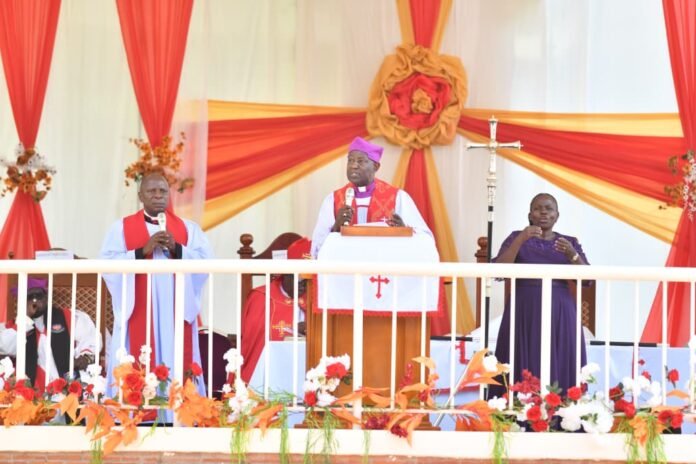
Uganda’s Anglicans marked this year’s Uganda Martyrs Day with a tightly controlled “scientific” celebration at the Namugongo Anglican site, after government and health authorities postponed the usual mass pilgrimage over Ebola concerns in neighbouring DRC. Attendance at the June 3 service was limited to a small invited congregation—bishops, clergy, choir, media and a handful of officials—under strict health protocols, with the Church of Uganda urging the faithful to join by television, radio and online rather than travelling to the shrine.
Uganda Christian University (UCU), appointed by the House of Bishops to lead the 2026 observance, coordinated liturgy, logistics and media at the site, building on hosting responsibilities that had been set out years earlier and then disrupted by public‑health concerns. The Most Rev. Stephen Kaziimba Mugalu, who also serves as UCU Chancellor, inspected the updated facilities at Namugongo ahead of the feast and insisted that the reduced numbers did not diminish the spiritual and historical weight of the Anglican martyrs’ shrine.
Preaching at the live‑broadcast service, Archbishop Kaziimba focused on unity, national cohesion and steadfastness in Christ, reminding worshippers that Catholics and Anglicans died together at Namugongo and insisting that their shared blood is a rebuke to tribalism and sectarian politics. “We are anchored in the cross for unity, and we will remain united even in fire,” he said, calling Ugandans to build their common life on prayer, work and mutual forgiveness and to become instruments of peace amidst political and social tensions.
Provincial statements framed the Church’s acceptance of state health measures as an expression of Christian prudence rather than capitulation, stressing that protecting life—especially of the most vulnerable—is integral to discipleship. With the congregation at Namugongo capped, the Church cast this year’s commemoration as a dispersed national liturgy, with one small assembly at the shrine and believers across Uganda and the diaspora urged to renew their baptismal witness from homes and parish churches.
Looking ahead, Church leaders have tasked UCU to continue the teaching and evangelistic initiatives originally planned around the hosting, including conferences for women, youth and children once full‑scale celebrations can resume. Officials repeatedly stressed that while crowds at Namugongo may be temporarily curtailed, the “spirit of Namugongo” endures wherever Ugandan Anglicans live out the martyrs’ legacy of unity, holiness and costly fidelity to Christ under pressure.