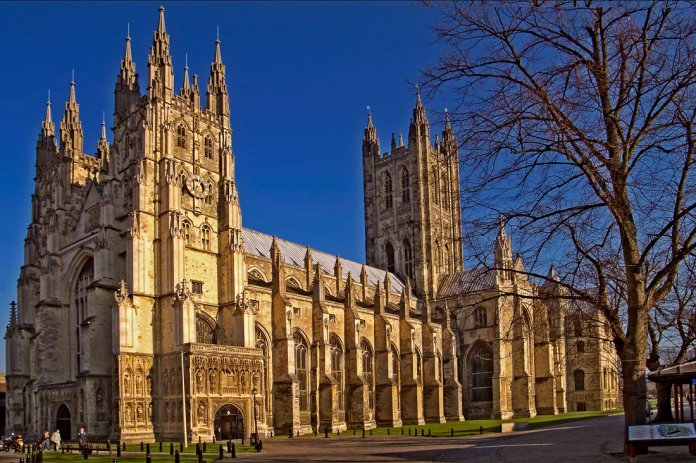
It’s been a rough week for the Church of England.
First came the announcement of a new Archbishop of Canterbury—a decision that breaks with two thousand years of Christian tradition. Then came the photos from Canterbury Cathedral itself: graffiti splashed across the pillars and walls of that great and ancient cathedral.
Note: Canterbury isn’t just another cathedral. It’s where the story began. It is the cradle of English Christianity. The seat of the Gospel on British soil since 597, when Augustine came from Rome to preach Christ to the Anglo-Saxons. 1From that moment on, Canterbury became the spiritual heart of a nation. Kings were crowned there. Martyrs bled there. Pilgrims walked for days to pray there.
Every Anglican church in the world can trace its roots back to that mission. That’s what makes this so serious. When Canterbury loses her sense of the sacred, something profound—and ancient—is being lost with her.
Put these headlines together, and you see an embarrassing and tragic problem. The Church isn’t being murdered by outsiders. She’s doing herself in. This is not vandalism or persecution. It’s suicide.
Every time we trade holiness for popularity, or beauty for relevance, a little more of the Church’s purpose falls from view. The Church will never die, but a congregation can. A denomination will. And the Church of England had better wake up and realize that antics such as these are not just silly—they are harmful to its mission.
The Church is harming itself—self-vandalizing. That’s the real murder in the cathedral.
The Cathedral as Billboard
The Dean calls it art—an installation called Hear Us. Vinyl graffiti stickers, plastered on medieval stone, meant to look like spray paint from a subway tunnel. Supposedly, it’s meant to make people “think.”
I’ve seen the photos. Some graffiti artists are true to their art form—bold, illegal, shocking by what it says and where it says it. But the shock value here is only in where it’s plastered.
And when was the last time you saw graffiti that had been carefully sourced? Typed in a font made to look like graffiti—the “real thing”—then scanned at the nearest FastSigns in Canterbury and neatly applied on the pillars and staircases. Stick and peel.
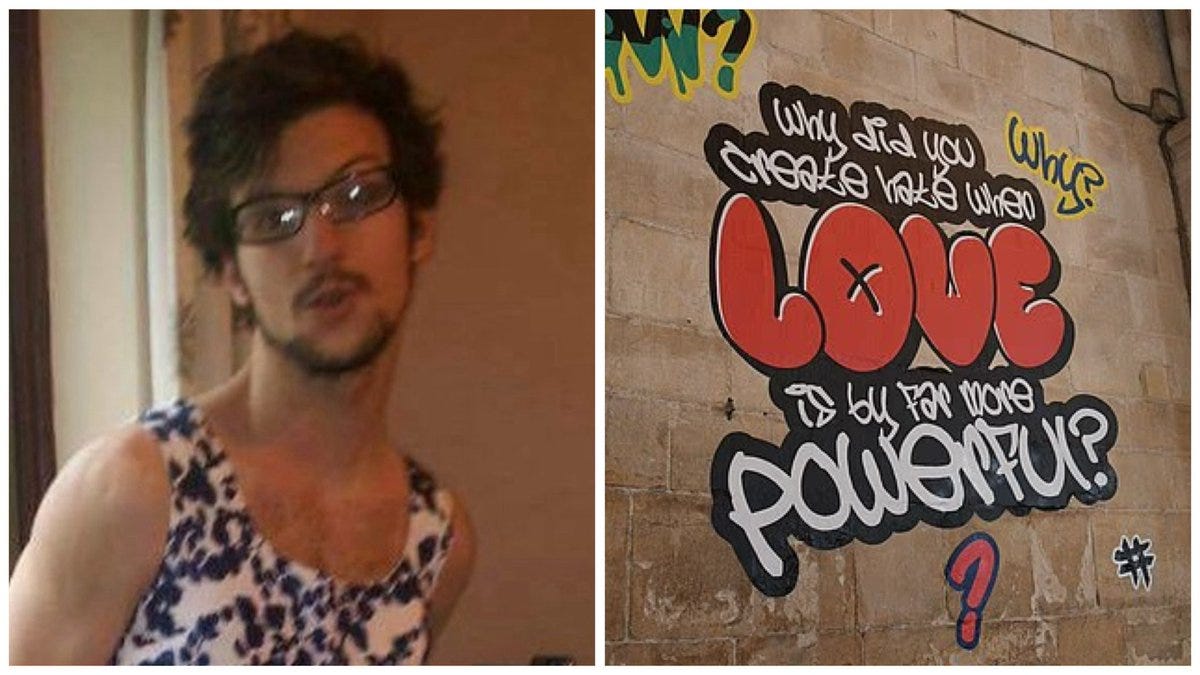
One observer put it plainly:
“You don’t take a sacred site like Canterbury Cathedral—one of the oldest and most culturally significant buildings in England—and turn it into a billboard for a temporary art project. This isn’t engaging with the community. It’s a blatant disregard for the sanctity of a space that should be treated with the utmost reverence.”
And that’s exactly the point. We’ve stopped believing that the sacred is sacred. We’ve convinced ourselves that to reach the world, we must become like the world—even in our sanctuaries.
Another voice on X said it perfectly:
“Every line of this ‘installation’—‘Are you there?’ ‘Do you regret your creation?’—reveals the modern clergy’s nervous breakdown. The faith that once proclaimed truth now questions itself in neon letters. The cathedral hasn’t been vandalized by outsiders; it’s vandalized itself from within, trading reverence for relevance and beauty for gimmickry.”
Even our own Vice-President, J. D. Vance, weighed in:
“It is weird to me that these people don’t see the irony of honoring ‘marginalized communities’ by making a beautiful historical building really ugly.”
Chasing Relevance
I’ve written about this before.
There’s a mini-revival of spiritual things happening in England. The culture is asking the kind of questions the Church has the answers to.
But the Church of England is pretending it doesn’t know.
It’s feigning dumb.
Acting mute.
Trying not to sound self-assured, as if questions are always better than answers.
This impulse—to make faith “relatable”—has infected churches for decades. It sounds noble: We want to reach people where they are. But in practice, it becomes a slow death.
I learned this early in ministry. In seminary, the question was always, How can I make the Gospel relevant to modern life? It sounds harmless enough. But once you make relevance your goal, you’ll bend anything to achieve it.
You’ll dress up the message, sand off the edges, trade truth for tone. And little by little, you start to lose the very thing you meant to share.
It’s not murder with a knife. It’s murder by compromise—a slow, smiling suffocation of the sacred.
The Gospel Doesn’t Need Makeup
But the Gospel doesn’t need to be dressed up. The Holy Spirit is already at work in the world. He stirs hearts, awakens hunger, and draws people to Christ. Our job is not to sell Jesus, but to show him.
Not to lure, but to present Him to the world.
“Christ Jesus came into the world to save sinners.” That’s enough. That sentence could fill a cathedral all by itself. The Gospel is inherently beautiful, inherently magnetic.
It doesn’t need graffiti to make it interesting.
The Cult of the Question
If you care to count, the graffiti in the cathedral is a list of questions. Questions. Always questions. Never answers. As I count—and there are more besides—they might make for a great sermon series:
- “Are you there?”
- “Does our struggle mean anything?”
- “Where does love come from?”
- “Why did you create hate when love is by far more powerful?”
Will the Dean of the Cathedral provide answers to these questions? Doubtful, really. Questions are always preferred by progressive Anglicans and Episcopalians.
Read it all in The Anglican