Kevin Kallsen, George Conger, and Gavin Ashenden discuss the Royal Chaos caused by Harry and Meghan’s decision to ‘step back’ from Senior leadership. And somehow, George and Gavin ventured into the vast Eucharist discussion while talking about Francis Chan’s recent revelation.
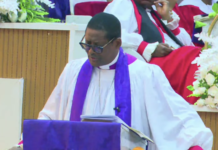
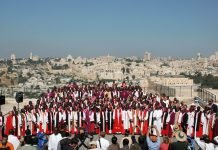


Eucharist is an elitist academic greek word the Greeks don’t even use (Holy Sacraments to them). It is a very high brow word (different from High Church) used by those to ‘splain’ the results of the redacting-demystifying- scientific compliance movement in the 1960s and 1970s.
Holy Communion and/or The Lord’s Supper was used back in the day when western Anglicans were more than an anomaly. The old Prayerbook phrase ‘…these Holy Mysteries’ explained it sufficiently unless the expectation is to use Jesus’s directive as a mean to melt out the dross to lessen the Father’s job on Judgement Day. My observation is there were many more Anglicans back in the days when Morning Prayer was the Sunday norm rather than using the Eucharist and ‘Our Baptismal vows’ to justify anything and everything.
The term Eucharist was explained to me by my daughter after she took a course in ancient Greek. Charist is a two part action. On the part of the Doer who gives, grace, graciousness, etc. and the part of the Receiver who response with, thankfulness, gratitude. The eu meaning good. I find the best definition we have is when we receive Holy Communion. “The body of our Lord Jesus Christ, which was given for thee, preserve thy body and soul unto everlasting life:”. This is what God the Doer has done for us. “Take and eat this in remembrance that Christ died for thee, and feed on him in thy heart by faith with thanksgiving”. How we the Receivers respond. Similarly when we receive the Cup with “The Blood of our Lord Jesus Christ, which was shed for thee, preserve thy body and soul unto everlasting life: Drink this in remembrance that Christ’s Blood was shed for thee, and be thankful. My preference is to use Holy Communion or the Lord’s Supper.
There’s no temptation like obtaining power and authority over other people. And that applies no less to Christians than anyone else. But of course that is not possible in the case of The Lord’s Supper if you take solely the Bible’s account of the context in which Jesus instituted it (the annual Passover meal), what he did and said, and the reason he gave why it should be done.
It was a simple thing but designed to recall something so profound that it should never become commonplace in anyone’s mind. But where’s the power in something if it’s kept simple? No; if it should serve the need for authority, to have power over others, it required man’s embellishment, his ability to impress with many words, and make much of confusing ideas, provide the hook of superstition to keep a hold over people’s minds. And we know the rest.
Hmmm…what do the LDS call that sister-wives thingy? That sounds interesting if not a little expensive.
Actually eucharisto is used every day in Greek. It means “thank you”..I think you’re right. The chips with everything attitude to Communion cheapens it, and the parish communion movement has unchurched many people.
Regarding Harry and Meghan. I view their action as an employee telling his employer what his job is going to be. In any business anyone who tries this will soon find that they will soon been without a job. Is this because they are young, don’t think so, just naive.
The whole family is not usually visible on the desk- the photos on display show the line of succession- the Princess Royal is never on display, nor Andrew, Edward or their children. William’s children take precedence over Harry. When Richard Chartres was Bishop of London, the memorial service he organised for Lady Diana was far more Christian than her funeral, and her brother’s sermon was more naff thanCurry’s with no word of God in it.
I don’t think the Queen got it wrong, Tony Blair and the media got it wrong. She stayed with her grandchildren
Luther thought Aristotle was a fathead, who was misunderstood by the hog theologians and that you can only be a true theologian if you abandon Aristotle.. There is some confusion about real presence because if you deny it people think you believe Christ’s presence is not real; it’s real but not “in re”, a true presence and real absence.In John 6 Jesus equates feeding on his flesh with coming to him and believing in him.
We are commanded to partake. Is it fatal to be in the wrong camp? I hope it isn’t Calvin’s ‘frozen chosen’. Some of the nuances from the theologians are beyond my ability of understanding.
There are caveats also such as being in love and charity with one’s neighbor (swallow). There is a reason confession comes before.
Calvin emphasised our spiritual presence with Christ at table in his kingdom.
Institutes Book 4 chapter 17 paragraph 31 You may also be interested to read the 1541 Short Treatise on the Lord’s Supper. He chides Luther for localising the body and blood of the Lord, and chides Zwingli, Melancthon and Oecolampadius for reducing the sacrament to mere sign, though he acknowledges they are reacting to wrong ideas. Calvin argues from the Fathers as well as from Scripture. I believe Luther decided to be intransigent at Marburg because he was appalled by the suggestion that truth as he understood it could be bartered for the political expediency of Protestant Unity. I have never had any problem with working with Lutherans, seems to me there is room for a diversity of opinion .
to be honest I think I may have been quoting a lecturer on Calvin rather than Calvin himself, though he does say that we should lift our hearts and minds to heaven, where Christ is, and that our Communion is with the Risen Christ. Seems to me that George is right, Anglican formularies are more in line with Calvin than reformed churches who only have communion four times a year. I wonder why people don’t go back to the first centuries for baptismal practice. Luther thought baptism was uncorrupted because babies don’t have money- but I think baptismal practice was reformed in the time of Augustine- it had definitely moved a long way from the NT by the second century.
Man, John 6 was a lot easier to understand.
Obviously Christians ought to be praying for the royal family and extended family in England. In one sense the ”problem” is that royalty are generally as ”lost” as any of us commoners. Billy Graham once preached at Wembly stadium: ”You must be born again” !
We all need a saviour. We all share the DNA of Adam. The feel good-ism of the current Anglican church in England IS NOT enough. Barring renewal, it will eventually collapse. Islam is waiting.
Based on actions it looks to me like the prince and Meghan are equally lost. For the Monarchy to have any sense in today’s world, royalty in England need to be the leadership (at least for the British Commonwealth) and that means leading. And leading really begins with character and strength: call it ”requiring” the perfect or ideal citizen.
There are duties and responsibilities here. America may be different, of course. We rejected Kings and Queens. The queen is respected because of all things, she understands her DUTY to the people under her ”rule”. Perfect or imperfect, she wants to rule wisely.
She is respected because even though some of her duties and responsibilities have been extremely tough, she has not shirked from them.
The prince and Meghan should not walk away from the hard parts and still expect the money, the prestige, and the privilege.
I personally believe that in THEIR position (and I include the other royals) it is like parenting. Some days, weeks, and months are awful, but if you stay the course, satisfaction will come.
what is wrong with argument?