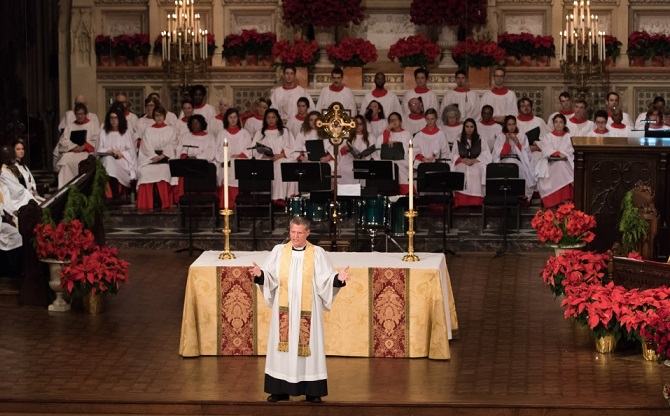
The top clergyman at one of the wealthiest parishes in the U.S.-based Episcopal Church has abruptly stepped down.
The Rev. Dr. William Lupfer, rector of Trinity Wall Street Episcopal Church since 2015, announced his departure in a January 3 brief letter to church staff, first published by The Living Church.
Such an abrupt departure is highly unusual. Stepping down over a holiday break with no announced transition to an interim rector (Lupfer will be succeeded by church vicar Phillip A. Jackson, who will become priest-in-charge) indicates the departure decision was sudden. As of the morning of January 6, Lupfer’s name and photo had already been removed from the Trinity staff page.
“I have come to the decision to step away for a time, resign as Rector of Trinity, and enjoy some sabbath rest,” Lupfer wrote, noting that it follows “five years of intensive work” with vestry and other stakeholders.
Trinity holds billions of dollars in property and financial assets, dating to an early 18th century grant of Manhattan farmland from Queen Anne. In February 2019, the New York Times reported that the parish portfolio was worth an estimated $6 billion.
While not especially large in membership, the parish holds an influential role in the worldwide Anglican Communion. According to its web site, internationally, Trinity Church provides grants to dioceses, provinces, and seminaries within the global family of churches descended from the Church of England. Among those grants are funds provided to Anglican provinces in Africa to support their participation in gatherings friendly to the more liberal Episcopal Church.
In March, the parish announced it was effectively purchasing the Church Divinity School of the Pacific, a seminary that prepares future clergy for service in the Episcopal Church.

Remarkably unchanged: Trinity Wall Street reports constant membership and attendance numbers for much of the past decade.
The parish largely lives off these assets, reporting no congregational plate-and-pledge income for the past four reporting years. Prior to that, the parish reported exactly $600,000 in annual plate-and pledge donations going back to 2010. Statistics made available by the Episcopal Church Office of the General Convention list an unchanged membership of 950 and attendance of 625 from 2011 onward. Streaming video of services appears to show an attendance closer to 200 persons.
Trinity’s vestry and clergy have had friction before, usually centered around financial management disagreements. The Christian Post reported that the previous rector, The Rev. Dr. James H. Cooper, announced a departure in 2013 following accusations against him “included misreporting of numbers of worshippers on Sunday services; demands for a $5.5 million SoHo townhouse; an allowance for his Florida condo and fat salary; trips around the world at church’s expense; wasting more than $1 million on development plans for a luxury condo tower; and spending $5 million on a publicity campaign.”
The church listed the Federal-style townhouse on the market in 2015 with an asking price of $12 million, according to the New York Post.
Almost uniquely among parishes, Trinity’s 22-member vestry has people not drawn from the congregation. Among them is Gabrielle E. Sulzberger, wife of New York Times publisher Arthur Ochs Sulzberger Jr. Only seven persons serving on the large vestry are listed as members of the parish.
According to a letter from the parish vestry provided by a spokesperson for the church, it will conduct a call process to select the next rector, “who will lead the church in its mission both as a local congregation and global parish.”



22 member vestry and only 7 of them are church members. It sounds more like a corporation and less like a church. Are the non-members even Episcopalians? How about Christians? Curious minds want to know.
Go to the link in that sentence–most of them are Episcopalians, but members of other TEC parishes. There is a dual TEC/UMC member and one non-member of anywhere. Very. very strange.
Essentially, it is a Real Estate Investment Trust that benefits (into the hundreds of millions) by tax exempt status. So it has the “board” of a REIT. Being on the Trinity vestry is way cooler than going to GC.
I will guess that what most would consider to be a vestry is the Congregational Council. The vestry is probably more of a corporate board that overseas the assets while the Council handles the parish.
The video of Sunday’s sermon at Trinity Wall Street is interesting. The speaker is a female “Reverend” and her subject is the visit of the Magi and the flight into Egypt. She describes the Magi as “academics”, Jesus as Joseph’s “adopted” son, and his family as refugees. God in the talk is sometimes female (the “Her” is deftly slipped in several times).
The only surprise in the video was that so many people were apparently willing to endure the experience, possibly believing it was all in a good cause.
200 people on a given Sunday? Even that number would still put it in the upper 10% of Episcopal Churches for attendance.
I happened over to Juicy Ecumenism, where this article first appeared, and one of the posters there pointed to an article that includes a portion of the original charter granted to Trinity by the English Crown in 1697 (which gave them the big chunk of Manhattan, which along with the church itself, was taken from the Church of England when PECUSA left that church)-
Under the Dennis canon, since dead whales and shipwrecks are chattels of the Episcopal Church, and they have filed numerous federal court cases that the Dennis Canon can be enforced upon pre-existing parishes and dioceses, I think there is a claim to be made that TEC is financially responsible for all costs related to dead whales, shipwrecks, oil spills, refuse, beach cleanup, sewage, etc, going back to the date of formation of the diocese that includes the beach or harbor in question. And that would be in all 14 countries which they claim as their jurisdiction.
Apparently the Dennis Canon wasn’t quite as retroactive as TEC has claimed, or else Bishop Schori would have turned the assets of Trinity Church over to Queen Elizabeth a decade or more ago.