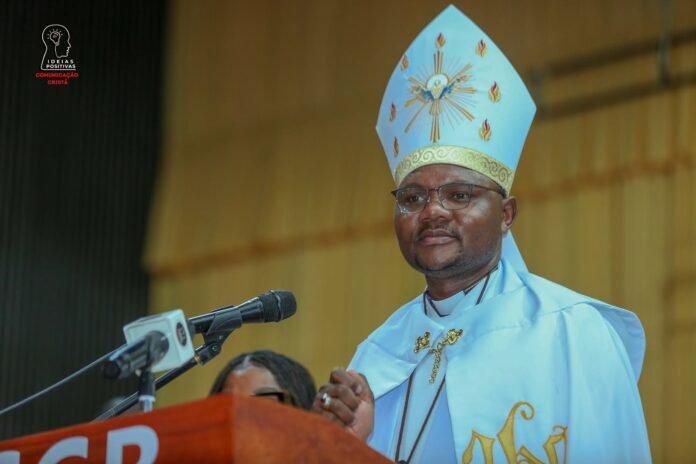
The Anglican Church of Mozambique and Angola (IAMA) has called for a swift investigation into the 6 June killing of Roman Catholic Bishop Osório Citara Afonso of Quelimane, as authorities continue to face questions over an arrest widely viewed as implausible.
Archbishop Vicente Msosa, Presiding Bishop of IAMA, said he was deeply troubled by the death of Bishop Afonso, describing him as a friend and colleague. “No one has the right to take another’s life,” Msosa said in a statement reported by the Mozambican daily O País. He called on authorities to clarify the circumstances of the murder and bring those responsible to account.
Msosa said Bishop Afonso had been a man of dialogue and a source of wise counsel, and described his death as a loss not only for the Catholic Church but for Mozambican society.
Bishop Afonso, 54, was found shot dead in a corridor of his episcopal residence in Quelimane in the early hours of 6 June. He had been shot in the chest with an AKM-type assault rifle. Investigators from SERNIC, Mozambique’s national criminal investigation service, said assailants had scaled the walls of the compound and disabled the security system before entering the building.
Three people have been arrested: a Catholic priest assigned to the Diocese of Quelimane, along with a guard and a gardener employed at the residence. The priest has not been named in official communications.
The arrests have not satisfied observers familiar with the situation on the ground. A source working with church leaders in Mozambique told The Pillar that if the original accounts of the attack are accurate — an armed, coordinated assault requiring the breaching of security measures — the crime could not have taken place “without the involvement of somebody at a government level.”
“Even if the order didn’t come from the top, somebody at the local level would have been involved,” the source said, adding that the arrest of a priest appeared to serve as a deflection.
Saint Anne Parish in Quelimane moved to defend one priest whose name had circulated on social media. In a 10 June communiqué, the parish called allegations against Fr. Novais Adelino Amado “false, unofficial, and without any official basis” and urged the faithful to await a formal statement from the Episcopal Conference of Mozambique (CEM).
The Anglican statement came alongside condemnations from Catholic bodies across Africa and the Vatican. The Catholic Bishops’ Conference of Mozambique described the killing as a “vile and cowardly crime” and warned that any failure to investigate would amount to complicity in violence.
The Symposium of Episcopal Conferences of Africa and Madagascar (SECAM) issued a statement signed by Cardinal Fridolin Ambongo demanding an “immediate, thorough, transparent, and independent investigation” and calling for accountability for “direct perpetrators, accomplices, and masterminds.”
Pope Leo XIV expressed “deep sorrow” over the killing while on an apostolic visit to Spain and subsequently appointed interim administrators for the Dioceses of Quelimane and Beira.
Afonso was a Consolata Missionary with academic credentials in biblical studies. He held a Licentiate in Sacred Scripture from the Pontifical Biblical Institute in Rome and had studied at the Hebrew University of Jerusalem and the École Biblique in Jerusalem. He served at the Vatican’s Dicastery for Evangelization before being appointed Auxiliary Bishop of Maputo in 2023 and consecrated in January 2024. Pope Leo XIV transferred him to Quelimane on 25 July 2025, where he was also serving as Apostolic Administrator of the Diocese of Beira at the time of his death.
The killing occurred against a background of sustained political instability. Since the disputed October 2024 elections, Mozambique has experienced widespread unrest: Amnesty International documented 315 deaths in post-election protests through January 2025. An Islamist insurgency in northern Cabo Delgado province, linked to the Islamic State, has killed more than 60,000 people since 2017 and displaced hundreds of thousands. Catholic leaders have been vocal critics of both the insurgency and the government’s handling of its aftermath.
Church leaders have previously been targeted. In 2021, Bishop Fernando Luiz Lisboa of Maputo was transferred back to Brazil after receiving threats linked to government-connected figures.
The investigation into Bishop Afonso’s death remains open. IAMA and the wider ecumenical community have made clear they expect a credible outcome.