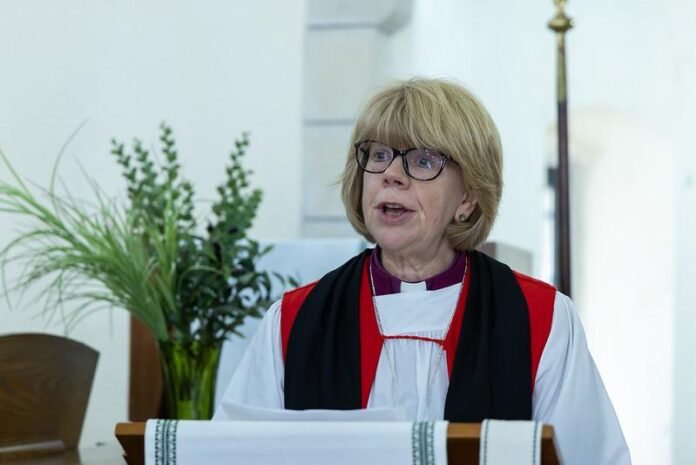
Archbishop Sarah was making the first visit of an Archbishop of Canterbury to St Peter’s Anglican Church in the Palestinian Christian town of Birzeit. She introduced her sermon by thanking the rector, Father Fadi Diab, and the congregation for their hospitality, recognising too the costliness of life for them and their families in the occupied West Bank.
She told the congregation she would use her role as Archbishop to seek “the peace you desire and the freedom you deserve”.
The Holy Eucharist at St Peter’s this morning was presided over by the Anglican Archbishop in Jerusalem, the Most Revd Dr Hosam Naoum, who is accompanying the Archbishop on her pilgrimage through the Holy Land.
In her sermon, Archbishop Sarah spoke about living faithfully in times of fear, trusting in the promises of Christ, and Christian hope as an act of resistance.
She said: “And your faithful, hopeful resistance is also visible as fathers and mothers navigate the web of checkpoints daily to provide an income for their family, or to get their children to school to provide for their future, or as you gather to break bread together week by week in this church. All these acts of faithful resistance point to our hope in Jesus Christ and reflect your ongoing struggle for freedom and dignity.”
Archbishop Sarah’s Introduction:
I am grateful for your hospitality today. It is a privilege to spend time in solidarity with you and learn about your lives here in Birzeit.
It is an honour to spend time with Archbishop Hosam this week, to meet Father Fadi and clergy from the surrounding area, to gather with our fellow brothers and sisters in Christ, to pray and worship, and to learn about the life of the Church in this place.
I am aware that I have certain freedoms that many of you do not enjoy, being able to cross borders and checkpoints, spending time in neighbouring communities, and going to Jerusalem. I am deeply humbled by this opportunity to join you in prayer and fellowship.
I recognise the costliness of life for you and your families, and the costliness of following Jesus here in this land, which was our Saviour’s home and is your home.
Thank you for the openness with which you have welcomed me. I will not forget what I have seen and what I have heard. I could not forget it. I will carry these encounters with me as I return home. I will use my role as Archbishop to seek the peace you desire and the freedom you deserve.
Archbishop Sarah’s sermon:
Jeremiah 20:7-13
Romans 6:1-11
Psalm 69: 14-20
Matthew 10:24-39
Let us pray: May the words of my mouth and the meditation of our hearts be acceptable to you, O Lord, my rock and my redeemer. Amen. (Psalm 19.14)
Our scriptures give us a lens through which we can see the world and reflect upon our lives. There are two important themes we might reflect on in our readings today.
The first is fear: how do we live as people of faith in fearful times?
The second is hope: how do we live as those who trust in the promises of Christ and bear witness to hope?
The Psalmist writes to people living in fearful times. They are experiencing the trauma of oppression and exile, of families being separated: “I have become a stranger to my kindred, an alien to my mother’s children” (Psalm 69.8); and there is a profound sense of abandonment: “Do not hide your face from your servant, for I am in distress – make haste to answer me”. (Psalm 69.17)
In the Gospel of Matthew, Jesus is speaking to a community living in fear: his own people living in an occupied land and under foreign rule. Matthew writes for a community that knew uncertainty, insecurity, and pressure.
Jesus speaks these words: “Are not two sparrows sold for a penny? Yet not one of them will fall to the ground apart from your Father. And even the hairs of your head are all counted. So do not be afraid; you are of more value than many sparrows.”
Jesus tells his own people, who are living in fear, that they are valued in God’s eyes. He reminds them that they are precious in God’s sight; that the hairs of their head are counted; that they are known and loved by God.
I think these words are even more powerful when heard against this backdrop of fear. They are spoken not to those who are secure and comfortable, but to those who are anxious and burdened.
I can only imagine how these words may sound to you today as you live with the realities of life under occupation here in Birzeit, and when your fellow Palestinians still strive for freedom and dignity in Gaza.
I wonder how these words of Jesus sound when you have felt that the eyes of the world, the international community, and even parts of the wider Church have turned away from you. Yet Jesus speaks these words to you now: you are precious in God’s sight; you are known, seen, and loved.
I hope that, through my visit, you may also know that you are not forgotten by the wider Body of Christ. The Church is called to rejoice with those who rejoice and to weep with those who weep. The Church stands with you in your right to live in freedom and dignity.
How then do we continue to live faithfully in times of fear?
Jesus speaks truthfully about the cost of discipleship.
At first, Jesus’ words sound surprising: “Do not think that I have come to bring peace to the earth; I have not come to bring peace, but a sword.” This seems the opposite of what we expect from the Prince of Peace.
Jesus is not glorifying conflict. Rather, he is speaking honestly about the reality that faithfulness can be costly. The Gospel reveals truths that the world would often prefer to leave hidden. It exposes divisions, challenges injustice, and calls people to difficult paths of discipleship.
Jesus is describing the cost of discipleship as the call to be holy and distinctive, even within our own families and communities. Following Christ Jesus has always been costly. The Christians that lived in this land in the first and third centuries experienced persecution from the Roman Empire. I lament that almost two thousand years later you are now facing so many barriers to practising your faith and living freely.
Perhaps, then, here in Birzeit, the words of our Gospel today speak with particular force. The Gospel reveals what is hidden. It shines a light on wounds that others may not see. It acknowledges suffering and gives language to pain. But it also reveals something else: the steadfast love of God and the compassion of Christ for those who suffer.
Jesus speaks honestly into the pains and divisions that we carry. More than that, Jesus himself bears them. The sin and brokenness of the world are carried by Christ to the heart of the Father. As people who are known and loved by God, and whose pain is carried into the very life of God, we can live as people of hope.
And hope itself becomes an act of resistance.
As I stand with you this morning, I am reminded that the Church encounters Christ wherever his people remain faithful amidst hardship; wherever believers continue to pray, worship, forgive, serve, and love despite uncertainty. In that faithfulness, Christ is present among you.
And your faithful, hopeful resistance is also visible as fathers and mothers navigate the web of checkpoints daily to provide an income for their family, or to get their children to school to provide for their future, or as you gather to break bread together week by week in this church. All these acts of faithful resistance point to our hope in Jesus Christ and reflect your ongoing struggle for freedom and dignity.
In his Letter to the Romans, St Paul speaks profoundly about hope in Jesus Christ: “For if we have been united with him in a death like his, we will certainly be united with him in a resurrection like his.”
As we live out our baptism, we are called to bear witness to hope. We are called to be salt and light in the world; to be yeast that transforms the dough; to be seeds that take root and grow, even in difficult soil.
Hope does not deny suffering. Hope looks suffering in the face and yet refuses to grant it the final word.
And because Christ is risen, fear does not have the final word. Violence does not have the final word. Division does not have the final word. Death itself does not have the final word. Our hope is in Jesus Christ.
This is my hope, and it is my prayer for you: That you know yourselves to be precious in God’s sight—the very hairs of your head are counted. That you know Christ’s presence with you amid the fears, pains, and uncertainties you carry. That you continue to be faithful witnesses to the hope of Christ, following him with courage and perseverance.
May you know the hope to which you are called in Jesus Christ, and the comfort, strength, and peace of his love at work within you.
Amen.