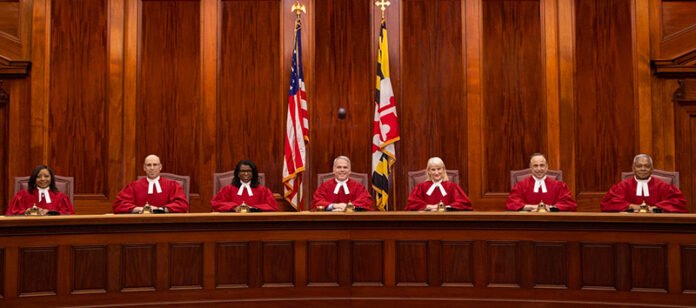
The Supreme Court of Maryland has held that a former bishop of the Eritrean Orthodox Tewahdo Church has no legal right to remain in a church-owned residence in Hyattsville, reversing lower court rulings that had dismissed the case under the ecclesiastical abstention doctrine. The decision applies the neutral principles of law approach familiar to Anglicans and Episcopalians from two decades of church property litigation across the United States.
The July 23, 2026, opinion directs that judgment be entered in favor of the Eritrean Orthodox Tewahdo Diocese of U.S.A. and Canada, Inc., on its wrongful detainer claim against Abune Sinoda Tafla. The case returns to the District Court of Maryland in Prince George’s County, which must still consider the corporation’s requests for damages and attorney’s fees.
The dispute centers on a property at 812 Chillum Road, purchased by the religious corporation in 2011 and used as a parsonage for the church’s bishop of the United States and Canada. Abune Sinoda, appointed bishop in 2005 by the late Patriarch Abune Antonios, has lived there since the purchase.
In 2016 the church’s Holy Synod removed him from office. The corporation asked him to leave the residence. He refused, maintaining that the Synod was illegitimate—stemming from the Eritrean government’s earlier removal and detention of Patriarch Antonios—and that he remained the rightful bishop with a corresponding right to occupy the parsonage.
The corporation filed a wrongful detainer action seeking possession, $20,000 in damages, and $10,000 in attorney’s fees. The District Court dismissed the suit, concluding that determining control of the property would require interpretation of church law and the legitimacy of the bishop’s removal. The Circuit Court for Prince George’s County affirmed.
Maryland’s Supreme Court disagreed. Writing for the court, Judge Biran held that the matter could be resolved through neutral principles of property law without deciding ecclesiastical questions. The corporation holds legal title. No lease, employment agreement, deed provision, or church governing document granted the sitting bishop a legally enforceable right to occupy the residence. Abune Sinoda paid no rent, and the corporation never recognized him as a tenant with exclusive possessory rights.
The court found that he occupied the property as a licensee. Under Maryland law, a license to occupy real property may be revoked at the owner’s pleasure. The corporation had repeatedly demanded that he vacate, including a final notice in July 2024. “The ecclesiastical abstention doctrine has no application to this case because Respondent’s right to possess the Property does not turn on whether he is the Church’s rightful Bishop of the United States and Canada,” the opinion stated.
The ruling applies the neutral-principles approach long used by American courts in church property disputes. That framework, articulated by the U.S. Supreme Court in Jones v. Wolf (1979), permits civil courts to examine deeds, corporate charters, bylaws, and state property law without delving into doctrine or polity.
Similar questions have featured prominently in litigation involving the Episcopal Church over the past two decades. After theological divisions led numerous parishes and several dioceses to depart, state courts across the country applied neutral principles to resolve ownership of church buildings, rectories, and endowments. Outcomes varied by jurisdiction. In some states, courts upheld trusts asserted by the national church or dioceses under the so-called Dennis Canon. In others, including Texas and South Carolina, courts found that local corporations retained clear title where no enforceable trust had been created under state law. Maryland’s decision aligns with the same methodological preference for secular legal tools over judicial deference to hierarchical determinations when property rights can be settled without resolving questions of religious authority.
The Eritrean Orthodox case turns on narrower facts—a single residence held by a Maryland religious corporation and occupied under a revoked license—rather than the broader congregational or diocesan schisms that marked the Episcopal disputes. Yet the court’s insistence that title and license status control, irrespective of internal claims about legitimate leadership, follows the same path many American courts have taken when church property questions reach the civil docket.
Proceedings will now resume in the District Court on the remaining claims for damages and fees.