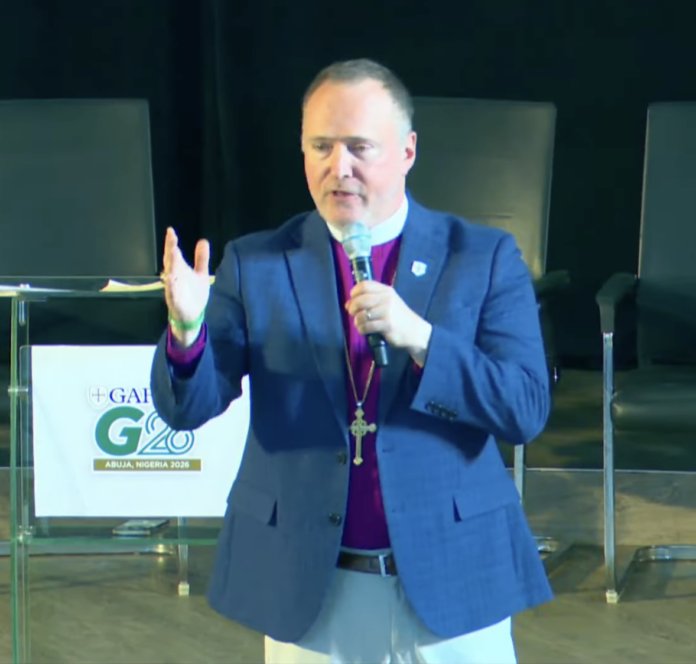
[Abuja, Nigeria] A stark summons to choose this day—Scripture or institutional drift—resounded on March 5, 2026, as the Rt. Rev. Paul Donison, GAFCON’s General Secretary, opened the G26 conference in Abuja with his address, “The Future Has Arrived: The Beatitudes and the Kingdom of God.” The first of 12 talks over two days at the GAFCON mini-conference held at St Matthias House in Abuja, it pressed Anglican the 450 Anglican bishops, clergy and lay leaders to take Matthew 5’s Beatitudes as the model for God’s kingdom breaking in.
Bishop Donison recited the Beatitudes, showing how Jesus turns the world upside down: blessing comes to the poor in spirit, the grieving, the meek, those hungering for righteousness, the merciful, the pure in heart, peacemakers, and the persecuted. Persecution for the gospel proves this blessing real.
The speech tied this to Jesus’ call to be salt and light, casting GAFCON as the force holding Scripture at Anglicanism’s core.
It recalled the speaker’s first GAFCON in Nairobi in 2013, feeling the global church’s power, and his daughter’s healing through group prayer. GAFCON’s progress followed: missions, evangelism, new churches, and dioceses.
The general secretary’s address confronted the Anglican Communion’s need for reordering, citing the 2023 Kigali meeting’s urgent call. This led to talks among primates and the Macquarie Statement—also called the Martyr’s Day Statement of October 16, 2025—that calls the church to gather and hear God.
Donison first refuted the idea that the statement creates a new or rival Communion. He stressed it aims only to reorder the existing Anglican fellowship around biblical truth.
Second, he rejected schism charges against GAFCON. The real failure rests with the instruments of unity—the Archbishop of Canterbury, Lambeth Conference, Anglican Consultative Council, and Primates’ Meetings. These modern structures were meant to uphold Lambeth Resolution 1.10, passed overwhelmingly in 1998 (526-70), which defines marriage as one man and one woman for life and calls homosexual practice incompatible with Scripture. They did not enforce it, so GAFCON filled the gap.
Third, Donison clarified that constitutional changes, like removing Canterbury references, are encouraged but not mandatory. Provinces or dioceses unable to amend immediately remain welcome. The goal is a confessional, conciliar fellowship tested by the Jerusalem Declaration.
Fourth, the statement did not react to the Church of England’s first female Archbishop of Canterbury. The meeting was planned well before her appointment, though the timing felt providential to Donison. Problems lie in her doctrine and failure to keep ordination vows, not her gender.
The Jerusalem Declaration, from GAFCON’s 2008 Jerusalem gathering, sets this standard. Its 14 points reaffirm Anglican basics—the Thirty-Nine Articles, 1662 Book of Common Prayer, ordinal—back Lambeth 1.10, and reject homosexual practice as unscriptural. Born from 2003’s gay bishop ordinations and same-sex blessings, it claims to define true Anglican faith against Communion shifts.
Scripture’s authority emerged as the real issue, from sexuality to transgenderism and identity politics: “What does God’s Word say?”
The speech returned to the meekness Beatitude, calling for humility and grace as the source of gospel loyalty.
It closed by citing 1555 Reformation martyrs Latimer and Ridley, burned for the gospel, who lit a candle in England that still burns worldwide in the Anglican family—God’s Word cannot be chained.