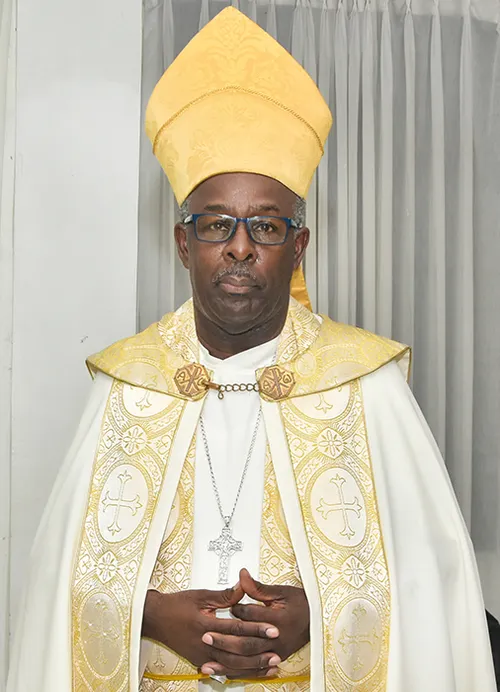
The Bishop of Jamaica has denounced the end of Jamaica’s Cuban medical mission as “ungodly” and “cruel,” warning that poor Jamaicans will suffer as Cuba withdraws its medical professionals from the island after failing to reach new terms with the government of Prime Minister Andrew Holness.
The Rt. Rev. Leon Paul Golding, Bishop of Jamaica and the Cayman Islands, criticized both Washington and Kingston on Tuesday, April 7, at the opening service of the 155th Synod of the Diocese of Jamaica and the Cayman Islands, held at the Cathedral of St Jago de la Vega in Spanish Town. “The actions of the USA against the Cuban people in recent times, … those actions are cruel; they’re ungodly,” Bishop Golding said as reported in The Gleaner, adding that Cuba had been a helpful neighbor and had contributed positively to Caribbean nations despite political differences.
The bishop also faulted the Jamaican government, saying: “It is sad that after 50 years, the relationship that our Government had with the Cuban government to help staff our health sector has ended because of the dictates of a foreign power”. He warned that “with the majority of the Cuban medical professions returning home, the poor will suffer longer delays before being seen and treated by a doctor”.
Cuba’s medical mission in Jamaica has been active for approximately five decades and has become an important part of the country’s public health system, especially in hospitals and underserved communities where staffing shortages have long been a problem. Cuban state media says more than 4,700 Cuban medical personnel have served in Jamaica over the last 30 years, treating more than 8.1 million patients, performing 74,302 surgeries, attending 7,170 births, and saving more than 90,000 lives. Cuba also says its Operation Miracle eye-care program, active in Jamaica since 2010, restored or improved vision for nearly 25,000 Jamaicans.
The current withdrawal affects 277 Cuban medical professionals who had been serving in Jamaica when Havana decided to repatriate the brigade. Jamaica had more than 400 Cuban doctors, nurses, biomedical engineers, and technicians in the country the previous year, while local reporting cited by the Associated Press said nearly 300 Cuban doctors and specialists remained under existing contracts after the prior agreement expired.
The Jamaican government says the breakdown was caused by Cuba’s refusal to agree to terms that would bring the mission into compliance with Jamaican law. Jamaica’s Ministry of Foreign Affairs said its review found that Cuban personnel were not in possession of their own passports and that salary payments, calculated at the same level as Jamaican counterparts, were being paid by Jamaica to Cuban authorities in U.S. dollars rather than directly to the workers. The ministry said only overtime was paid directly to the Cuban personnel and that there was no contractual provision stating what share of the salary payments reached the workers.
Kingston said those arrangements raised serious concerns under Jamaican labor and tax laws and under international labor conventions. The government said it began formal discussions with Cuba in July 2025, made a formal proposal in October, and followed up in December, seeking to continue the program if Cuban medical personnel were paid directly and allowed to control their own travel documents. Jamaica said no substantive response was received from Havana, leaving the existing arrangement legally untenable.
Prime Minister Andrew Holness has said the Cuban Medical Mission was beneficial to Jamaica and that Cuban doctors and nurses had assimilated well into Jamaican hospitals and developed strong bonds with patients. But he said aspects of the program, including how personnel were paid, ran counter to Jamaican law and international conventions, and that Jamaica had hoped changes could be made so Cuban health professionals could continue serving in the country.
Cuba has made overseas medical missions a foreign policy priority for more than six decades, using doctors, nurses, and technicians as instruments of diplomacy, political influence, and economic survival. Havana presents the brigades as international solidarity with the Global South, while the program also generates significant foreign revenue because host governments commonly pay the Cuban state for the workers’ services. In 2024, Cuba’s state newspaper said more than 20,000 Cuban medical professionals were active in more than 50 countries.
Washington has increased pressure on countries participating in the Cuban missions, arguing that the system is exploitative because host countries pay Havana while workers receive only a fraction of the compensation and may lack control of their passports. Cuba has accused Jamaica of yielding to U.S. pressure and said the withdrawal interrupts decades of cooperation that brought “countless benefits” to the Jamaican people (Granma).
The Holness government has left open the possibility of employing Cuban medical professionals individually under Jamaican labor law, rather than through the expired government-to-government arrangement. For Kingston, the issue is not whether Cuban doctors are needed, but whether Cuba can continue a state-run labor arrangement in Jamaica without direct pay, passport control, and contractual transparency for the workers.