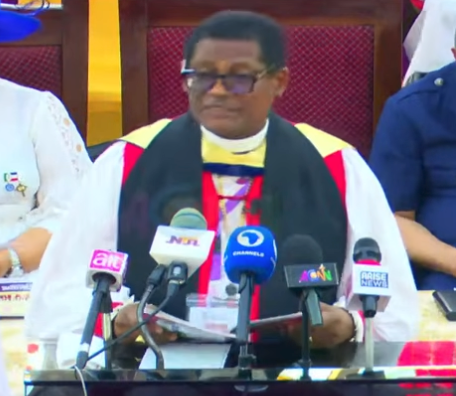
Nigeria should be riding an oil boom. Instead, the Primate of All Nigeria told the Diocese of Abuja that like Esau the country has been selling its birthright for ready cash.
The Most Rev Henry Ndukuba, Bishop of Abuja and Primate of the Church of Nigeria, used his Bishop’s Charge to the First Session of the 13th Synod of the Diocese of Abuja to deliver a wide-ranging address on Nigeria’s economic distress, political disorder, insecurity, and the Church’s theological task. The Synod met at St. James’ Anglican Church, Asokoro, Abuja, from May 14-17, 2026 under the theme “The Priesthood of All Believers: Equipping God’s People for the Work of Ministry,” with 1 Peter 2:4-5 and 9-10 as its text, according to ACNN TV’s official listing of the event.
Archbishop Ndukuba’s address moved quickly from prayer to public life. “The situation in Nigeria seems to defy solution, but we shall not give up,” he said, before adding that God had gathered the Synod “to refresh, empower, lift and lead us forward.” His charge was at once economic, political, and theological: Nigeria’s reforms, he argued, have not yet reached suffering households; the political class is already consumed by the 2027 elections; and the Church must recover the priesthood of all believers if it is to meet the crisis of the hour.
The Primate gave the Tinubu administration credit for some signs of macroeconomic stabilization. He commended “the competence and confidence demonstrated in the management of the economy” and said the “battered condition” inherited from the Buhari administration had been handled by “competent hands.” But he said the gains remain incomplete. “Nigeria’s macroeconomy is showing signs of steady stabilization,” he said, while warning that inflation, even after falling, “is still too high to ease the cost of living and drive growth.”
Official figures support part of that mixed picture. Nigeria’s headline inflation rose to 15.69 percent in April 2026 from 15.38 percent in March, while food inflation stood at 16.06 percent year on year, according to NBS figures reported by Channels Television.
Archbishop Ndukuba said the effect on ordinary Nigerians remains severe: “At this level, inflation continues to erode salaries and pensions and remains the biggest threat to household welfare.”
He also tied the economic pain to unemployment and poverty. “Growth only matters if it translates into jobs,” he said, urging industrialization, agricultural revival, and business expansion alongside information technology. The National Bureau of Statistics’ 2022 Multidimensional Poverty Index found that 63 percent of Nigerians, or 133 million people, were multidimensionally poor, with 65 percent of the poor living in the North.
The most striking part of the charge concerned oil. Global crude prices have risen sharply amid Middle East tensions, but the archbishop said Nigeria has failed to enjoy the kind of windfall available to other oil producers. “Unlike the other oil producers, Nigeria has not benefited from the windfall because of the regime of her pre-sold crude,” he said. “We not only borrow and borrow what our great-grandchildren cannot pay, but we also sell our oil up front.”
Reuters reported in April 2026 that Brent crude rose nearly 3 percent to $108.23 as stalled U.S.-Iran talks and restricted shipments through the Strait of Hormuz kept supplies tight. The higher price environment would normally improve the fiscal position of oil exporters, but Nigeria’s crude-backed financing has complicated the picture. Reuters reported in June 2024 that Afreximbank had disbursed $925 million to NNPC as part of a $3.3 billion prepayment facility secured by crude oil, bringing total disbursements under that facility to $3.175 billion.
Reuters later reported that NNPC was seeking at least another $2 billion oil-backed loan, to be secured against 30,000 to 35,000 barrels per day of crude production.
Archbishop Ndukuba also warned about the politics surrounding crude sales and the Dangote refinery. “The politics surrounding crude oil sales and Dangote refinery should be handled in the interest of Nigerians,” he said. Arise TV, citing NUPRC data, reported that domestic refineries were allocated 61.9 million barrels in the first quarter of 2026, but actual deliveries were only 28.5 million barrels, with the regulator attributing the gap mainly to pricing disputes under a “willing buyer, willing seller” framework.
His criticism sharpened when he turned to China. Archbishop Ndukuba said the “recent handover of the national refineries to China must be reconsidered” and argued that competent Nigerians should be given opportunities to invest and “plow back their gains into Nigeria,” rather than “allow China to loot our oil, just as they have done in the solid mineral sector.” NNPC’s own description is more limited than the Primate’s phrasing: the company said in May 2026 that it had signed a Memorandum of Understanding with Sanjiang Chemical Company Limited and Xinganchen Industrial Park Operation and Management Co. Ltd. toward a possible technical equity partnership for the Port Harcourt and Warri refineries, including completion, operation, maintenance, expansion, and upgrade work.
The China question is part of a wider Belt and Road debate. China’s embassy in Nigeria says Nigeria signed a Belt and Road cooperation agreement with China in 2018 and lists Lekki Deep Sea Port, the Zungeru Hydroelectric Project, the Lagos-Ibadan rail line, the Abuja-Kaduna rail line, the Abuja-Keffi-Lafia-Makurdi road dualization, and several airport terminals among Chinese-enterprise projects in Nigeria.
Energy for Growth Hub says China funds or builds roughly one in five power-generation projects in sub-Saharan Africa, but warns that bundled finance and construction arrangements can weaken host-country leverage unless governments negotiate well and enforce oversight.
The primate’s reference to solid minerals also has an external context. Mining.com reported on a NEITI-ANEEJ study alleging that foreign buyers, particularly Chinese actors, exert disproportionate influence over pricing, purchasing, and export channels in Nigeria’s illegal mineral trade, while noting that the Chinese embassy and Nigeria’s Ministry of Solid Minerals Development did not immediately respond to requests for comment.
The Primate connected economic disorder to insecurity. “Nigeria is bleeding and the lives of our citizens are being wasted,” he said, rejecting language that describes attacks as merely “communal clashes” or “herders and farmers clashes.” He said “Islamization and expansionist land grabbing agenda remain central to insecurity in Nigeria,” along with criminal attempts to seize mineral resources. He called for sustained military action, better protection of communities, and accountability for perpetrators and sponsors.
He was equally blunt about politics. “It is unfortunate that Nigeria has leaders who serve their own interests and work for themselves rather than the citizens,” he said. He accused the political class of abandoning governance for 2027 election maneuvers, while urging Christians to participate in politics “in any party of your choice.”
Yet the charge was not simply a political speech. Ndukuba repeatedly returned to the Synod theme, arguing that “the whole people of God” must be equipped for “the whole task of God to the whole world.” The priesthood of all believers, he said, is not a slogan against ordained ministry but a call to recover the vocation of every Christian. “All believers are therefore priests of God,” he said, adding that priesthood “is a function and not just a bearing of office.”
He urged the Diocese of Abuja to become a functional, missionary Church shaped by Scripture, prayer, fellowship, household discipleship, service, and lay ministry. “Christian maturity is not measured by the gifts that you manifest,” he said. “Christian maturity is measured by your capacity, your ability, your readiness to grow in the fruit of the Spirit.”
Archbishop Ndukuba closed with a missionary warning. Citing Augustine, he said, “As fire exists by burning, so does the Church exist by mission.” When believers stop witnessing, he said, “the church starts to die.”