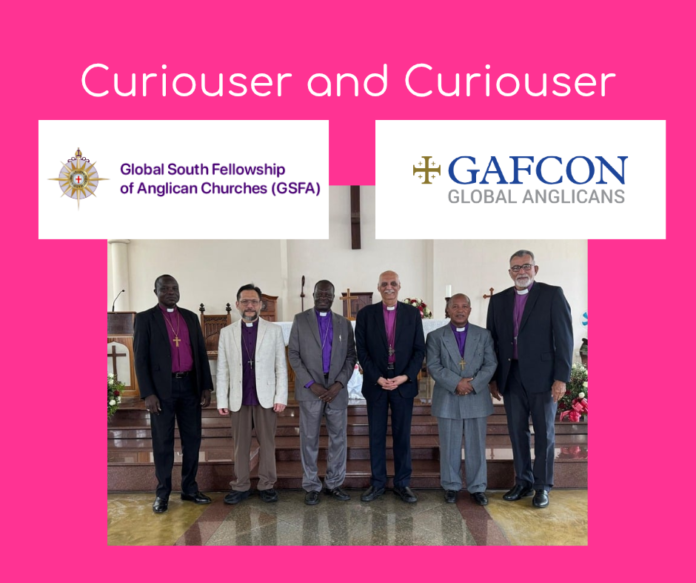
Last week the Primates of the Global South Fellowship of Anglicans (GSFA) met in the Seychelles. It was their first meeting since Gafcon published the Martyrs’ Day Statement in October and their Communique has left many faithful Anglicans scratching their heads.
At first glance it appears that the GSFA and GAFCON may be at loggerheads.
In October, Gafcon announced that they were taking responsibility for the reordering of the Anglican Communion:
- “We declare that the Anglican Communion will be reordered, with only one foundation of communion, namely the Holy Bible, “translated, read, preached, taught and obeyed in its plain and canonical sense, respectful of the church’s historic and consensual reading” (Jerusalem Declaration, Article II), which reflects Article VI of the 39 Articles of Religion.
- We reject the so-called Instruments of Communion, namely the Archbishop of Canterbury, the Lambeth Conference, the Anglican Consultative Council (ACC), and the Primates Meeting, which have failed to uphold the doctrine and discipline of the Anglican Communion.
- Therefore, Gafcon has re-ordered the Anglican Communion by restoring its original structure as a fellowship of autonomous provinces bound together by the Formularies of the Reformation, as reflected at the first Lambeth Conference in 1867, and we are now the Global Anglican Communion.
- Provinces of the Global Anglican Communion shall not participate in meetings called by the Archbishop of Canterbury, including the ACC, and shall not make any monetary contribution to the ACC, nor receive any monetary contribution from the ACC or its networks.”
The Statement went on to say that the details of their plan will be worked out at a meeting of orthodox bishops to be held in Abuja, Nigeria in March, where a new Council of Primates would be formed and a Chairman, who would be the primus inter pares (‘first amongst equals’), in the place of the Archbishop of Canterbury.
In contrast the GSFA appear to reject this approach – stating that it was they who were looking to “re-set” and “reform” the Anglican Communion and that they intended to “engage” with the IASCUFO Nairobi-Cairo proposals. Their Communique says:
- “We lamented the departure from historic Anglican teaching which is now becoming entrenched in the senior leadership of the Church of England. However, we recognise that there are many in the Church of England, united in ‘The Alliance’, who have remained faithful and are offering an increasingly effective resistance to the revisionist agenda. It was a privilege for some of us to be present with over three hundred orthodox leaders in July last year and we assure them of our continued solidarity as they contend for the faith.
- As GSFA we are working to be truly a home for all orthodox Anglicans in which relationship based mission, mutual service, discipleship and practical action to care for one another are the flesh on the bones of our ecclesial structure. GSFA will also continue to engage for the time being with the IASCUFO Nairobi-Cairo proposals.
- Two sessions of our meeting were given to considering a comprehensive Strategic Plan which will enable GSFA to be an increasingly effective instrument for the reform of the Communion. We have in the past written about the need for a ‘reset’ of the Communion and it was achieved in principle by the introduction of the Cairo Covenant in 2019. This created a framework for a process of reformation which is the work to which we are now committed.”
It is understandable then that many see this as a parting of the ways between the GSFA and Gafcon. In particular, the GSFA’s commitment to “engage” with the Nairobi-Cairo proposals put forward by the Inter-Anglican Standing Commission on Unity, Faith, and Order (IASCUFO) has led many to presume that GSFA provinces will attend the Anglican Consultative Council (ACC) in Ireland in June, where these proposials are due to be be discussed. This would clearly go against Gafcon’s call to reject the, “so-called Instruments of Communion.”
Yet, this may be an over-simplistic reading of the situation. Regular readers of this blog will remember that many provinces are members of both Gafcon and the GSFA, as the table below makes clear, and many provinces were not represented at either meeting – with four not offering any public support to either statement.
| Gafcon Primates Council | Covenanted GSFA Provinces + Gafcon Primates | Covenanted GSFA Provinces |
| Anglican Church of Rwanda | Episcopal Church of South Sudan | Church of Bangladesh |
| Church of Nigeria | Anglican Church of the Congo | Province of the Indian Ocean |
| Anglican Church of Kenya | Anglican Church of Chile | Church of the Province of South East Asia |
| Church of Uganda | Episcopal Church of Sudan | |
| Episcopal/Anglican Province of Alexandria | ||
| Church of the Province of Myanmar | ||
| Gafcon Jurisdictions | ||
| Anglican Church of North America | ||
| REACH-SA | Anglican Church of Brazil |
Present in Sydney at the meeting of leaders of Gafcon, which produced the Martyrs’ Day Statement (There are reports that five more Gafcon Primates approved the Statement)
Present in the Seychelles at the GSFA Primates Meeting
Not present in the Seychelles, but signed the GSFA Communique
Present at both meetings
Archbishop Miguel Uchoa, from the Anglican Church in Brazil, which has never been formally accepted by Canterbury, was the only Primate who was both present at the meeting that wrote the Gafcon Martyrs’ Day Statement and a signatory to the GSFA Communique. In an interview with ‘The Living Church’ he played down any controversy, offering a different perspective on the differences between the two statements.
His first point, was obvious, but often gets forgotton – that neither Gafcon nor the GSFA have ever said they are leaving the Anglican Communion:
“It is necessary to remember that all the members of GAFCON, as well as the GFSA, have always stated that ‘we are not leaving the Anglican Communion. In our understanding, those who left the Anglican Communion were the provinces of revisionist theology that abandoned the ‘Cramnerian’ principles that gave rise to this Communion since the 16th century, namely: the 39 Articles of Religion, the Book of Common Prayer, and the Ordinal. Besides the Bible, which is intrinsic.”
It could be argued that Gafcon’s refusal to participate in the ‘Instruments of Communion’ signifies a separation akin to leaving the Anglican Communion but this is not how they, nor the Instruments themselves, have interpreted their actions.
Second, he addressed the fact that the GSFA Communique was silent with regards to the Gafcon Martyrs’ Day Statement, saying that it had been agreed that with only half the GSFA Primates present at their meeting in the Seychelles, “no issues outside the agenda would be discussed”. Instead the Primates focused their attention on preparing, “a strategic plan for the GSFA”. Details of that plan have yet to be published, but it is likely to be focused on encouraging the wider Communion to adopt their 2019 Cairo Covenant.
Which raises the third issue, that of the GSFA’s decision to, “to engage for the time being with the IASCUFO Nairobi-Cairo proposals.” This is unsurprising given that three of those present at the meeting in the Seychelles are also members of the IASCUFO. At the moment it seems that they believe they can have some influence over how the Anglican Communion is organised. Last year the GSFA wrote, “… the GSFA offers to all orthodox Provinces a framework of covenanted relationships, rooted in an explicit commitment to orthodox Anglican doctrine and mutual accountability which we commend to the whole Communion as a matter of urgency.”
At the last ACC meeting IASCUFO wrote that the “proposed covenantal structure of the Global South Fellowship of Anglican Churches… deserves careful consideration.” This sentence is repeated in the current proposals and it therefore makes sense for GSFA to remain engaged while their Covenant is being considered. If, and perhaps when, their Cairo Covenant is sidelined by the wider Anglican Communion, it may be that the GSFA will withdraw their engagement. In that case, the phrase, “for the time being,” is carrying considerable weight.
The GSFA Communique also made no mention about their relationship with the Archbishop of Canterbury-elect, the Rt Revd Sarah Mullally. It can therefore be assumed that they continue to hold the view that they are, “no longer able to recognise the then Archbishop of Canterbury as the ‘first amongst equals’ leader of the global Communion.” If this is the case, it might be that most GSFA Primates will reject future invitations to Primates Meetings called by Archbishop Sarah.
At the end of the day, the different approaches of Gafcon and GSFA is perhaps more about tone and tactics than any real disagreement. As Archbishop Miguel Uchoa has said, “I believe that GAFCON and GSFA can and should coexist with common purposes and different strategies; each of these organizations has a unique calling, but GAFCON, since 2008, has already declared its goal to be the resettlement of the Anglican Communion.”