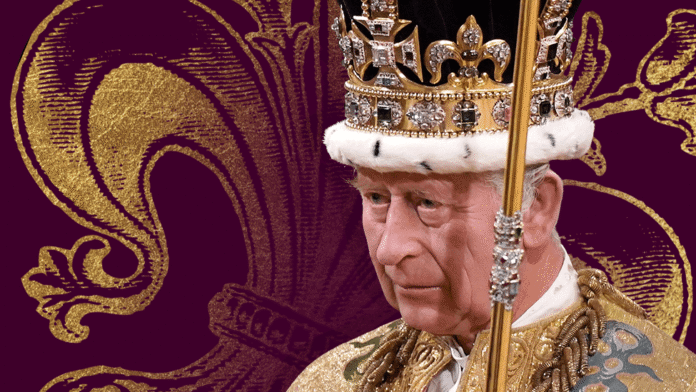
At the service in Westminster Abbey marking King Charles III’s first inauguration of the Church of England’s General Synod, he could face a protest by ‘orthodox members’ refusing to take Holy Communion if they take the advice of campaign group Anglican Futures.
The Church’s media centre has announced: ‘His Majesty The King will inaugurate the newly-elected General Synod of the Church of England at a ceremony in London on Tuesday, November 17.
‘It will be the first inauguration of a new Synod in The King’s reign and first in the Archbishop of Canterbury, Sarah Mullally’s tenure. His Majesty will attend a service at Westminster Abbey before moving to the adjoining Church House, Westminster, where he will address the inauguration ceremony in the Synod chamber. Archbishop Sarah and the Archbishop of York, Stephen Cottrell, will also give addresses.’
Anglican Futures has called for orthodox members to refuse to take Holy Communion at the Westminster Abbey service in a blog titled: ‘What’s the first test for General Synod?’
The blog argues that orthodox members of the Synod have a ‘choice to make’ over taking Holy Communion because if they did, they would be acting as if they were in ‘spiritual fellowship’ with revisionist bishops and LGBT campaigners in the congregation who want to ditch the Church’s biblical doctrine on marriage and sexual morality.
The blog says: ‘It is difficult to think of a more obvious sign of spiritual fellowship than the sharing of the bread and wine. The very bishops who they claim to have no spiritual fellowship with will be present at Westminster Abbey. There will be many in the congregation who are unrepentantly campaigning to tear the doctrine of the Church of England away from its biblical foundations. It will be an “open table”.
‘While the efficacy of the sacrament is not in question, they will need to decide how they register their broken spiritual fellowship. Some may choose not to attend the service at all. But for those who take their seat, the question is whether they will remain in it during the administration of Holy Communion. The alternative will be to go with the flow and receive the bread and wine alongside those they know to be living in sustained open disobedience.’
The blog says orthodox members who stay in their seats during Holy Communion ‘will be in august company. This, after all, was the costly decision taken by the bishops of the Global South Fellowship of Anglicans, at the Lambeth Conference’ [in 2022 during the reign of the King’s mother, the late Queen Elizabeth II].
But how costly would it be for orthodox Synod members to make such a protest at the Westminster Abbey Holy Communion service? Would anyone get arrested or even disbarred from being present at the inauguration ceremony in the Synod chamber or from taking part in the Synod sessions?
What should Synod members do if they have a conscientious objection to taking Holy Communion with flagrant false teachers? Should they go to the service as duly-elected members of the Houses of Clergy and Laity in the General Synod but stay in their seats during Holy Communion?
The attractions are obvious for clergy members of processing in and out in their robes at the inaugural service in Westminster Abbey or for a lay member appearing in a smart suit or ‘winter-wedding’ gear at an invitation-only event in the presence of the King as the Church’s Supreme Governor. But isn’t there a danger of childish exhibitionism or even of a Pharisaic display of piety in making a conspicuous gesture during Holy Communion?
Wouldn’t it be more in line with Christ’s Sermon on the Mount for orthodox members to stay away from the service altogether and to be discreet about it?
Julian Mann, a former Church of England vicar, is an evangelical journalist based in Lancashire, UK.