I. The Church in turbulent times
“Since we are receiving a kingdom that cannot be shaken, let us give thanks, by which we offer to God an acceptable worship with reverence and awe.” (Hebrews 12.28)
We do not need to be persuaded that these are turbulent times. Across Europe, we are living with war and the threat of further conflict, political instability, economic anxiety, migration and displacement, the climate crisis, rapid technological change, and a growing distrust of institutions and of one another.
Many of our societies are becoming more fragmented and public debate more polarised. People are less certain whom to trust, and the future feels less secure.
The Church does not stand outside these pressures. We know disagreement, declining trust, limited resources, changing patterns of belonging, and the temptation to retreat into our own camps.
So the question is not simply: What should the Church say in turbulent times? Perhaps the more important question is: What does it mean to be the Church in such a time?
I want to suggest three things. (1) The Church must be a community that remembers; (2) a community that refuses fear; and (3) a community that makes visible the reconciliation it proclaims in Jesus Christ.
A community that remembers
One danger of turbulent times is that the latest crisis fills the horizon and the latest division seems permanent.
The Church and Christian worship is called to resist that loss of perspective by placing us within a larger story – a story of hope. Whenever we gather around “Word and Sacrament”, we remember that the Church was not born in stability or ease. The Gospel emerged amid empire, violence, persecution and uncertainty, and yet the first Christians dared to confess that Jesus Christ is Lord.
That confession was a reordering of the world. Caesar was not Lord. Violence was not Lord. Fear was not Lord. History was not finally in the hands of those who appeared to possess power.
To be the Church today means inhabiting that larger story of hope: creation and covenant, incarnation and cross, resurrection and Pentecost. The Church belongs to Christ before it belongs to any nation, political culture, ideology or age.
That memory gives us humility, because the Kingdom of God can never simply be identified with one political programme; and freedom, because Christians need not accept the terms of every political argument as though they were the only terms available. We possess another grammar, a Christological one, infused by grace and hope: repentance, forgiveness, reconciliation, neighbour, stranger, communion.
A community that refuses fear
Secondly, Christian hope is not optimism, nor a denial of danger. Christians look honestly at suffering, sin and death. At the heart of our faith stands the cross. But the cross is not the final word.
Fear is one of the most powerful forces in political and social life: fear of the stranger, decline, insecurity, cultural change – ultimately, fear of one another. It can turn communities inward and persuade us that security is possible only through exclusion.
The Church must resist that logic. Not because Christians are naïve about human nature, but because our deepest identity is not constructed against another person. In baptism we receive an identity that precedes nationality, class, ethnicity and political allegiance. We become members of one body – the body of Christ.
The Church should therefore be one of the places where people who would not otherwise choose one another learn to belong to one another. Communion is is the refusal to let disagreement destroy relationship.
A community that makes reconciliation visible
That brings me to the third point. Beyond creating ecclesiastical complexity, more importantly Christian division compromises our witness. If we preach reconciliation while remaining content with separation, something is wrong.
The ecumenical movement therefore cannot be something we only engage with during easier times. Communion across national borders matters when nationalism grows stronger; friendship across political cultures matters when societies polarise; shared baptism matters when identities are increasingly defined against one another.
For those of us gathered within the Porvoo Communion, this has particular significance. Our relationships are much more than simply diplomatic or institutional. We have recognised one another as churches belonging to the one Church of Jesus Christ. We share sacramental life and episcopal ministry in profound ways.
So as well as asking how we preserve these relationships, we must also ask what they enable us to do together. How can our churches speak together about peace, defend the vulnerable, and help our societies rediscover disagreement without hatred? Above all, how can our common life make the Gospel believable?
In turbulent times there is a temptation simply to become louder. Sometimes we must speak clearly and courageously. But our deepest calling is to become more deeply ourselves: to pray, worship, proclaim Christ, serve the poor, tell the truth, refuse fear and remain in communion.
In an unstable world, the Church exists because God is faithful. Whatever storms are raging around us, our task, by the by the grace of God, is to be a sign of the kingdom that cannot be shaken.
II. A vision for the kind of Church we are called to be
“May the God of hope fill you with all joy and peace in believing, so that you may abound in hope by the power of the Holy Spirit.” (Romans 15.13)
What, then, might this mean for the kind of Church I hope we can be in these turbulent times?
I have now been Archbishop of Canterbury for just over six months. Before my installation, I walked from St Paul’s Cathedral to Canterbury Cathedral over six days. It was an opportunity to walk with God, into God, and with others as I made this transition in ministry.
What surprised me was how that ordinary action captured people’s imagination. Walking, praying, meeting people and making the journey publicly seemed to offer a point of access to the Church and, I hope, to God.
At my installation, on the Feast of the Annunciation, we heard the words spoken to Mary: “Nothing will be impossible with God.” They seem especially important when hope appears difficult.
Christian hope is not the conviction that everything will be easy, but that we make this journey with God. We do not bear our calling in our own strength, but by the grace and power of God.
That has increasingly shaped the vision I have for my ministry as Archbishop of Canterbury: to build confidence in the Gospel – confidence that God is at work among us, that the Gospel still speaks to our deepest hopes and fears, and that the Church, for all its frailty, can still be the hands and feet of Christ in the world.
For me, that has several dimensions.
First, I want to be a shepherd of the flock. Leadership must begin with care – for bishops, clergy, congregations and communities. It means taking safeguarding, accountability and the rebuilding of trust with the utmost seriousness; offering calm, consistent spiritual leadership; and leading collaboratively rather than imagining that any one person possesses all the answers.
Secondly, I want us to rediscover hospitality as one of the Church’s great gifts. The Church is called to be a place of welcome and belonging. We will always have disagreements, and our differences will continue to matter. But this spirit of hospitality will enable us to remain in relationship as brothers and sisters in Christ.
If the Church can be a place where people who disagree profoundly nevertheless pray, listen, eat together and remain in communion, Christian hospitality itself becomes part of our public witness.
Thirdly, we have Christian hope to share. I was struck by The Episcopal Church’s description of itself as “a hopeful church, always looking for signs of God’s redeeming love at work so that we might participate in it.”
That is a compelling description of Christian vocation. Hope is omething in which we participate. We look for where God is already at work – healing, reconciling, restoring – and ask how we might join in.
That hope also gives the Church courage to be a faithful and prophetic voice. The Gospel speaks about the dignity of every human being, justice, peace, the use of power and what it means for human beings genuinely to flourish. But our prophetic voice must grow out of our life in Christ, or we risk becoming simply another voice competing for attention in an already crowded public square.
We speak because we have first listened. We act because we have first prayed. We offer hope because we have ourselves received hope.
And all of this has an ecumenical dimension. One of the great joys of these first months has been encountering Christians across the Anglican Communion and across our ecumenical relationships. Again and again I have been reminded how much we need one another.
Visible unity matters because the world needs to see that reconciliation in Christ is more than an aspiration.
The Porvoo Communion already embodies something of this. Communion is something lived in prayer, friendship, shared ministry and the willingness to remain alongside one another. In turbulent times, perhaps we are being called to inhabit it more deeply – and to ask what the communion we have agreed upon in principle now makes possible in practice.
These are not easy times to be the Church. But they may be very important times: rooted in Scripture, tradition and reason; hospitable to those who seek Christ and to one another; and hopeful, looking for signs of God’s redeeming love and having the courage to participate in them. Whatever fears we may have, we are called to one hope.
III. Communion, historic sees and the ministry of unity
“That they may all be one. As you, Father, are in me and I am in you, may they also be in us.” (John 17.21)
I want to end with something rather more explicitly ecclesial.
These first months as Archbishop of Canterbury have made me reflect more deeply on what it means to inhabit an ancient see – and what such a ministry is for.
I say that with considerable humility. The Archbishop of Canterbury is not the head of the Church. Christ is the head of the Church. Canterbury is not the source of our communion. Christ is. That distinction is profoundly important.
There is an image – an icon – which has helped me to think about this: Christ surrounded by his apostles, sometimes called the Tree of Life.
At the centre is Christ. Everything begins with him and everything depends upon him. The apostles are not gathered around an institution or an idea, but around a person. Their unity comes from their common life in Christ.
The image calls to mind his words in St John’s Gospel: “I am the vine; you are the branches.” The branches have life only because they remain in the vine, and they belong to one another because they share the same source of life.
The life is his. The Church is his. Those who stand in apostolic ministry do so only because they remain dependent upon Christ: “Apart from me you can do nothing.”
That must surely be the beginning of any theology of ecclesial office: humility and dependence.
And yet the vine grows.
The Gospel takes flesh in communities, ministries and places. New branches emerge, new Christian communities are formed, and new sees come into being. But the important point is that they grow organically from an apostolic life already received and handed on.
Christ gathers and sends the apostles; the apostolic witness takes root in particular places; communities grow; ministries are handed on; and particular sees come to carry a special responsibility for memory, continuity and communion.
These relationships express the organic and apostolic character of the Church: a living body, growing through time, held together by communion – communion with Christ and, through him, with one another.
Over centuries, particular sees have come to embody particular ministries of memory and communion: Rome, associated above all with Peter and Paul; Constantinople, whose apostolic tradition looks to Andrew; Alexandria, to Mark; and Canterbury, whose story is inseparable from Augustine and the mission sent from Rome to the English people.
The seesreminds us that Christianity is incarnational: the Church has history, memory, places and relationships through which communion is handed on from one generation to another.
In every age and generation, we receive the Church as a gift entrusted to fragile human beings.
The Church’s institutions and leaders can fail; its history contains sin as well as sanctity. Anglican history, too, contains relationships distorted by colonialism and the misuse of power. We should never minimise that. But repentance for the misuse of a gift is not necessarily the same as abandoning the gift itself.
The deeper theological question is: What forms of relationship help the Church remain in communion across difference, geography, culture and time?
And here I want to say something about Canterbury.
Historically, Anglican identity has been expressed in a particular relationship with the See of Canterbury. That relationship has never meant that the Archbishop of Canterbury commands the Anglican Communion. It is not a three-line whip. Nor does it mean that Anglicans must agree with the Archbishop of Canterbury on every theological, ethical or political question.
Rather, I understand the See of Canterbury as a symbol and instrument of communion – not because Canterbury is the source of Anglican unity, for Christ alone is that, but because through history this see has come to embody a particular ministry of memory, relationship and gathering within the Anglican family.
Its vocation is therefore to serve communion: to convene, encourage, reconcile and help us remain in relationship when agreement is difficult.
That is a much humbler claim than leading or dominating. But I think it is also a deeply ecclesial one, because communion becomes visible precisely when disagreement is real and yet we refuse to abandon one another.
There will be times when churches profoundly disagree with Canterbury, and times when Canterbury gets things wrong. But the highest expression of communion is the determination, wherever possible, to remain in relationship, speak truthfully, listen patiently and seek reconciliation rather than separation.
To sever communion should therefore never be easy. If the Church is genuinely an organic body, then the relationships through which we have received the apostolic faith cannot simply be treated as disposable.
A branch does not create its own life; it receives life through its belonging to the vine. And none of us – Canterbury included – possesses that life in ourselves. We receive it from Christ, and therefore receive one another as gifts within his body.
Perhaps this is one of the gifts that the Porvoo Communion can offer to the wider Church.
We should not think of Porvoo is as an exercise in ecclesial absorption. We have not become one institution. Our churches retain their histories, liturgies, cultures and particular gifts. And yet we have recognised one another more deeply. We share the Eucharist. We recognise and interchange ministries. We receive one another as churches within the one Church of Jesus Christ.
It is, in a very real sense, reconciled diversity. And that seems to me important.
I do not believe the Spirit is drawing the churches towards sameness. But I do believe the Spirit is drawing us towards one another.
Church leaders are increasingly discovering that the great questions before humanity call us to greater partnership in mission. The Ecumenical Patriarch has repeatedly called Christians to care for creation. Pope Leo has spoken about human dignity in an age of artificial intelligence. Within the Church of England, we too have been reflecting on artificial intelligence and our responsibility for the environment.
These are different traditions and contexts, yet there is often a remarkable convergence – perhaps because the Spirit is drawing the churches into deeper attentiveness to Christ and, therefore, to one another.
That is why I remain committed to ever closer communion. Not institutional tidiness, or centralisation, or the erasure of legitimate difference.
But a deeper fellowship in Christ: a communion in which ancient sees serve rather than dominate; in which primates, bishops and churches can disagree without walking away; in which our different gifts are received rather than feared; and in which we continue patiently to seek the visible unity for which Christ himself prayed: “that they may all be one.”
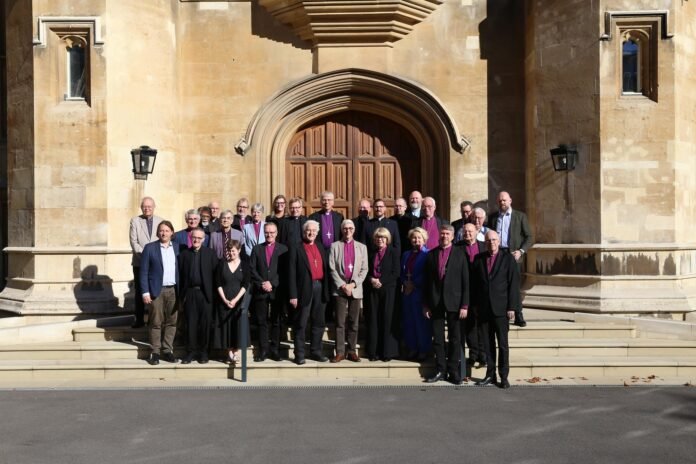
It is a privilege to be speaking with you, the Primates and Presiding Bishops of the Porvoo Communion. Our life together already bears witness to what is possible. We are one because Christ has called us into his body.
He is the vine. We are the branches. The See of Canterbury can only serve unity insofar as it points beyond itself to him. And the closer each of us is drawn to Christ, the closer we are drawn to one another.
Perhaps that is finally our task in turbulent times: rather than anxiously preserving ourselves; or retreating into ever smaller circles of certainty; perhaps our task is to allow the Holy Spirit to draw us ever more deeply into fellowship with Christ, ever more deeply into communion with one another, and through the Son, ever more deeply into the life of the Father.
That is the unity we seek. Instead of uniformity, communion. Instead of domination, service. Instead of separation when things become difficult, the patient work of reconciliation.
And always, at the centre, Christ himself – the head of the Church, the true vine, the one in whom all things hold together.