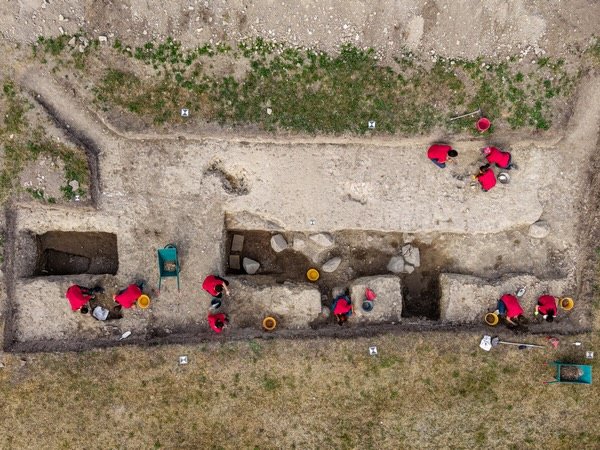
Archaeologists working near Venice have identified what they believe to be the remains of a 1,600-year-old cathedral and an adjoining episcopal palace, resolving a longstanding question about the location of one of the region’s earliest Christian centres.
The discovery was announced on 15 October by Ca’ Foscari University of Venice, following excavations at Altinum, an important Roman settlement on the mainland near the Venetian lagoon. The foundations of a substantial religious complex have emerged from an area where ancient written accounts had long indicated the existence of a cathedral, although its precise location had remained unknown.
The findings suggest that the church was constructed between the late fourth and early fifth centuries AD, making it the earliest Christian church so far identified archaeologically in the Venetian territory. The researchers believe the complex provides physical evidence of the period when Christianity was becoming an important political and administrative force in the declining Roman Empire.
A Cathedral Hidden Beneath a Roman City
The newly identified church was a rectangular structure approximately 30 metres long and 20 metres wide, without an apse and orientated towards the east. Its layout differs from the surrounding Roman street grid, reflecting the religious requirements of the early Christian community.
The architectural arrangement resembles early churches in the northern Adriatic region, particularly those associated with Aquileia, which was an important centre of Christianity during late antiquity.
An adjoining building, distinguished by its substantial foundations and a complex arrangement of internal rooms, has been provisionally identified as the bishop’s palace. Archaeologists believe it may have stood two storeys high, with residential accommodation for senior clergy above rooms potentially associated with privileged burials.
Among the most revealing discoveries is the extensive reuse of stone paving blocks taken from the Roman streets. These materials were incorporated into the foundations of the ecclesiastical buildings, providing evidence of how the city was being physically reorganised during the transition from Roman to Christian administration.
The university’s researchers suggest that the removal of public paving materials may also indicate the authority exercised by the bishop over urban infrastructure. This interpretation would place the emerging Church at the centre of the city’s political transformation.
Ancient Written Accounts Supported by Archaeology
The existence of an early Christian cathedral at Altinum had been documented in letters written by Saint Jerome, one of the most influential Christian scholars of the late Roman period.
Writing in AD 396, Jerome referred to the religious activities of Nepotian, a priest associated with Heliodorus, the first bishop of Altinum. His descriptions included the maintenance of church furnishings, walls, floors and sacred vessels, suggesting an established and relatively prosperous Christian institution.
Until now, however, archaeologists had struggled to connect those accounts to a particular building.
The latest excavations, combining evidence collected during the 2025 and 2026 campaigns, have provided what researchers consider a convincing identification of the ecclesiastical complex.
The excavation is directed by Diego Calaon of Ca’ Foscari University and co-directed by Elisa Possenti of the University of Trento. Their work has brought together earlier archaeological records and newly examined foundations, including sections exposed during investigations in previous decades.
Researchers have also identified a burial area dating from the sixth and seventh centuries. Many graves were disturbed when construction materials were removed from the abandoned complex, but surviving human remains offer opportunities for further scientific investigation.
Radiocarbon dating, anthropological examinations and additional geophysical surveys are planned to establish a more detailed chronology and search for other elements of the religious complex, including its baptistery.
Read it all at EU Today