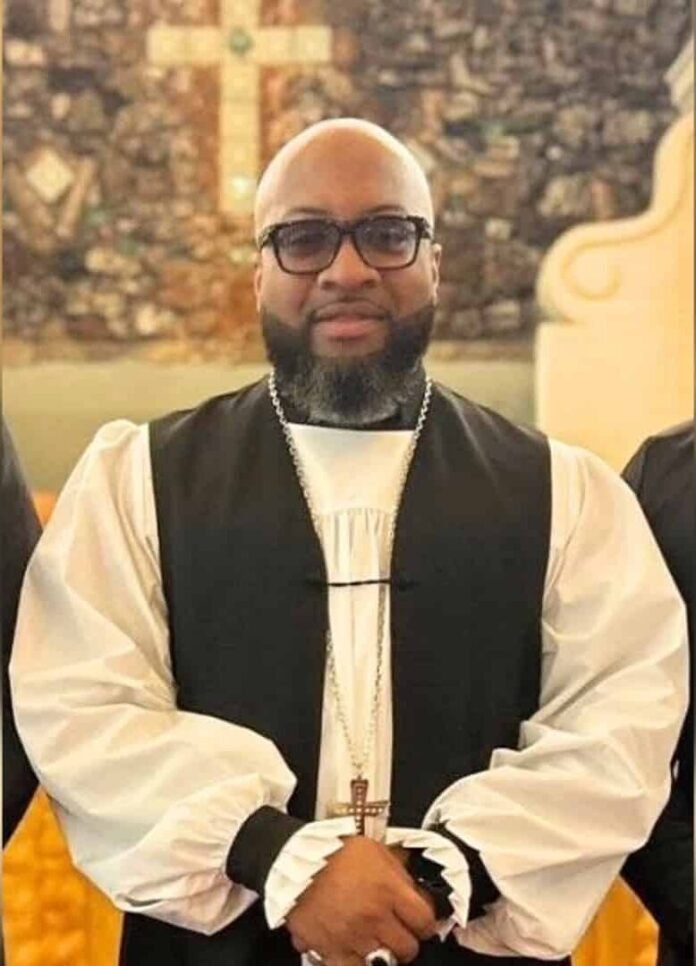
Baptist fellowship removes Missouri leader after child-sex conviction disclosed
The Full Gospel Baptist Church Fellowship International has withdrawn the appointment of a Missouri pastor as its state overseer after learning that he had been convicted in 2008 of second-degree rape of a 12-year-old girl and remains on Missouri’s sex-offender registry.
In a statement released this month, the fellowship’s international presiding bishop, the Rt. Rev. Joseph Warren Walker III, said Dr. Timothy D. Price III had offered his resignation from his proposed role as Overseer of the State of Missouri. The resignation was accepted with immediate effect, and Price was barred from holding jurisdictional or auxiliary leadership roles in the fellowship.
Price remains senior pastor of First Baptist Church City of St. Louis, a decision Bishop Walker said lies beyond the fellowship’s jurisdiction because its member congregations are autonomous.
“The safety of children and the integrity of pastoral leadership are sacred, non-negotiable priorities of this Fellowship,” Bishop Walker said. “When we fall short of that standard, as we did here, the responsibility rests with me as Presiding Bishop.”
The controversy comes as Anglican and other episcopal churches have faced renewed scrutiny over clergy discipline, safeguarding, and the limits of institutional accountability. In the Anglican Church in North America, the disciplinary proceedings involving Archbishop Steve Wood have brought questions of episcopal oversight, due process, the handling of allegations, and public confidence in church governance to the fore. Although the Full Gospel Baptist Church Fellowship is structurally different from the ACNA—and its congregations retain autonomy over their pastors—the Price case raises a related question: whether church systems possess clear, enforceable mechanisms to prevent those with serious histories of abuse from holding positions of spiritual authority and public trust.
Price had been slated for installation as Missouri State Overseer on 16 September. The proposed elevation became public after reporting by The Roys Report drew attention to his criminal record and continuing registration as a sex offender.
According to contemporaneous reporting cited by several outlets, Price, then 31 and serving as music director at Bethel A.M.E. Church in Baltimore, pleaded guilty in May 2008 to second-degree rape arising from sexual activity with a 12-year-old girl. He was sentenced in August 2008 to seven years’ imprisonment.
The public statement supplied to Anglican Ink says the fellowship had not been aware of Price’s 2008 conviction or registered-offender status when it made the appointment. Bishop Walker said he acted immediately once apprised of the information, spoke personally with Price, and accepted his resignation.
The fellowship has said Price “will not be allowed to serve in any jurisdictional or auxiliary positions” within its structure. It also said it would strengthen background screening at the state, regional, and international levels and institute continuing accountability reviews for persons holding positions of trust.
The circumstances in which fellowship leaders learned of Price’s record have become a matter of public dispute.
First Baptist Church City of St. Louis has said Price did not conceal his criminal history when he affiliated with the fellowship. In a public statement, the congregation said that the regional bishop responsible for considering Price’s elevation had been “fully informed,” that Price had disclosed the matter when the leadership opportunity arose, and that the regional bishop had nevertheless chosen to proceed. The church further maintained that the issue was revisited as social-media attention increased.
Bishop Walker has stood by his assertion that he personally had not been told of the nature or seriousness of Price’s history before the proposed appointment was announced. He acknowledged, however, that not all leaders involved in preliminary discussions had the same information at the same time.
The regional official said by First Baptist to have received the disclosure, Bishop Edward Houston Stephens Jr., declined comment when contacted by *The Roys Report*. The differing accounts have not been independently resolved.
First Baptist has continued to support Price’s local pastorate, saying he served his sentence, remains in compliance with registry requirements, has lived without subsequent offenses, and has expressed remorse. The church has also acknowledged that “redemption does not erase consequences” and that grace does not dispense with safeguards.
The dispute illustrates a recurring problem across American Christianity: the uneven exercise of authority in churches that combine episcopal titles and regional structures with congregational autonomy.
The Full Gospel Baptist Church Fellowship International has a presiding bishop, regional bishops, and state overseers, but does not possess the comprehensive canonical authority over local congregations found in episcopal churches such as the Anglican Church in North America, the Episcopal Church, the Roman Catholic Church, or the United Methodist Church. Bishop Walker could remove Price from fellowship-wide and jurisdictional leadership, but he could not remove him as pastor of First Baptist Church City of St. Louis.
In a traditional Anglican or Episcopal setting, a cleric’s suitability for ministry ordinarily falls under the direct authority of a bishop and the disciplinary processes of a diocese or province. Clergy licensing, background checks, safeguarding requirements, and canonical discipline are intended to prevent a minister from simply moving between congregations or jurisdictions after serious misconduct becomes known.
The effectiveness of such systems, however, rests on consistent implementation, transparent disclosure, reliable inter-jurisdictional communication, and the willingness of bishops and church institutions to put the protection of children before reputational or institutional concerns.
Bishop Walker’s statement drew a distinction often obscured in church debates over forgiveness and office. “Redemption through Christ does not erase consequence,” he said, adding that grace does not exempt anyone—including a presiding bishop—from accountability.
That distinction lies at the center of modern safeguarding practice. Christian repentance, forgiveness, and pastoral care may be offered to any penitent person, but restoration to public ministry—particularly ministry involving authority, visibility, pastoral access, or contact with children—is a separate question. It calls for assessment of risk, compliance with civil law, clear boundaries, independent oversight, and the protection of the vulnerable.
First Baptist Church City of St. Louis, founded in 1817 and widely identified as the oldest African-American church west of the Mississippi River, must now determine whether its own governance and safeguarding obligations require further action concerning its senior pastor. The fellowship’s action has settled the question of Price’s denominational advancement, but not his continued local ministry.
The Full Gospel Baptist Church Fellowship International has said it is revising its vetting procedures. Whether those reforms include mandatory disclosure requirements, registry checks, outside safeguarding review, and written standards governing eligibility for ordained and lay office will be the practical test of the fellowship’s pledge that such a failure not be repeated.