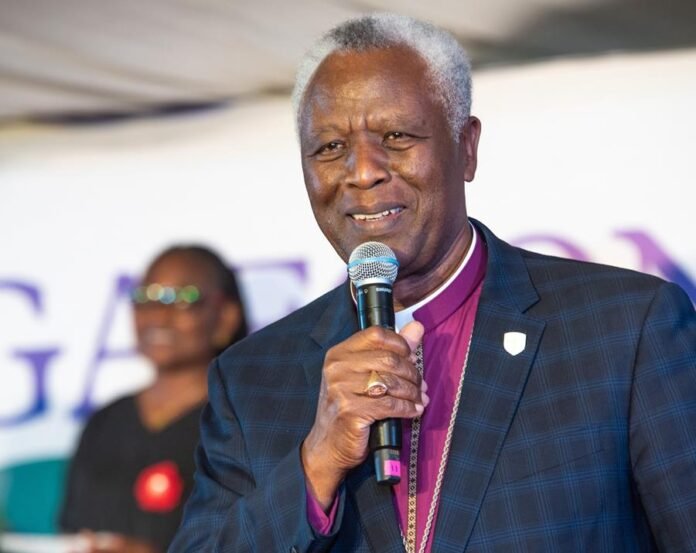
The House of Bishops of the Province de l’Eglise Anglicane du Rwanda (EAR) is to meet today (11 September 2026) to elect the fifth Archbishop and Primate of the province, choosing a successor to the Most Rev. Dr. Laurent Mbanda, who steps down after seven years at the helm of the 13-diocese province and as the international standard-bearer of the Gafcon movement.
Three diocesan bishops meet the canonical requirements to stand: the Rt. Rev. Manasseh Gahima of Gahini, the Rt. Rev. Nathan Rusengo Amooti of Kigali, and the Rt. Rev. Assiel Musabyimana of Kigeme. Under the constitution of the EAR, a candidate must be between 55 and 60 years of age and must have served at least five years as a diocesan bishop. The election is conducted in a closed session of the House of Bishops, which votes from among its own number before the result is announced.
Archbishop Mbanda, 71, had been due to retire at 65 in 2019 but was granted an extension by the province — an accommodation, colleagues say, that allowed him to complete the reordering of Rwandan diocesan life, to steady the province through the Mugisha affair in Shyira, and to lead Gafcon through the tumult of the Canterbury succession. He confirmed the election date in a message to the province on Sunday, 6 September 2026, and asked Rwanda’s Anglicans to pray for the House of Bishops as it deliberates.
An African archbishop of international consequence
Born in Rwanda in 1954 and raised in exile in Burundi, Laurent Mbanda took his early theological training at Kenya Highlands Bible College before completing graduate work in missiology at Fuller Theological Seminary, a Master of Arts at Denver Seminary, and a doctorate at Trinity International University in Deerfield, Illinois. Before his consecration in March 2010 as Bishop of Shyira, he served for many years as a vice president of Compassion International, where he built the child-development ministry’s African programme and cultivated the relationships with North American evangelicalism that would mark the rest of his ministry.
He was elected the fourth Archbishop and Primate of the EAR on 17 January 2018 at St. Étienne Cathedral, Kigali, chosen from a field of five candidates to succeed the Most Rev. Onesphore Rwaje. His enthronement on 10 June 2018, at which he also became Bishop of Gasabo, drew thousands to Kigali, including Prime Minister Édouard Ngirente and a large delegation from the wider Communion.
At home, Archbishop Mbanda oversaw the continued expansion of the province’s diocesan structure, the consecration of a new generation of bishops — among them the bishops of Butare, Cyangugu, and Shyogwe — and the enlargement of the EAR’s educational, health, and development ministries through partners such as RDIS. In September 2024 he was elected President of the Rwanda Inter-Religious Council, succeeding Bishop Filipo Rukamba of the Catholic Diocese of Butare, and became the public face of Rwanda’s inter-faith engagement with the government during a period in which the state was rewriting the regulatory framework for religious bodies.
His tenure was not without controversy. The suspension in 2024 and subsequent criminal conviction of the former Bishop of Shyira, the Rt. Rev. Samuel Mugisha Mugiraneza — following a diocesan forensic audit and a Rwanda Investigation Bureau inquiry into alleged misuse of diocesan funds — divided opinion inside and outside the province. The archbishop and the House of Bishops have consistently maintained that the discipline followed the canons of the province and that the criminal proceedings are a matter for the Rwandan courts. Retired Bishop Alexis Bilindabagabo publicly urged clemency; the primate declined to be drawn.
Gafcon and the shape of a global Anglicanism
Archbishop Mbanda’s international stature grew in tandem with his provincial work. A supporter of Gafcon from its founding conference in Jerusalem in 2008, he was elected vice-chairman of the Global Fellowship of Confessing Anglicans in 2019 and, on 21 April 2023 at Gafcon IV in Kigali — the largest gathering of orthodox Anglicans since 2018, hosted at his own cathedral — he was elected the movement’s third chairman, succeeding the Most Rev. Foley Beach.
He was not present at the closing Eucharist that announced his election. Two days earlier he had flown to the United States on the sudden death of his son Edwin (“Eddie”), aged 33, in Philadelphia. That his colleagues nonetheless entrusted him with the chairmanship in his absence was a measure of the confidence he enjoyed among the primates.
From that chair he steered Gafcon through its most consequential season. Under his signature, the fellowship in October 2025 announced its intention to “re-order the Anglican Communion,” instructing member provinces to disengage from Instruments of Communion presided over by Canterbury and to align themselves with a “Global Anglican Communion” bound by the Jerusalem Declaration of 2008. In March 2026, at the G26 meeting in Abuja, Nigeria, the Gafcon Primates Council was dissolved and reconstituted as the Global Anglican Council — a body including bishops, clergy, and laity — and Archbishop Mbanda was unanimously elected its first chair. Archbishop Miguel Uchoa of Brazil was chosen as vice-chair and Bishop Paul Donison as general secretary; the council’s officers will serve until Gafcon’s next major gathering, in Athens in 2028.
The Abuja communiqué stopped short of electing a rival primus inter pares to the Archbishop of Canterbury — a step some delegates had expected and others feared — leaving Archbishop Mbanda as the recognised leader of what Gafcon now calls the Global Anglican Communion, while formally allowing that Dame Sarah Mullally holds the See of Canterbury. That careful settlement, more than any single statement, has been the hallmark of his chairmanship: a willingness to press the argument for orthodox reform while declining the shortcut of open schism.
His public interventions on the appointment of the first female Archbishop of Canterbury, on the Church of England’s Prayers of Love and Faith, on the Jones affair in ACNA, and on a succession of disputes across the Communion have been consistent in substance and, by the standards of the age, restrained in tone. He has been a pastor first and a polemicist rarely.
The succession
The three candidates before the House of Bishops on 11 September represent the settled centre of the EAR. Bishop Gahima of Gahini, a former principal of the Byumba Bible School, has taken a leading role in evangelism and clergy formation in the eastern province. Bishop Rusengo of Kigali, previously of Cyangugu, brings administrative experience in the capital diocese and long service on provincial commissions. Bishop Musabyimana of Kigeme, consecrated in January 2018 in the same season Archbishop Mbanda was elected primate, has led one of the province’s most missionally active dioceses in the south-west.
The archbishop-elect will be enthroned in due course as Bishop of Gasabo as well as primate — the two offices having been held in tandem since the province’s re-organisation. He will inherit a province at once stable and stretched, a seat on the Global Anglican Council, and the moral inheritance of a predecessor who took the EAR from a Rwandan story into the front rank of world Anglicanism.
Anglican Ink will report on the outcome of the election as it is announced from Kigali.