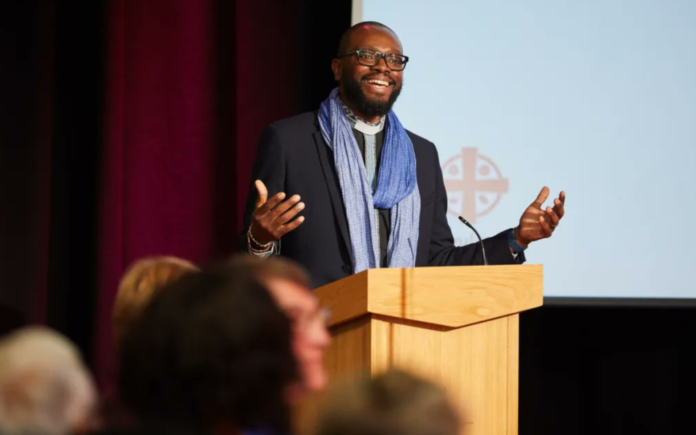
When 20,000 people gathered for the “Standing Strong: Extinguish Antisemitism” rally on Whitehall in May, they may not have been expecting to be hearing from a senior Church of England official. But Lusa Nsenga-Ngoy, Lead Bishop for interfaith engagement, gave a stirring and impassioned speech on the dangers of Jew-hate and where they can lead.
“Antisemitism possesses a particular persistence and ubiquity that demands moral clarity”, he told the crowd.
“It mutates. It survives. It appears across the political spectrum and feeds on fear, grievance, and division. And perhaps most dangerously of all, it grows when public voices choose outrage over responsibility; when influence is used not to strengthen the social fabric, but to tear it apart; when platforms capable of shaping culture become instruments for scapegoating, mockery, and suspicion.”
He went on to say that “when public figures trade in conspiracy, humiliation, and division, they do not merely inflame opinion; they corrode the moral foundations of a nation. Leadership that profits from division is not courage. It is recklessness. And rhetoric that dehumanises any community ultimately threatens every community.
“History teaches us with terrifying consistency that when antisemitism rises unchecked, democracy itself begins to decay.”
Two months later, the Church held its annual Synod, at which a specific motion, on the plight of Palestinian Christians, was scheduled for a vote. The motion included a document known as Kairos II, which among other things, claims Zionism is a settler-colonial movement built on “Jewish supremacy” and with genocidal intent, and urges Christians worldwide to refrain from any dialogue with “Zionists” –precluding any discussion with a significant majority of Jews.
Despite warnings from British Jewish religious and lay leadership, the Synod voted overwhelmingly in favour, albeit with a decision to “hear” it rather than to “receive” it – a difference widely viewed among British Jews as mere semantics. Chief Rabbi Mirvis referred to the vote as “shameful”, and “a sad day for Jewish-Christian relations.”
Bishop Lusa, who moved from the Democratic Republic of Congo to Belgium as a child, later entering the priesthood, was not at the Synod himself – he is not a member – but he was watching closely. He noted that a Synod vote about Palestinians had been “delayed for a number of years” and felt that the Church had therefore been “trying to do a multiplicity of things at once…I think personally that it was unfortunate that the Kairos II document was included in that motion.”
He elaborated further, describing the document as “problematic”.
Read it all in the Jewish News