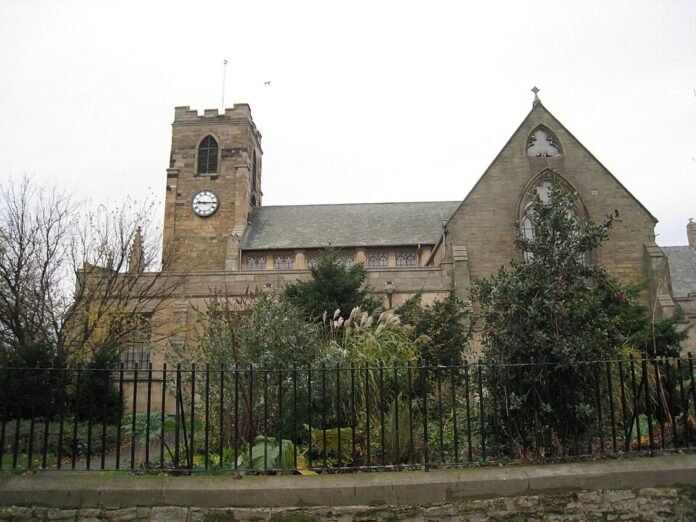
Sunderland Minster has posted a sign in the colors of the transgender flag on its women’s toilets declaring that “all women,” including transgender women, are welcome to use them — and has said the sign will stay, notwithstanding new statutory guidance that single-sex facilities must be designated by biological sex. The Diocese of Durham, in a statement published 29 May 2026, said the Minster had not consulted it and that the two bodies are separate legal entities.
The sign appeared following the UK Supreme Court’s ruling in April 2025 that “sex” in the Equality Act 2010 means biological sex. It returned to public attention on 21 May 2026, when Equalities Minister Bridget Phillipson laid the Equality and Human Rights Commission’s draft Code of Practice before Parliament. The Code, which reinforces the Supreme Court’s definition, directs that single-sex toilets, changing rooms, and hospital wards be designated on the basis of biological sex. It is subject to a 40-day parliamentary scrutiny period before it can take effect.
Sunderland Minster, a Grade II* listed building in Tyne and Wear and a member of the Inclusive Church Network, posted the following statement on its Facebook page after the EHRC Code was laid before Parliament:
“This sign was displayed in the minster following the Supreme Court’s narrow biological definition of sex last year. As an Inclusive Church, we found the implications for our transgender brothers and sisters unacceptable. Now that the updated EHRC code of practice has reinforced that definition, we want to affirm that the sign will remain. If you are uncomfortable using our restrooms knowing that transgender women are welcome, please feel free to ask one of our clergy or volunteers, who will happily accompany you and wait outside the stall until you have safely used our facilities.”
The post was subsequently removed from Facebook. It had already attracted widespread attention — and ridicule — before its deletion.
Rev Canon Clare MacLaren, Canon Provost of the Minster, defended both the sign and the church’s legal position. She said the EHRC Code “was laid before Parliament on May 21, 2026, and will only come into effect 40 days later,” and cited a provision of the Equality Act 2010 that “the code does not impose legal obligations.” The Minster was not, she argued, in breach of the law.
On pastoral grounds, she said:
“We believe that transgender men and women have as much right to privacy, dignity and safety as cisgender men and women. The limited toilet facilities in our Grade II* listed building are difficult and costly to adapt, however they all have cubicles, as do any public toilets. The only shared space is for hand-washing. As a church, we take our safeguarding responsibilities to all vulnerable adults and children extremely seriously. Our transgender and gender non-binary worshippers and friends at the Minster are very vulnerable and fearful of abuse. I regret that some individuals feel threatened by them.”
Canon MacLaren added that if the Code is ultimately adopted into law, the Minster’s governing body would be consulted on next steps. She is listed as a speaker at a Trans Rights Sunderland rally on 14 June, billed as “a Christian priest, mother of an adult trans son, and community leader in Sunderland.”
A diocesan spokesperson said:
“Last year, the Church of England published a resource document encouraging local churches to take a pastoral approach to all the complex and often sensitive issues which have to be considered in the light of the Supreme Court’s April 2025 judgment concerning the legal definition of sex. This resource is kept under review. Churches in the Diocese of Durham are indeed encouraged to demonstrate care for all people while ensuring that they abide by the law in their policies and practices. The Diocese is ready and willing to support parishes as they interpret the recent EHRC guidance in their own contexts, and understands the challenges that many churches have when accommodating current legislative requirements in their often historic, listed buildings.”
The statement continued:
“Sunderland Minster had not consulted the Diocese of Durham about this matter, and Sunderland Minster and the Diocese of Durham are separate legal entities, each with their own governing board of trustees who are responsible and accountable for their own actions and communications.”
The Diocese neither endorsed nor condemned the Minster’s position, but the disclosure that the Minster acted without diocesan consultation — paired with the insistence that parishes must abide by the law — represents a pointed institutional distancing.
Maya Forstater, Chief Executive of Sex Matters, told The Times the Minster was exposing itself and others to legal liability.
“Sunderland Minster is brazenly and foolishly encouraging people to break the law with this sign, and offering a patronising compromise to women who want the law upheld for the sake of their privacy, dignity and safety.”
Forstater argued that any woman using the facilities could have grounds for a harassment claim against the Diocese, and questioned the framing of the Minster’s offer of a chaperone: “Instead of offering to escort women who don’t want to share facilities with men, why not offer that service to trans-identifying males who may be uncomfortable using the men’s toilets?”
This is not the first time Sunderland Minster has attracted controversy. In early 2025 the Minster was criticised for draping a Progress Pride flag over its altar — a display that drew objection on the grounds that Church of England courts had previously ruled the flag was not a Christian emblem and should not appear in that position.
The Minster’s membership in Inclusive Church, which describes its mission as “visibility, affirmation, and advocacy for LGBTQI+ folk” and commits to “challenging patriarchal structures and biases,” places it at the progressive end of the Church of England’s unresolved debate on sexuality and gender.
The controversy lands in a charged local moment. Sunderland City Council, now controlled by Reform UK, announced this week that it will not fly the Pride flag from City Hall — a decision that drew protests from LGBT charities ahead of Pride events in the city this weekend. A Church of England minster openly defying the EHRC in the same city, in the same week, sharpens a cultural and political contest that shows no sign of resolution.