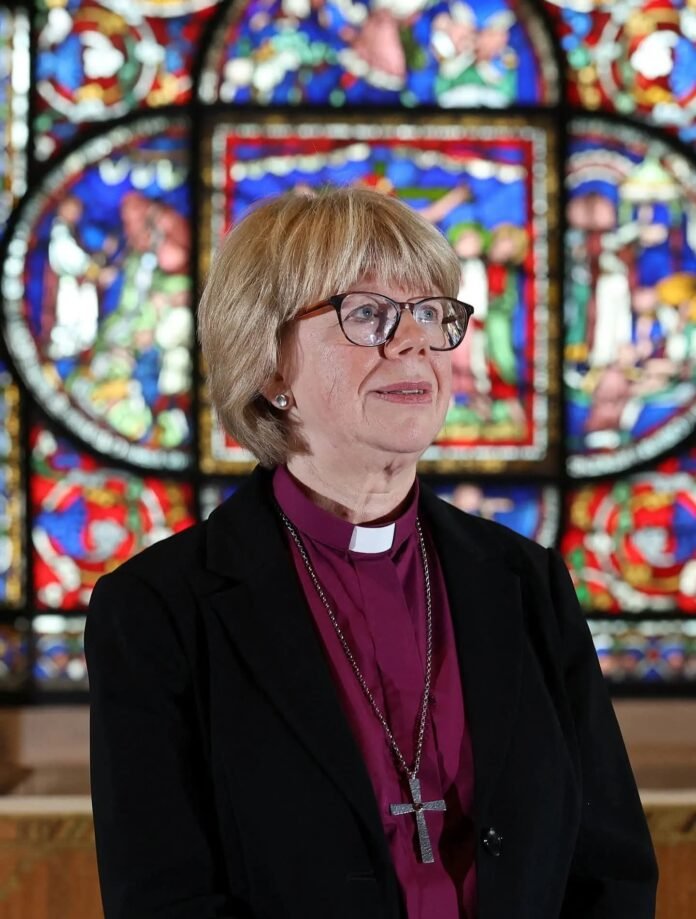
Sarah Mullally is to be the 106th Archbishop of Canterbury, which has upset a number of Christians, especially in the Anglican community here and abroad, and particularly in Africa. Though if you aren’t a Christian, you may be confused as to why many are unhappy with the appointment. Most of the negative commentary is either written for a church audience, and hence does not explain precisely why this statement or that stance is such a problem, or it attacks her identity politics and lack of charisma — charges that could just as easily be made about a non-Christian selected to run a public body.
But for Christian believers, the Church of England isn’t simply a Quango headed by a state functionary. The theology, integrity and gender of the incumbent are key parts of what it means to lead the Anglican communion, which is why there has been such an issue with her appointment.
Let us take some of the issues in turn, starting with the most obvious point of difference from her predecessors: her gender.
Women’s ordination didn’t just arrive last Friday; the Church of England first ordained women in 1994, and first consecrated female bishops in 2015. The appointment of a female archbishop arguably makes things hotter for those within the church who oppose all such ordinations, but they have found workarounds so far and will probably continue to do so. But since Mullally has put the issue back in the spotlight, let us consider it.
In the life of the church, 1994 is extremely recent. For nearly all of church history, women’s ordination was unknown. Partly this is because of extremely plain statements in the Bible. As Paul the Apostle puts it in 1 Timothy 2:12, “I do not permit a woman to teach or exercise authority over a man.” This command has been subject to any number of creative re-readings over the last few decades, but it still stubbornly says exactly what it seems to be saying. Consequently this is a straightforward matter of obedience, which Mullally (along with her enablers, male and female) is not obeying. This is a problem for one who claims to be a servant of Christ.
The fiercest fights in church history have not historically been over ethics or power but over the identity of the God we worship
The issue, however, is deeper than a single arbitrary rule. In fact, the rule is not arbitrary. The Bible is a realist about sex, unlike our modern culture: God created it, it is good, and so men and women are different, and both are good. In particular, men are made to govern and women are made to nurture. The interplay of the two sexes is beautiful; the overthrow of the distinction leads to all kinds of chaos. Societies which attempt to treat men and women as interchangeable are setting themselves up for problems they cannot solve and cannot understand.
It goes deeper still; the interplay between men and women is an echo of the love between God and the church, with God in the masculine role. Church leaders are his representatives as he speaks to his bride. Their masculinity is part of their representation. To ordain women is to lose some of our understanding of the love of God — a thing the church cannot very well do without.
Same-sex blessings
Mullally has been closely involved with the so-called “Prayers of Love and Faith”, proposed marriage-like prayers for same-sex couples. When PLF was approved she described it as “a moment of hope” for the church, leaving little doubt as to her own opinion. It is this position, rather than anything about the ordination of women, that has caused the most consternation from conservatives. GAFCON and GFSA, two large alliances in the worldwide Anglican Communion, both speak of it as a key driver for continued suspension of ordinary relations with Lambeth.
Once again the history of the church is instructive; any kind of acceptance of same-sex unions was unknown to Christianity before about the last hundred years, and has only found widespread traction in about the last thirty. (Of course, popes, televangelists and many others have had their moral failings, but these were always recognised as failings and a subject of scandal when revealed.) And once again this is in part because of extremely plain statements in Scripture. Such behaviour is an “abomination”; those who practice these things “will not inherit the kingdom of God”. There is a famous story about Sodom and Gomorrah with which you may be dimly aware. Scripture is at pains to point out that this sin, like all others, will be forgiven for anyone who repents; but it is a sin, and forgiveness does require repentance. (Of course, for all the creative reinterpretations that have flourished here as well, the real reason for the church’s shift is evident to anyone with half a brain: the culture moved, and the church wanted to move with it.)
Here there is an important difference from the issue of women’s ordination. While Scripture is clear on that topic, it is silent on its precise seriousness; most conservatives would not suggest that disobedience around women’s ordination is necessarily the death of faith. But the matter is very different with sexual immorality (of which same-sex unions are of course only one example); here God repeatedly warns us that unrepentant disobedience means judgement. To our culture, obsessed with sex and thereby cheapening it, this seems a strange overreaction. In reality, however, God could hardly do otherwise. Sex is deeply significant, the closest you can get to another human being and therefore an act with enormous power. Any parent can testify to its life-giving strength; any victim of sexual abuse, to its destructive force. God takes it seriously because it is serious.
Mullally, and all those in the Church of England who share her stance, is therefore not only disobedient, but a false teacher. She encourages others to do things that will lead to their destruction. Jesus describes such teachers not as sheep or shepherds but as wolves.
Calling the Holy Spirit “She”
Of all the issues with Mullally, however, arguably the most serious is one which has received relatively little attention. In prayers from last year, she speaks of the Holy Spirit as “she”. While Mullally herself does not appear to use this language often (one hopes for her sake that these prayers were an ill-thought-through one-off), the usage reflects a push in the church towards “inclusive language” about God.
The immediate error here has already been highlighted. While God is the creator of sex and therefore beyond sex in himself, God is masculine towards us. Male and female are specifically created to give us this image. To switch these pronouns is to reinvent mankind’s relation to God. But behind this error is a far deeper one that has nothing at all to do with gender.
Read it all in The Critic