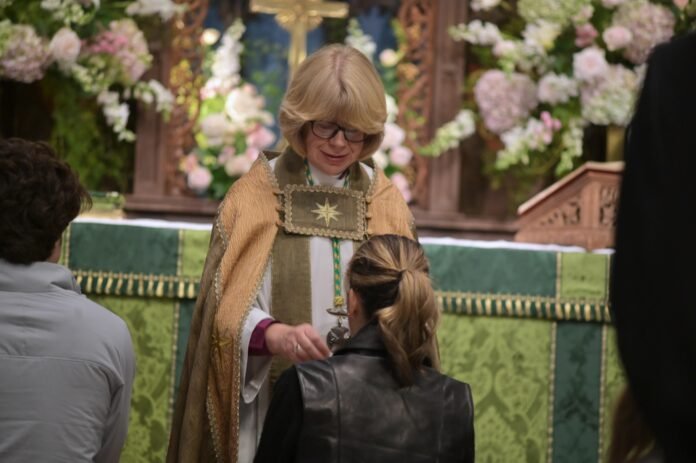
It is a real joy to be with you this morning. Thank you, Revd Marek, and all your team, for the kind invitation to share with you in worship here at Christ Church Greenwich. Thank you, Bishop Jeff and Bishop Laura for your generous hospitality in welcoming me here in your Diocese and for sharing your ministry with me.
May I speak in the name of God, Father, Son and Holy Spirit. Amen.
‘At the name of Jesus every knee should bend, in heaven and on earth and under the earth, and every tongue should confess that Jesus Christ is Lord’ (Philippians 2:10–11)
During my visit to Burundi this summer for the Installation of Archbishop Eraste, as the Primate, we greeted one another on the runway. We were welcomed by an incredible display of Burundian drummers. The drummers of Burundi are recognised by UNESCO on the list of Cultural Heritage. Traditionally, a royal drum used to welcome Kings and Queens, the drummers greeted us. They danced, jumped, and sang traditional poetry and songs of welcome and blessing. It was inspiring – and incredibly loud. To stand on that tarmac, with my brother Archbishop-elect, on the eve of his Installation, was incredibly moving. As he prepared to offer himself to God as shepherd of his people, in a country with a rich heritage but one that is named among the poorest in the world, I stood there and prayed for him. I too recalled my own recent Installation and experienced a powerful sense of God’s extravagant blessing: a blessing that is showered on each one of us, even in the midst of the poverty of what we, I, or any of us have – the poverty of what we can offer God. God blesses us.
I was struck by the humility of Archbishop Eraste as he sought to follow Jesus, to bend his knee in worship and confess Christ as Lord. Later we shared communion at the altar following his Installation he asked to receive God’s blessing. I had a profound sense of our brother-and-sisterhood in Christ, our common desire to follow the way of Jesus and our shared hope to witness all creation confess that Jesus Christ is Lord.
More recently, I visited a parish church near Leicester, in the heart of England, as part of a Diocesan visit. At the church, early in the morning, a wonderful thing called ‘Muddy Church’ took place – children and families gathered to worship outside; they share in crafts using natural materials, they read stories, they talked about Jesus and then gathered under canvas to pray and sing together: the community are fondly known as the ‘Muddy Saints’. And as I sat in the tent, seeing the children pray and sing so joyfully, I had the same profound sense of our shared faith and our common desire to confess, amidst all creation and the messy, muddiness of life, that Jesus Christ is Lord.
Whether we come at faith from the joyous eruption of drumming on the runway in Burundi – or from the simplicity of a tent in a field in Leicester, we are called to the same humility before Jesus. Whether we are muddy saints or new Archbishops, Jesus invites us to do the same, to be people who seek the Kingdom of God and his righteousness.
In our Gospel reading today, people struggle with Jesus’ authority – ‘By what authority are you doing these things, and who gave you this authority?’ It is clear that Jesus posed a threat to those in positions of power and influence – not by lording it over them, but because he uprooted their understanding of what authority and power look like – what those in authority should do; whom they should eat with, and with whom they should associate.
It is a lesson in expectations of privilege and authority, of deference and honour, and of the misuse of power for personal gain, and false declarations of deference and allegiance for show. Jesus uses his authority in this account not to shame or lord it over those who are trying to accuse him – but to bring to light the things that are hidden, and to reveal the dynamics of the Kingdom of God.
The ‘Song of Humility’ in Philippians, Chapter 2, gives poetic form to these dynamics of the kingdom:
Though he was in the form of God, he did not regard equality with God as something to be exploited, but emptied himself, taking the form of a servant, being born in human likeness. And being found in human form, he humbled himself and became obedient to the point of death— even death on a cross.
For the early church, these words may have served as an early credal statement, spoken or sung communally, as an affirmation or declaration of faith in Jesus Christ. It is a description of Jesus that resonates both with the incarnation, the humble birth of Jesus and the first revelation of that birth to the shepherds and the sages; with the image of Jesus kneeling at the feet of his disciples in the hours before his own betrayal and arrest, to wash the feet of those he came to save, and, most poignantly, with the self-giving love of God revealed on the cross.
For the writer of this song of faith, this description of humility is not one that denigrates, but rather establishes a rightly-placed authority, the servant-hearted love of Christ. This is the humility of Jesus: the servant king who washes the feet of his disciples; the rabbi and teacher who sits and eats with tax collectors and prostitutes; the anointed, holy one who humbles himself, becoming obedient to the point of death, even death on a cross. To this Jesus, rightful praise and authority are to be given:
Therefore God also highly exalted him and gave him the name that is above every name, so that at the name of Jesus every knee should bend, in heaven and on earth and under the earth, and every tongue should confess that Jesus Christ is Lord, to the glory of God the Father.
As I experienced the common call alongside my brother Archbishop Eraste; and as I recognised in the tent with the Muddy Saints in Leicester – our fellowship at the table, or in prayer and worship, also has the potential to be remind us of our shared humanity in Jesus Christ. We ‘bow the knee together in heaven and on earth’, confessing with one voice ‘that Jesus Christ is Lord.’
As St Paul writes, so powerfully: ‘Therefore, my beloved… work out your own salvation with fear and trembling; for it is God who is at work in you’. When we approach the table of the Lord, to receive from our Lord’s hand that which he sacrificed for us, we do so from the same level of the bowed knee, the humble-thankful heart, working out our own salvation with fear and trembling – knowing that God is at work in each one of us.
As our world grapples with the challenges of authority and power on a global stage, affecting communities caught up in armed warfare; as we witness the catastrophic effects of climate change and the imbalance of resources to address these disasters; as we see churches strive to be kingdom-people in a global economy that bows before wealth and fame; so we desperately need to hear the song of humility echoing down through the ages once again.
Jesus is questioned: ‘By what authority are you doing these things?’ and the answer we receive is in the Song of Humility: ‘though he was in the form of God, he did not regard equality with God as something to be exploited; but emptied himself, taking the form of a servant’. Jesus’s authority flows from this servant-hearted authority.
As followers of Jesus, Paul invites us to do the same: ‘therefore, let the same mind be in you that was in Christ Jesus’ – ‘be of the same mind, having the same love, being in full accord and of one mind. Do nothing from selfish ambition or conceit, but in humility regard others as better than yourselves. Let each of you look not to your own interests, but to the interests of others.’ We are called to cultivate this Christ-like model of humility and authority.
At my Installation in Canterbury on the Feast of the Annunciation, the scripture readings reminded us that as a Church, we are a pilgrim people, who, like Mary, are called to trust in the words of the Angels, that ‘nothing will be impossible with God’. Those words are particularly important when we see so much in the world that makes hope seem impossible.
As I reach my six-month milestone in the role of Archbishop of Canterbury, I am learning what this Christ-like model of humility and authority looked like. What a certain-hearted leadership means. As you would expect, there have been ups and downs, great joys and also challenges. My hope, my call as the Archbishop of Canterbury, is to be rooted in my desire to nurture confidence in the Gospel. That confidence was equally visible as I shared bread and wine with my brother Archbishop Eraste as it was when I sang and prayed with the Muddy Saints in Leicester.
And this is the confidence that we share, that God is at work among us and that God’s church, are his hands and feet in the world. God calls us to love mercy, to walk humbly, to act justly – trusting in Jesus our servant-king.
We have a story of hope to tell. The Episcopal Church says, ‘We are a hopeful church, always looking for signs of God’s redeeming love at work, so that we might participate in it’. It is a joy to see this hope in you today. It is a joy to share with you in worship, side-by-side with you in prayer and humble service, as we together proclaim with one voice, that at the name of Jesus every knee shall bend, in heaven and on earth and under the earth, and every tongue should confess that Jesus Christ is Lord, to the glory of God the Father.
Amen.