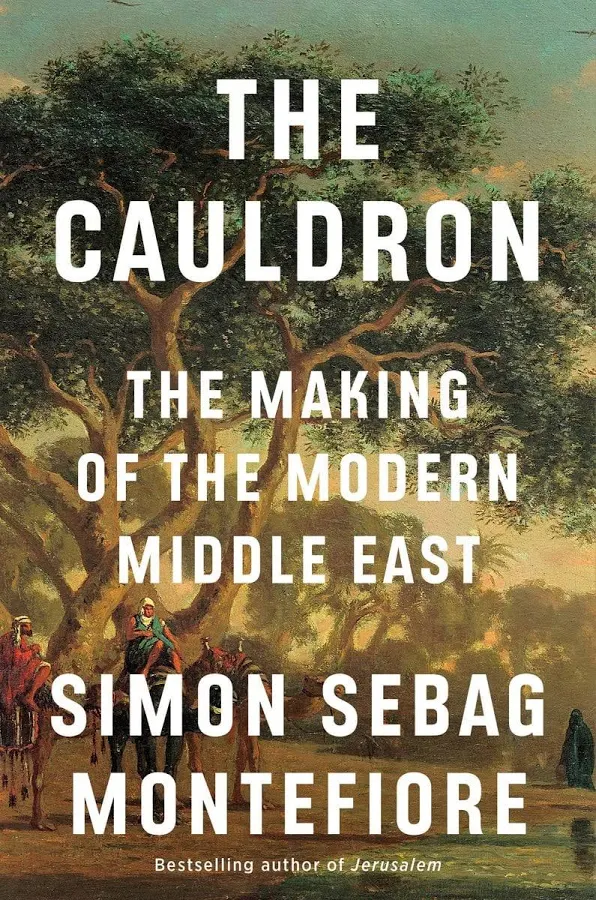
The Cauldron, The Making of the Modern Middle East by the British Jewish historian, Simon Sebag Montefiore, is an astonishing achievement because of the number of countries whose histories the book distils since 1900.
The press release from publisher Weidenfeld & Nicolson includes a militarily concise summary by General David Petraus, a former director of the CIA:
‘Masterful. In The Cauldron, Montefiore brings extraordinary narrative power and scholarly depth to the making of the modern Middle East, tracing the region’s turbulent evolution from empire to ideology, and from revolution to war. Ranging from Morocco to Iran, and from 1900 to the present, this is history at its best – richly told, unsentimental, and essential for understanding the forces that continue to shape one of the world’s most consequential regions.’
Montefiore sets out his aim in his introduction to ‘depict both the beauties and the perils of this astonishing, diverse and kinetic region – its potential for disaster and mayhem unparalleled, but its creativity and centrality also holding out hope of new alignments and auspicious conjunctions’.
With his flair for story-telling about the various individuals who shaped the modern Middle Eastern nations, swashbucklers, such as Prince Abdulaziz Al Saud, whose daring raid on Riyadh in 1902 led to the creation of Saudi Arabia, and brutal despots, such as the Ottoman butcher, Pasha Jemal, who terrorised Jerusalem in the First World War, Montefiore succeeds in that aim.
For a British historian, he is refreshingly alive to the spiritual dimensions of the task he set himself: ‘It is impossible to write about the Middle East without at least some interest in the nature of holiness, the human craving for a link to divinity through cults that shape and enforce consolingly ritualistic lives and places where God is perceived to be closer to man.’
He declares that ‘one of the greatest tragedies has been the decades-long purge of Christians’ in the Middle East.
He writes: ‘Thanks to Arab nationalism and Islamist terror, Middle Eastern Christians have declined from 20 per cent in 1900 to 4 per cent today. In 1900 Christians were 14 per cent of Iraq’s population; now they are 0.4 per cent; in 1900, a million Christians, today 150,000.’
In his conclusion he expresses his aspiration for a less war-torn future for the region, a hope based on the relationships he has built with ‘many people amongst the sects and nations of all nineteen countries’ in the course of writing this ‘daunting book’:
‘Amongst Iranians, Israelis, Palestinians, Sudanese, Lebanese and so on, there is still hope – not the folly of that delusional optimism that often leads to more bloodshed – but the toughness of hope in a noble project that may take generations to build.’
He muses: ‘Ignorance is the father of righteous certainty, hatred and slaughter; knowledge is the mother of respect for others, alliance, sharing and tolerance. Knowledge is an elixir, the antidote to the poisons of supremacy, bigotry and ignorance. Peace is only possible when a majority in any society hears and accepts the narrative of others. That is the mission of this book.’
So, this is a good book by a good man. But it needs to be stated that any history of the Middle East is inevitably overshadowed by the spiritual grandeur and moral seriousness of the Old Testament history books, such as 1 and 2 Kings, which cover mostly the same geographical area.
The heights of the sacred history are simply beyond the power of any secular historian to scale. But Montefiore’s book is nonetheless a magnificent public service because of the crying need for the education it offers.
The Cauldron, The Making of the Modern Middle East was published in the UK by Weidenfeld & Nicolson on August 25th AD 2026 at £25 in hard back. It is due to be published in the United States on September 29th at $40 – ISBN:9780593805053.
Julian Mann, a former Church of England vicar, is an evangelical journalist based in Lancashire, UK.