A risque joke about a priest and a nun, told by a ruling-party politician at a national political assembly and falsely attributed to the Book of Psalms, has ignited a storm of protest from Christian leaders across Malaysia, casting a shadow over the country’s Malaysia Day celebrations on 16 September 2026 and exposing the fragile state of religious relations in a country that prides itself on managed pluralism.
The controversy erupted on 12 September 2026 when Datuk Noorazli Said, the Sepang Division chief of the United Malays National Organisation (UMNO) and treasurer of its Selangor chapter, told the joke at the party’s 2026 annual general assembly. UMNO is the dominant component party of Malaysia’s ruling Barisan Nasional coalition and the traditional political vehicle of Malay Muslim identity.
The joke, which circulated rapidly on social media after being filmed at the assembly, involves a Catholic priest driving a manual Proton Saga — Malaysia’s best-known national car — who spots a nun waiting at a bus stop and offers her a lift home. Each time the priest changes gears, his hand brushes against the nun’s thigh. Each time, the nun reminds him to recall Psalm 129, and each time the priest withdraws his hand.
Upon arriving home, the priest opens his Bible to discover what Psalm 129 actually says. Noorazli’s punchline, delivered to laughter from the assembly floor, was: “Go forth and seek further up and you will find glory”.
The line does not appear in Psalm 129, which speaks of the affliction and deliverance of Israel. Noorazli subsequently explained that he had used the story as an analogy to illustrate “the importance of focus, perseverance, and wisdom in achieving a goal,” and that it was never his intention to insult any religion. He had been praising the political wisdom of UMNO president Ahmad Zahid Hamidi at the time.
Church leaders, legal bodies, political figures from across the spectrum, and Malaysia’s own National Unity Minister have condemned the remarks with unusual unanimity. Within the ruling party, the reaction was sharp. Umno Youth chief Dr Akmal Saleh called for an immediate apology, pointedly asking: “Imagine if it was an imam”. Sabah UMNO leaders, whose constituency includes the largest concentration of Christians in Malaysia, demanded an unqualified public apology. Unity advocate Tan Sri Lee Lam Thye warned that jokes mocking religious figures risk “fraying the nation’s social ties” and undermining Malaysia’s social harmony.
The Catholic Bishops’ Conference of Malaysia (CBCM), through its president, Kuching Archbishop Simon Poh, described the joke as “hurtful to the Catholic community,” noting that priests and nuns are held in high esteem within the Church. Speaking in a Malaysia Day message that the incident had forced into unwanted territory, Archbishop Poh said jokes demeaning religious figures “have no place in any official assembly in Malaysia” and called on Malaysians to “guard against prejudice and reject divisive political and religious language”.
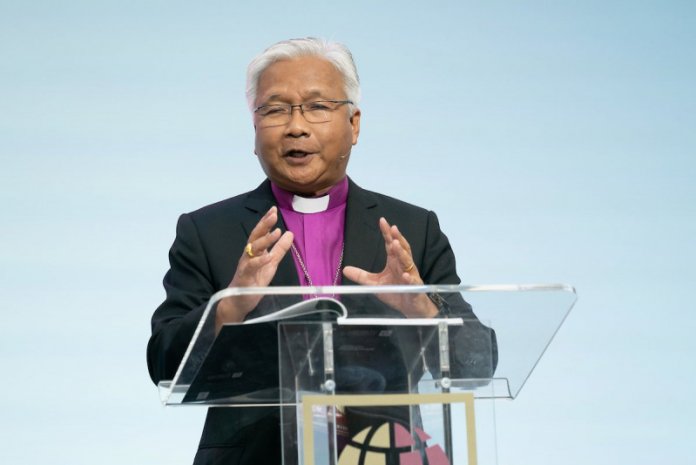
The Association of Churches in Sarawak (ACS) chairman, the Rt. Rev. Datuk Danald Jute, Anglican BIshop of Kuching, objected to the politician’s language as demeaning and a danger to communal relations.
“Sacred Scriptures and consecrated religious figures of all religions are not material for cheap political comedy, nor should they ever be abused as props to score fleeting political popularity,” he said, urging politicians across party lines to avoid rhetoric that disparages any faith, saying Malaysia needed “peace, healing, understanding and genuine unity” rather than religious division.
Bishop Jute also urged Christians to respond to the controversy without hatred or malice.
“Let us not respond with hatred or malice but with love and truth,” he said.
The Anglican Church in Malaysia — the Church of the Province of South East Asia — sits within the same embattled Christian minority that has reacted with such force to Noorazli’s remarks. Christians comprise approximately nine per cent of Malaysia’s population of 33 million, concentrated significantly in the East Malaysian states of Sabah and Sarawak, where many of the most vocal political reactions have originated.
The Province of South East Asia covers Malaysia, Singapore, Indonesia, Nepal, and Cambodia. Its Malaysian dioceses — West Malaysia, Sabah, and Kuching — operate in an environment in which religious speech is closely regulated, conversion from Islam is legally prohibited in most states, and the use of the word “Allah” by non-Muslim publications has been the subject of protracted litigation. In that context, a sexually charged joke about Christian clergy told to applause at the national assembly of the country’s largest Muslim political party is not merely an embarrassment to be managed — it is a live signal about the respect, or lack of it, that the Christian minority commands in Malaysian public life.
Noorazli’s response has satisfied almost nobody. His initial social media statement offered to apologise “if” offence had been caused — a conditional construction that opposition lawmakers and church leaders alike identified as no apology at all. DAP lawmakers rejected it explicitly. The Catholic Federation said it rang hollow. Whether authorities will act — and whether UMNO’s leadership will require more of its Selangor treasurer than a grudging conditional expression of regret — will test the Anwar Ibrahim government’s stated commitment to national unity.
The incident is, at one level, a low-grade political embarrassment: a minor party official at a party assembly making a poor decision in pursuit of a cheap laugh. But the ferocity of the reaction, and the breadth of those who have felt compelled to respond, reflects something larger than one man’s lapse of judgment.
Malaysia’s model of managed religious pluralism has always depended on a degree of mutual restraint — the willingness of the Muslim majority to treat the symbols, clergy, and sacred texts of minority faiths with public respect, and the willingness of minorities to accept significant legal disadvantages in the expectation that social peace will be maintained. When a politician uses a national party platform to deploy Christian religious figures in a lewd joke and then offers a non-apology apology, that compact is strained.
For Malaysia’s Christian communities that have learned over generations to be careful, patient, and theologically disciplined in their public advocacy — the question the Noorazli affair poses is simple: how much does the dignity of their clergy, their scripture, and their faith actually count on the Malaysian national stage?
On Malaysia Day, at least, the answer was not encouraging.