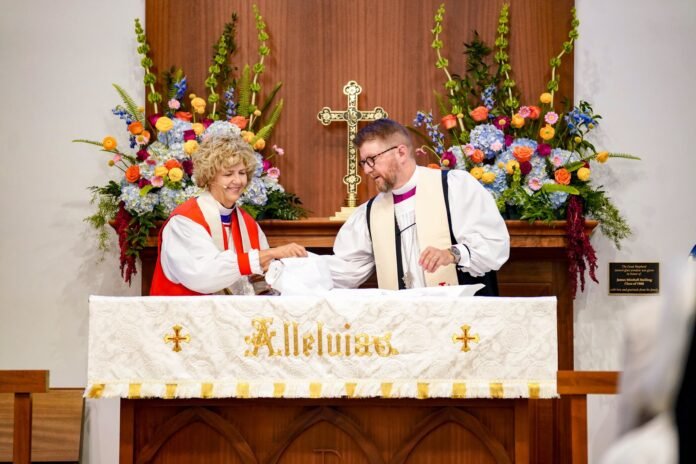
The controversy arising from the August 18 dedication of St. Timothy’s Chapel at Porter-Gaud School has been instructive, though perhaps not in the manner its loudest participants intended.
A chapel was blessed. Bishops from two Anglican jurisdictions appeared in the same service. Photographs were taken. Social media did what social media does: it discovered a crime scene, appointed itself prosecutor and judge, and began passing sentence before breakfast.
The event involved the Rt. Rev. Chip Edgar, bishop of the Anglican Diocese of South Carolina, and the Rt. Rev. Ruth Woodliff-Stanley, bishop of the Episcopal Diocese of South Carolina. Both serve as trustees of Porter-Gaud, one of Charleston’s oldest independent schools. The school occupies an awkward but not unprecedented institutional space: it has lived through the divisions of South Carolina Anglicanism, has relationships across the present ecclesiastical divide, and has leaders drawn from more than one jurisdiction.
The Rev. Palmer Kennedy, Porter-Gaud’s Anglican chaplain, preached. The Eucharist was reportedly celebrated by the Rev. David Madison. Bishop Edgar and Bishop Woodliff-Stanley participated in the service and chapel dedication. Accounts of the event and the photographs circulated afterward indicate that both bishops distributed Communion.
There is enough in that description to justify questions. There is not enough to justify the more extravagant claims now being made.
It is possible that the service was imprudent. It is possible that its visual and sacramental symbolism was confusing. It is possible that Bishop Edgar should have anticipated that the appearance of an ACNA bishop and a TEC bishop in vestments, acting publicly in proximity to the altar and distributing Communion, would be understood as saying more than anyone intended to say.
Those are matters worthy of episcopal reflection.
They are not, without more, proof that Bishop Edgar has abandoned ACNA’s doctrine, repudiated its separation from The Episcopal Church, entered into a new communion with TEC, or committed a canonical offense.
Yet that is where much of the discussion has gone.
The theology of the photograph—and the clothing
The internet is a marvelous instrument for many things. It permits families to see children, parishes to communicate, journalists to find documents, and scholars to bludgeon one another, smiting them high and thigh, over obscure points of Anglican lore.
It is less effective at ecclesiology. It is particularly poor at vesturology, a subject on which many online observers have discovered strong convictions only after enlarging a photograph.
Yet, in this instance, the vestments are not a trivial detail.
Photographs are powerful. They can capture an expression, an action, a symbolic gesture, or an arrangement of persons in a way that produces an immediate impression. They can also mislead—not necessarily because they are false, but because they are partial. They record a moment, not an entire service; an image, not an intention; a public action, not the full ecclesial and institutional context in which it occurred.
But liturgy is visible theology, and vesture is part of liturgy. What a bishop wears and holds says something about the role he is undertaking.
In the Anglican inheritance, the rochet and chimere are the traditional components of a bishop’s choir dress. The normal accompanying garment is the tippet, the black preaching scarf associated with the Daily Offices and with a bishop’s presence in choir dress. The tippet is not a stole. It is not, in itself, a eucharistic vestment. It signals something different: the minister’s participation in the Church’s daily worship, preaching, or ceremonial life rather than his exercise of a specifically eucharistic ministry.
A stole says something different.
The stole is an ordained minister’s liturgical vestment. It is the garment most commonly associated with the exercise of priestly or episcopal office in sacramental rites and, in contemporary Anglican practice, with eucharistic worship. The distinction is not always applied with mechanical uniformity in every Anglican jurisdiction. Bishops have sometimes worn a stole with rochet and chimere at confirmations, baptisms, marriages, and other solemn acts. But the distinction remains intelligible, historically grounded, and symbolically important. A tippet says “choir dress.” A stole says “liturgical ministry.”
This distinction matters at Porter-Gaud.
If Bishop Edgar appeared in rochet and chimere with a eucharistic stole rather than the customary tippet, the dress itself compounded the ambiguity of the occasion. He was not dressed simply as a bishop attending, preaching at, or offering a prayer in an Office-like service. He appeared in a form of vesture that, whatever his private intention, could readily be understood as signaling participation in a eucharistic act.
When that vestural signal was combined with the presence of an Episcopal bishop, a eucharistic liturgy, public action in the sanctuary, the distribution of Communion, and a heavily symbolic shared chapel dedication, it is not difficult to see why Anglicans concluded that the service said more than its organizers may have intended.
The point is not that a stole over rochet and chimere is unknown in Anglican practice. It is not. Nor is the point that Bishop Edgar’s clothing proves that he meant to declare sacramental fellowship with TEC. Vestments do not furnish a complete transcript of the wearer’s theology.
But vesture is not neutral. If a bishop wishes to communicate the distinction between Christian collegiality and eucharistic communion, he must take care not to blur the distinction with the very symbols entrusted to his office.
In this case, the mismatch of choir dress and eucharistic stole and the sharing of a crozier made a complicated situation worse. It turned what might have been explained as institutional courtesy and common Christian prayer into an event whose visual grammar suggested shared sacramental ministry.
That was, at minimum, sloppy liturgical communication.
It may have been imprudent. It may have been needlessly confusing. It may warrant a private correction, an explanation, and clearer provincial guidance for the future.
But it does not, by itself, establish that a bishop has committed a canonical offense. A badly chosen vestment is not a presentment. An unfortunate symbolic message is not, without further evidence, apostasy. And a liturgical muddle—even a conspicuous one—is not license for the social-media constabulary to conduct a public auto-da-fé.
Fellowship is not full communion
The Church has long possessed more than two categories for describing relations with other Christians. It is not necessary to choose between full sacramental communion and treating one’s neighbors as heathens. There is more to it than sheep and goats.
There is common baptism. There is ordinary Christian fellowship. There is common prayer. There is friendship. There is shared work in schools, hospitals, charitable institutions, and civic life. There is theological dialogue. There is cooperation in the defense of the vulnerable or the relief of suffering. And there is, at the far end of the spectrum, full ecclesial and eucharistic communion.
These things are related, but they are not interchangeable.
Anglicans have historically recognized this reality, even when they have been vigorous defenders of doctrine and church order. The Chicago-Lambeth Quadrilateral was not an invitation to theological indifference. It named the Holy Scriptures, the historic creeds, the dominical sacraments, and the historic episcopate as a basis for the pursuit of visible Christian unity. Its very existence assumed that divided Christians have an obligation to seek a unity grounded in the apostolic faith.
The Thirty-Nine Articles are clear. Article XIX teaches that particular churches may err, even seriously. It does not teach that all error erases every Christian reality within an erring body. The Reformation Anglicanism of the Articles was not naïve about Rome, yet it did not require Anglicans to say that Roman Catholics were beyond the category of Christian neighbor.
The New Testament is still less accommodating to the pleasure some Christians take in denouncing others.
Our Lord prayed that those who believed in him might be one, “so that the world may believe” that the Father had sent him. St. Paul urged Christians to maintain the unity of the Spirit in the bond of peace, while confessing one body, one Spirit, one Lord, one faith, and one baptism. In the same letter, he instructed the Church to speak the truth in love.
Truth and love are not competing departments of the Christian faith, allotted to different parties in an ecclesiastical quarrel. They are commands given to the same Church.
A person who says that doctrine matters is right. A person who says that communion has consequences is right. A person who says that bishops should be careful what their public liturgical actions signify is also right.
But the person who says that Christian courtesy is treason, that every mixed institutional setting is an ecumenical betrayal, and that a disputed act must be treated as a proven canonical crime is not exhibiting greater fidelity. He is exhibiting less judgment.
Canon law for the impatient
The most overheated feature of the controversy has been the sudden discovery of canon law by people who seem to believe it functions like a pistol: point it at someone, pull the trigger, and a verdict issues forth.
Canon law is not a social-media bludgeon.
ACNA’s disciplinary canons identify specified offenses and establish procedures for addressing them. A bishop may be accused of false doctrine, abandonment of communion, dereliction of duty, conduct unbecoming a cleric, scandalous conduct, or other defined acts. But the accusation must be more than a mood. Someone must identify the relevant canon, establish the facts, and demonstrate how the conduct meets the standard of the law.
The charge must then be considered through the Church’s appointed process.
That may sound tiresome to those who prefer the efficiency of a viral post. It is nevertheless how law works. The alternative is not spiritual clarity. It is arbitrary power.
A bishop is not guilty because a commentator says that he is guilty. A photograph is not a presentment. A thread of mutual congratulations among the like-minded is not a court of competent jurisdiction. And a demand for public repentance is not a substitute for proof.
The point is not that bishops should be immune from scrutiny. On the contrary, bishops are properly held to a high standard because their actions bear a public and representative character. The question is whether that scrutiny will be conducted honestly.
If someone believes Bishop Edgar violated a specific ACNA canon, he should say which canon and explain how the known facts satisfy it. If someone believes the conduct was misleading but not canonical, he should say that. If someone believes the Province’s current rules do not provide sufficient guidance, he should ask the College of Bishops to provide it.
But the habit of treating the accused as guilty until a satisfactory public abasement has been achieved is neither Anglican nor Christian.
It is merely boorish.
The proper criticism
There is a sound criticism of the Porter-Gaud service, and it is more compelling than the rhetoric of outrage.
The Eucharist is the central sacramental act of the Church. It is an enacted confession of unity in faith and order. In a context where ACNA and TEC are not in communion, an ACNA bishop should be particularly cautious about actions that could reasonably be understood as expressing mutual eucharistic recognition.
That caution extends to vesture. In Anglican usage, rochet and chimere are the traditional marks of a bishop in choir dress, ordinarily accompanied by a tippet. A stole, by contrast, is the more usual sign of ordained sacramental and eucharistic ministry. The distinction is not always mechanically applied across every Anglican jurisdiction and rite, but it is sufficiently well established that it cannot be treated as meaningless.
A bishop wearing a stole over rochet and chimere in a eucharistic setting is communicating something different from a bishop in choir dress with a tippet. At Porter-Gaud, that visual message sat alongside the involvement of a TEC bishop and the reported distribution of Communion. It was precisely the sort of accumulated symbolism likely to lead ordinary Anglicans to infer a shared eucharistic fellowship that ACNA does not recognize.
The question, then, is not whether Bishop Edgar intended to repudiate ACNA’s convictions. There is no evidence that he did. The question is whether the service’s visible form—including the roles of the bishops, the distribution of Communion, and the choice of eucharistic rather than choir-office vesture—was likely to create confusion about the state of relations between the two jurisdictions.
That is a serious pastoral and ecclesiological question. It becomes more serious in South Carolina, where the division of the diocese was not an abstract constitutional event but a rupture experienced in parishes, schools, families, and friendships.
Bishop Edgar has acknowledged that the event and its photographs caused pain and confusion. He has affirmed that ACNA’s differences with TEC are substantial. He has sought the counsel of the College of Bishops concerning the boundaries appropriate to such situations.
That is a more responsible response than either defiance or evasion.
Bishop Edgar has accepted the criticism that he erred, and has asked the College of Bishops to offer him correction and counsel. The College should now provide clarity. It should address the practical distinctions between common prayer, institutional cooperation, Eucharistic participation, the distribution of the Sacrament, joint episcopal action, and the use of vesture that may imply a degree of communion ACNA does not recognize. It should recognize that schools, chaplaincies, charitable organizations, and legacy institutions will sometimes include Christians from churches not in full communion. And it should establish guidance that helps bishops act with both theological integrity and pastoral wisdom.
This would be useful not because the Church needs more rules for the pleasure of having rules, but because unclear expectations leave everyone vulnerable to misunderstanding.
The harder discipline
The Porter-Gaud affair is a test of Christian discipline for all concerned.
Bishop Edgar and other church leaders should take seriously the truth that sacramental actions carry meaning beyond private intent. Good motives do not erase public ambiguity. Bishops must be attentive not only to what they mean, but to what faithful people may reasonably understand them to mean. That attentiveness extends from the altar to the vestments worn before it.
The critics should take seriously the truth that accusations carry moral weight. “Heresy,” “betrayal,” “apostasy,” and “canonical offense” are not terms to be tossed about in response to a photograph or an unsatisfactory press report. They are claims with consequences for the reputation, ministry, family, and spiritual life of the person accused.
St. Paul’s direction is not obscure: “The Lord’s servant must not be quarrelsome but kind to everyone,” able to teach and able to correct opponents “with gentleness.” St. James describes wisdom from above as pure, peaceable, gentle, open to reason, full of mercy, and free from hypocrisy.
The fact that these verses are often posted by people who have just called someone a traitor does not diminish their force.
The Church needs boundaries. It needs bishops willing to uphold them. It needs candor about the divisions that prevent full communion. But it also needs adults.
The faithful may reasonably disagree over whether Bishop Edgar’s participation at Porter-Gaud was wise. They may reasonably ask the College of Bishops to say what ought and ought not to occur in similar settings. They may insist that the Eucharist not become a vehicle for ecclesiological ambiguity.
What they may not do, at least if they hope to claim the name of Christian, is confuse their own resentment with the defense of the faith.
The Porter-Gaud service may have revealed a need for greater clarity—not least about the visual grammar of episcopal vesture and sacramental participation. The reaction to it has revealed a still greater need for charity, restraint, and the rediscovery of the proposition that canon law is not a social-media bludgeon.