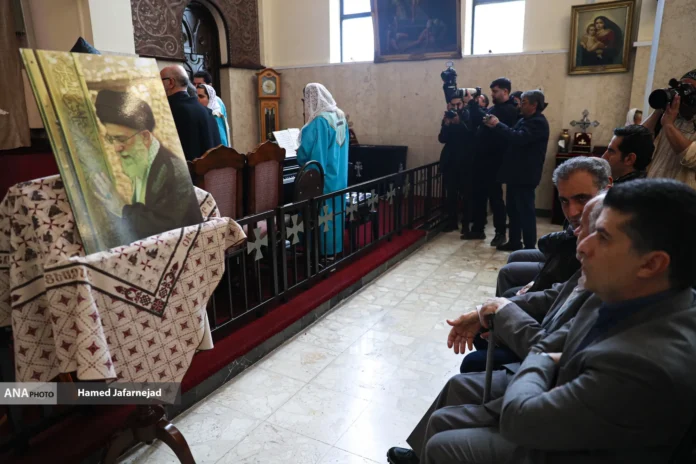
The Islamic Republic Iran has marked the fortieth-day since the death of Ayatollah Ali Khamenei with a memorial service at a Christian cathedral in Tehran, giving it a platform to fuse the traditional chehelom mourning rite with a staged display of inter‑religious unity – and to fix a contested narrative of the late leader’s legacy.
In Iranian Shi‘a practice, the 40th‑day memorial (chehelom) marks the move from immediate shock to settled remembrance, echoing the pattern of Arbaeen, forty days after Imam Husayn’s martyrdom at Karbala. Families commonly gather on day forty to pray and recall the dead, and the custom has become one of the most recognisable markers of mourning in Iran, even though it is not mandated in classical Islamic law.
Since 1979, 40‑day ceremonies for those killed in crackdowns have repeatedly turned into protest events, creating a rolling calendar of funerals and memorials that the authorities have struggled to control. The Islamic government’s decision to include a Christian church in the state sponsored chehelom, speaks to the regime’s claiming the language of martyrdom and continuity for its political project.
Against that backdrop, the 40th‑day service for Khamenei at Saint Sarkis Cathedral, the main Armenian church in central Tehran, carried unusual weight. On 19 Farvardin 1405 (8 April 2026), Armenian clergy led prayers in Armenian and Persian with candles lit before icons, joined by representatives of recognised religious minorities and the Minister of Culture and Islamic Guidance. Images distributed by Iranian and pro‑government outlets showed worshippers in the cathedral before a large portrait of Khamenei, with captions stressing that followers of all religions in Iran were united in mourning the “martyred Leader”.
State messaging presented the choice of a cathedral as proof of national and inter‑faith solidarity, implicitly casting the Islamic Republic as a protector of Christians. For Iran’s historic churches, however, participation in such ceremonies comes under the shadow of state control over recognised minorities and longstanding expectations that their leaders will appear at official events and open their buildings when asked.
Video from the cathedral showed clergy praying for the dead beneath the cross while surrounded by black‑and‑green Shi‘a martyrdom imagery and slogans honouring Khamenei as a shahid (martyr). Critics – including Iranian‑diaspora commentators – highlighted the strangeness of holding the chehelom of a hard‑line Shi‘a jurist in a Christian sanctuary, arguing that the service blurred the line between pastoral prayer and state propaganda.
Goftar News, in its report “Prayer Ceremony for Late Supreme Leader Ali Khamenei, The bloodthirsty dictator Amid Ceasefire Tensions,” framed the memorial as part of a wider effort to canonise a leader it described as responsible for executions, crushed protests and proxy warfare.
For the Islamic regime, inscribing Khamenei into the chehelom pattern is a way of signalling that his cause must continue and intensify. For opponents, the same 40‑day mark is a natural moment to insist that the true martyrs of his rule are the regime’s victims in prisons, on protest streets and in foreign conflicts.
For Anglican and other church observers, the Saint Sarkis memorial underlines how quickly Christian spaces in Iran can be drawn into the politics of chehelom. It leaves local clergy navigating familiar questions: how to pray for the dead and maintain community life under pressure, while resisting the pull to let the altar serve as a backdrop for the state’s chosen story about Ali Khamenei at forty days.