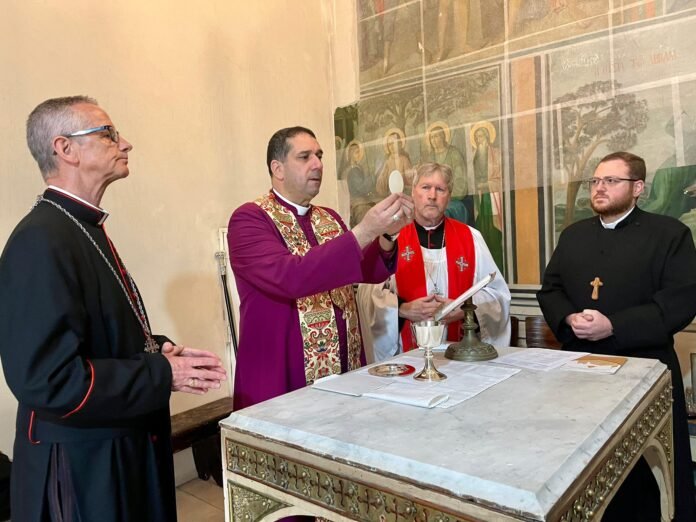
The Anglican Archbishop in Jerusalem, the Most Rev. Hosam Naoum, celebrated the Holy Eucharist at the Church of the Holy Sepulchre’s Abraham Chapel on Wednesday of Holy Week with five people present. The limited attendance, which Archbishop Naoum reported on his Facebook page, was the direct result of police restrictions imposed by Israeli authorities amid ongoing wartime security measures, illustrating the conditions facing Christian communities in the city this Easter.
The restrictions stem from a specific security concern. Israel’s Home Front Command has limited gatherings to fifty attendees at any location without an adequate public bomb shelter. The Old City of Jerusalem lacks such shelters, making its restrictions more severe than in other parts of the city. The Church of the Holy Sepulchre, the Al-Aqsa Mosque, and the Western Wall have all been affected. Missile fragments from Iranian strikes have fallen in the Old City and on top of the Church of the Holy Sepulchre itself in recent weeks.
The week began with an international incident on Palm Sunday, March 29, when Cardinal Pierbattista Pizzaballa, the Latin Patriarch of Jerusalem, and Father Francesco Ielpo, the Custos of the Holy Land, were prevented by Israeli police from entering the Holy Sepulchre to celebrate Mass. The Latin Patriarchate issued a statement calling it the first time in centuries that the heads of the church had been barred from celebrating Palm Sunday at the site, describing it as “a grave precedent” that “disregards the sensibilities of billions of people around the world.” Prime Minister Benjamin Netanyahu said the incident was not intentional: “Out of concern for his safety, and that was the only concern. There was no malice or no bad intention unlike the press reports.” He said he gave instructions immediately: “No, he should be free, the patriarch, to come with his party and perform services as he wishes.” The Latin Patriarchate and Custody confirmed in a joint Holy Monday statement that access for church representatives had been secured to carry out the liturgies and ceremonies of Holy Week, while public gathering restrictions remained in force.
With the arrangement in place, the Triduum proceeded, but in radically reduced form. The Custody of the Holy Land noted in an April 2 statement that, “unable to celebrate the great liturgies of the Paschal Triduum” at the Holy Sepulchre “due to the limitations imposed in these days, the different religious communities present in Jerusalem organised more intimate celebrations in their own churches and in the places entrusted to their care.” The Franciscan friars of the Custody began the Sacred Triduum at the Basilica of Gethsemane, “in the place where the Lord began His Passion with prayer and trustful abandonment to the Father.” The traditional Good Friday procession along the Via Dolorosa was largely halted; the Palm Sunday procession from the Mount of Olives did not take place at all. The Garden Tomb’s Easter sunrise service was pre-recorded without a public audience because the site has no shelter for more than fifty people.
The Latin Patriarchate’s Easter Vigil and Easter Sunday Mass were livestreamed from the Holy Sepulchre, presided over by Cardinal Pizzaballa.Sami El-Yousef, Chief Executive Officer of the Latin Patriarchate of Jerusalem, described the texture of the week for those living inside it. “Holy Week in Jerusalem will be very sad without the tens of thousands of pilgrims making their way through the narrow alleyways of the Old City,” he told the Weekend Argus. Despite that, he did not end without the season’s own word. “Easter represents an end and a new beginning that is characterised by hope. Despite the harshness of the war conditions, Easter brings a sense of hope that there is still some goodness in this world.”