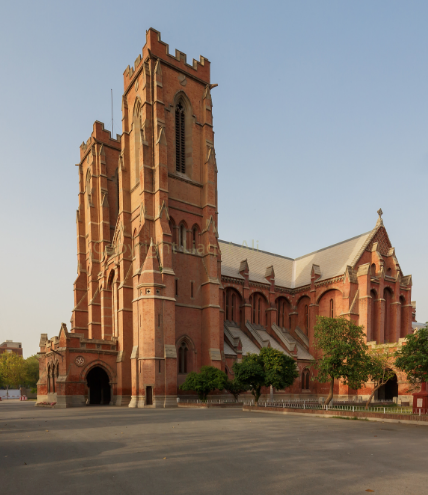
The Church of Pakistan is in the midst of a constitutional crisis centered on the Diocese of Lahore, where disputes over the bishop’s election and control of church properties have spilled into multiple courts and now reached the federal level. What began as an internal fight over episcopal succession has evolved into a broader struggle over governance, accountability, and the future shape of Anglican witness in Pakistan.
The Church of Pakistan (CoP) was formed in 1970 as a union of Anglicans, Methodists, Presbyterians, and Lutherans, with the union described at its founding as “irrevocable and indissoluble.” In its foundation documents the Synod is recognized as the premier national body with constitutional oversight over its member dioceses and their episcopal elections.
The Diocese of Lahore holds particularly significant assets the Lahore Diocesan Trust Association (LDTA), a corporate entity that holds title to properties worth billions of rupees which it inherited from its predecessor church bodies. The present crisis traces formally to January 2023, when the Diocese of Lahore organized an election and consecration of the Rev. Nadeem Kamran as the 10th Bishop of Lahore. The election was conducted within Lahore’s own structures and the consecration was performed by three retired bishops of the Church of Pakistan, rather than under the Synod’s direct authority and procedures.
Leaders from seven other dioceses—Raiwind, Multan, Karachi, Hyderabad, Faisalabad, Sialkot, and Peshawar—quickly challenged the move as “illegal” and “unconstitutional,” arguing that the Lahore leadership had ignored the CoP’s constitution and the established practice that the Synod convenes and oversees episcopal elections. They warned that the unilateral action threatened the unity of the 50‑year‑old church union and violated the All Saints’ Day 1970 pledge that the union was irrevocable.
On 11 April 2023, plaintiffs from other dioceses obtained a stay from a senior civil judge in Lahore, restraining Rev. Kamran from exercising the powers of bishop while the legality of the election was litigated. At the same time, the Diocese of Lahore was asserting before the civil authorities that it was “a fully autonomous body” not subject to control by any external church, council, or synod—a claim at odds with the Synod’s understanding of the CoP as a single constitutional entity.
Acting on a petition supported by Synod representatives, the Registrar of Joint Stock Companies, Lahore—who exercises regulatory oversight over such religious societies and trusts—examined the constitutional documents, past practice, and litigation history. On 11 August 2023, the Registrar declared the election of the Bishop of Lahore “illegal” and “unconstitutional,” concluding that:
– The Diocese of Lahore had misled the Registrar by claiming complete autonomy, despite previous legal findings that the CoP is a “constructive trust” with constitutional oversight over member dioceses.
– Documentary evidence showed that all previous episcopal elections in Lahore were held under the Synod’s election rules, undermining the claim that the diocese could elect a bishop on its own terms.
– The election rules invoked by Lahore had never been formally filed with the Registrar, contrary to the Societies Registration Act and the registered constitution of the Lahore Diocesan Council.
The Registrar ordered that the election be reconvened “immediately” in accordance with the registered constitution of the Lahore Diocesan Council and the Synod’s rules, effectively annulling Bishop Kamran’s election.
The Diocese of Lahore challenged this administrative order in the Lahore High Court. In August 2023, a single‑bench judge dismissed the diocese’s petition and upheld the Registrar’s decision, confirming that the election had been invalidly conducted and that a new, properly convened election was required. The Diocese then filed an intra‑court appeal (ICA) against the single‑bench decision, but on 20 January 2026 a divisional bench of the Lahore High Court again rejected the challenge and sustained the annulment of Bishop Kamran’s election.
Despite these rulings, Bishop Nadeem Kamran has continued to act in practice as bishop, including as ex officio chairman of the LDTA, even as the legal authority to sign and operate on LDTA accounts remains with his predecessor, Bishop Irfan Jameel. This split between de facto ecclesial practice and de jure corporate authority has intensified the governance crisis.
Running in parallel to the episcopal litigation is a dispute over the governance of the Lahore Diocesan Trust Association, which administers key church properties. In 2024 four LDTA directors—among them the vice‑president of the Diocesan Council—filed a petition in the Lahore High Court under the Companies Act 2017, asking for an administrator to be appointed and alleging deep‑seated corruption and mismanagement.
The petitioners accused the LDTA leadership of:
– Conducting affairs in a “deceitful manner” and in violation of its Articles of Association, including failing to hold an annual general meeting for roughly 20 years.
– Keeping directors in the dark about the use of income from income‑generating church properties and providing only verbal, cursory financial overviews.
– Creating “sham” documents of meetings and filing them with the Registrar to satisfy annual renewal requirements.
– Hand‑picking the executive committee rather than holding proper elections, contrary to Clause 8 of the Articles of Association.
– Retaining the same auditor since 1984 and allegedly using this arrangement to conceal fraudulent activities.
Other CoP bishops submitted complaints asserting that changes made by the Diocese of Lahore in LDTA governance—particularly steps to exclude the CoP as member and from the Board of Directors—were “illegal and unconstitutional” and designed to secure unilateral diocesan control over properties “comprising billions of rupees.”
The conflict quickly took on a personal and pastoral dimension. After the petition was filed, the Bishop of Lahore reportedly transferred one of the clerical petitioners to a rural district, a move seen by critics as retaliation and which contributed to a standoff between diocesan leadership and reform‑minded clergy.
The case has now moved to Pakistan’s highest constitutional forum, with significant implications for all earlier orders. On 4 February 2026, a bench of the Federal Constitutional Court of Pakistan comprising Justice Syed Hasan Azhar Rizvi and Justice Muhammad Karim Khan Agha, in F.C.P.L.A. No. 244 of 2026, suspended the operation of a Lahore High Court judgment while issuing notices to the respondents and to the Advocate General Punjab. The case arises out of the chain of writ petitions, intra‑court appeals, and administrative proceedings concerning the Registrar Joint Stock Companies, Lahore, and focuses on allegations of non‑disclosure of pending civil litigation between the parties.
According to the order as reported, counsel for the petitioner argued that:
– Several civil suits filed by the respondents were already pending before the relevant civil courts, with restraining orders still in force.
– In Writ Petition No. 43982/2023, no reference was made to these earlier civil suits or to orders already passed by civil and high courts.
– By allegedly concealing these material facts, the respondents approached the Lahore High Court, sought directions to refer the matter to the District Officer for the Registrar Joint Stock Companies, and thereby obtained the order dated 11 August 2023.
It was further contended that the subsequent single‑bench judgment of 17 August 2023 and the divisional bench’s order of 20 January 2026 were all built upon that Registrar’s order, which itself was procured after incomplete disclosure to the High Court. Taking note of these submissions and the “inter se litigation” already pending elsewhere, the Federal Constitutional Court ordered that the operation of the impugned order would remain suspended until the next hearing date, effectively freezing the legal effect of the challenged High Court judgment for the time being.
In its official press statement, the Church of Pakistan—through spokesperson Rev. Emmanuel S. Khokhar—clarified that F.C.P.L.A. No. 244/2026 was filed by the Church of Pakistan Lahore Diocesan Council through its Secretary, Samina Bhatti, against the Lahore High Court’s 20 January 2026 divisional bench order in I.C.A. No. 53042/2023, which itself arose from W.P. No. 52165/2023 concerning the Registrar’s 11 August 2023 order. The statement emphasized that the federal court has not issued any final judgment in favor of any party but has only issued notices and suspended the impugned order pending further proceedings.
The official response stressed three points in particular:
– The matter remains sub judice, and no final relief has been granted to any side.
– Social‑media claims of “victory,” “final decision,” or “validation” for one faction are “false, premature and misleading.”
– The suspension reflects the Court’s desire to carefully examine the record and maintain status quo, and clergy and laity are urged not to rely on propaganda or partial narratives.
Former General Secretary of the Synod Church of Pakistan and former Secretary of the Lahore Diocese, Anthony Aijaz Lamuel, publicly welcomed the order as evidence that the court had recognized the gravity of alleged concealment of pending cases. He underscored that civil suits filed by respondents No. 4 to 9 were still pending, and that Writ Petition No. 43982/2023 made no mention of earlier litigation, which he described as approaching the court with “unclean hands.” Lamuel argued that if concealment of material facts is established, it could significantly affect the legal standing of subsequent orders that rested on the allegedly tainted 11 August 2023 Registrar’s action.
The report notes that, conversely, if respondents succeed in showing that there was no material concealment, the suspension could be lifted and the High Court orders restored, leaving the previous legal landscape essentially intact. Until the Federal Constitutional Court finally adjudicates the petition, the legal status of the contested administrative actions remains temporarily frozen, and any public claims of decisive victory by either faction remain premature in law.
The legal drama has spilled into the pastoral life of the church. News and social media reports describe protests and heightened security in Lahore after the High Court’s dismissal of the intra‑court appeal in January 2026, with rival church factions organizing demonstrations and counter‑demonstrations. UCA News notes that the leadership dispute has “deepened rifts” in Pakistan’s largest Protestant church, undermining trust in institutions and exposing long‑running grievances about governance and financial transparency.
For many lay Anglicans and ecumenical partners, the central issue is less about personalities and more about structures: whether diocesan bodies can unilaterally declare autonomy in a way that effectively fragments the CoP, and whether those managing vast church properties can be held to the standards of public trust expected of religious organizations. Petitioners in the LDTA case explicitly frame their action as an effort to defend the Christian community’s patrimony and restore accountability, arguing that opaque financial practices are a betrayal of the church’s mission.
At the same time, the Diocese of Lahore’s leadership and its allies contend that they are defending their constitutional rights and resisting what they see as overreach by the Synod and allied bishops, emphasizing historical particularities of Lahore’s registration and governance. The tension between these competing narratives—central oversight versus diocesan autonomy; reform versus persecution—feeds the polarization and makes reconciliation more difficult.
The core question now before the high court is not directly who should be bishop, but whether prior litigants fully and honestly disclosed all related pending suits and orders when inviting the Lahore High Court to act. If the allegation of concealment is upheld, it could unsettle the foundational Registrar’s order and, with it, the series of High Court judgments that flowed from it. If, however, the respondents demonstrate that no material facts were withheld, the suspension may be lifted and the Lahore High Court’s reasoning—affirming the Synod’s constitutional role and invalidating the 2023 election—would likely stand.
For now, the Church of Pakistan continues to face what observers have termed a “crisis of trust and leadership,” in which its internal disagreements have become public test cases in Pakistani courts about church governance, corporate honesty, and the stewardship of Christian properties. The Federal Constitutional Court’s decision to suspend the Lahore High Court order underscores both the seriousness of the allegations and the continuing uncertainty: the legal and ecclesial future of the Diocese of Lahore remains open, and claims of final victory by any faction remain, in law and in charity, premature.