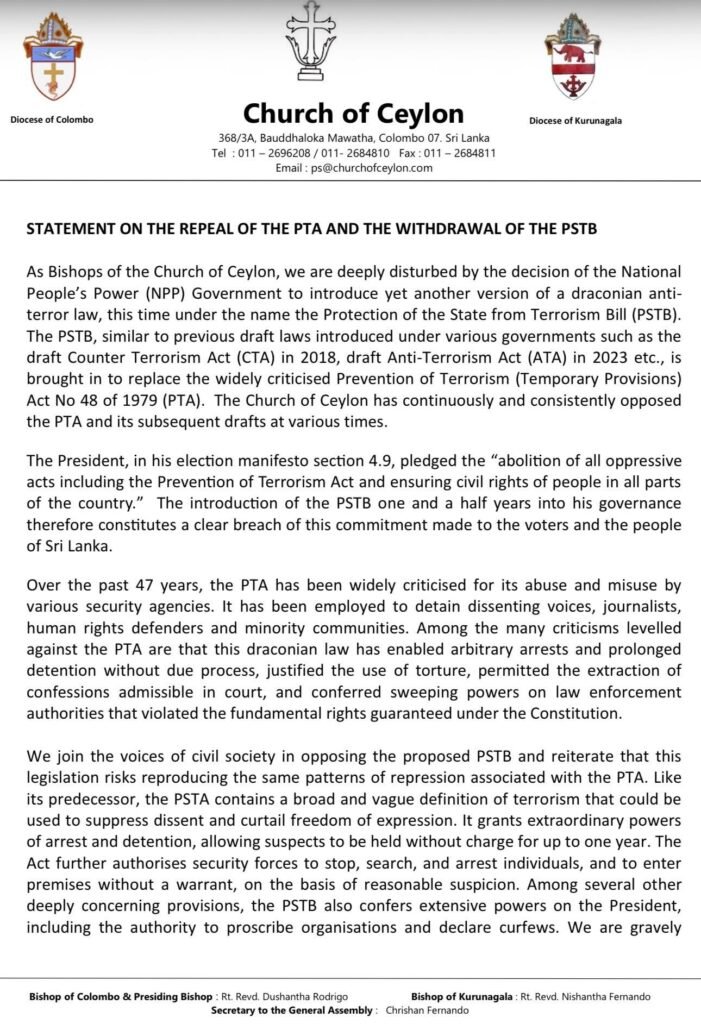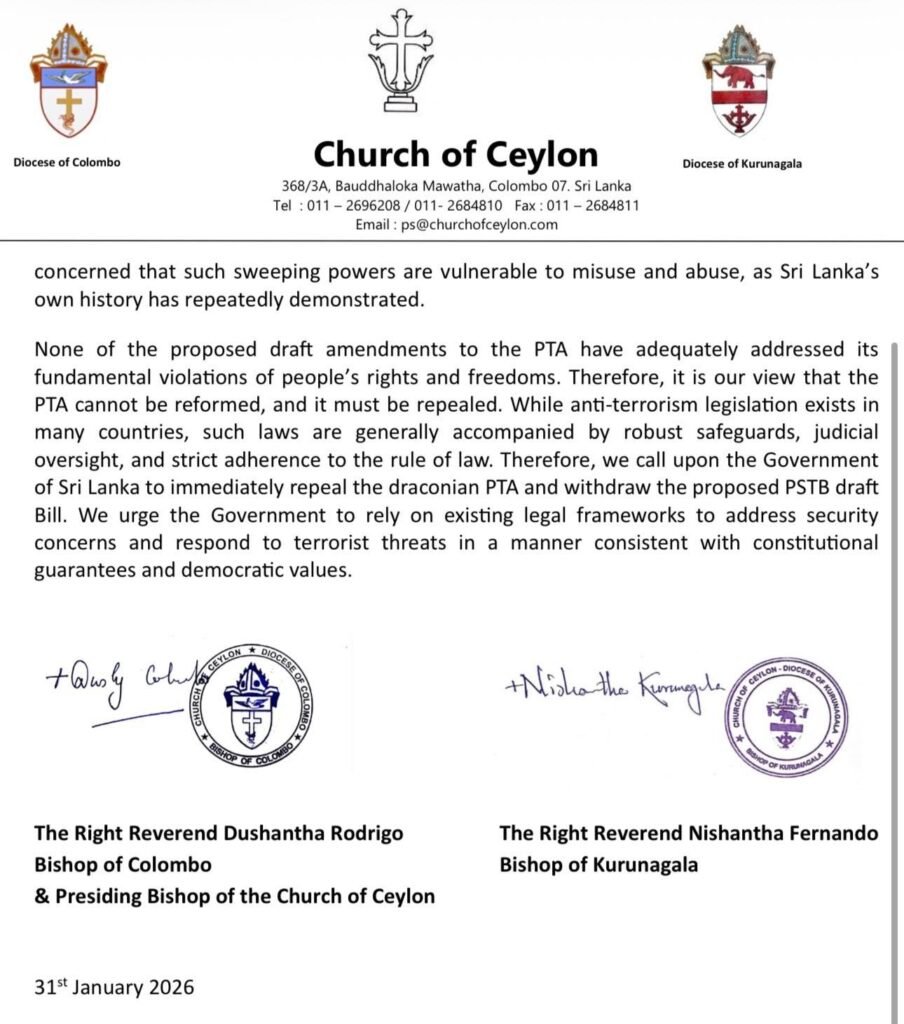
The Church of Ceylon has urged the government to withdraw its proposed anti-terrorism legislation, warning that it threatens fundamental freedoms and risks deepening a legacy of abuse. The Rt. Rev. Dushantha Rodrigo of Colombo and the Rt Rev Nishantha Fernando of Kurunagala in a statement released on 2 Feb 2026 argued that, despite government claims of modernization, the draft law largely reproduces the most troubling features of Sri Lanka’s long‑criticized emergency and security framework.
For more than four decades, Sri Lanka has relied on the Prevention of Terrorism Act (PTA), introduced in 1979 and repeatedly condemned by rights groups and UN experts for enabling arbitrary arrest, prolonged detention without charge, and torture. Although successive governments pledged to repeal or replace the PTA after the civil war, proposed substitutes have consistently retained vague definitions of terrorism and sweeping police and military powers.
The new bill, commonly referred to as the Protection of the State from Terrorism Act, is presented as the long‑awaited replacement for the PTA and as a measure aligned with international human rights standards. However, legal and church critics say it represents continuity more than change, preserving broad state authority under a different label.
The bishops principle concern centers on the bill’s expansive definition of terrorism, which extends beyond acts of serious violence to conduct that “intimidates the public” or seeks to compel the government or an international organization to act or refrain from acting. Even though the text attempts to reassure that peaceful protests and strikes are not automatically terrorism, the language leaves wide room for authorities to classify dissent, labour action, or political opposition as terrorist activity.
Under the proposed bill, police, armed forces, and coast guard officers would retain extensive powers to arrest without warrant, search property, and seize materials on the basis of “reasonable suspicion.” Suspects could be detained on remand without charge for up to a year, while separate executive detention orders could extend custody without charge to two years, with only limited practical judicial oversight.
The proposed law extends beyond physical violence into speech, media, and digital communications, criminalising the distribution or possession of “terrorist publications” and the publication of statements allegedly encouraging terrorism. Journalists, activists, clergy, and civil society workers fear that critical reporting, advocacy on behalf of minority communities, or even robust preaching could be construed as incitement or support for terrorism under such elastic provisions.
Additional clauses addressing “confidential information” and access to encrypted data heighten worries that ordinary secure communication, pastoral counselling, or legal advice could fall within the scope of counter‑terrorism investigations. The president would also gain wide powers to proscribe organizations, freeze assets, impose curfews, and declare “prohibited places,” further tightening executive control over public space and association.
The Church of Ceylon has urged the government to withdraw the bill rather than rush it through parliament. Anglican leaders argue that any genuine reform must clearly break with the abuses associated with the PTA, provide strong judicial safeguards, and narrowly define terrorism so as not to ensnare peaceful political activity, protest, or religious ministry.
National security cannot be secured at the cost of due process, freedom of conscience, and protection from torture or degrading treatment, the bishops said.