Marginally later than in some previous years, the full details of the annual returns on attendance for the Church of England has been published (‘Statistics for Mission’). This is in two parts, both linked here: a report, giving the main statistics and trends, helpfully illustrated with graphs; and the detailed breakdown by diocese in a series (not ‘serious’!) of spreadsheets. Both are worth looking at. Thanks as ever to Ken Eames in Church House for their production.
Preliminary figures were released in June, and I commented on them then. As Ken had predicted, the overall picture has not shifted; the early data is a reliable indicator of the full picture, but this report comes with more detailed analysis and reflection.
So, what is the headline? According to the press release on the Church of England website, it is:
“Attendance at Church of England churches rises for the fourth year in a row
“The overall number of regular worshippers across the Church of England’s congregations rose to 1.009 million in 2024, a rise of 0.6 per cent, according to the annual Statistics for Mission findings.
It was the second year in a row in which the Church of England’s “worshipping community” – the combined number of regular members of local congregations – has stood above a million since the Covid-19 pandemic.
“All age average attendance on a Sunday also rose 1.5 per cent to 581,000 in 2024, extending rises over recent years.
“And overall attendance across the week edged upwards by 1.6 cent in a year, and stood at just over 702,000 last year, according to the figures.
“The increase was driven by a recovery in attendance by adults (over 16), among whom average Sunday attendance was up by 1.8 per cent and weekly attendance rose by 1.8 per cent.”
I understand that one of the roles of Comms is to take the most positive angle on any story—but, as with the press release last year, the headline is deeply misleading. I sincerely hope we don’t have the same ecstatic claims from church leaders about ‘growing for the first time in 100 years’ or some such. That is all misleading—and is suggests that church leaders are in denial of reality. Unless you admit the problem, you cannot solve it.
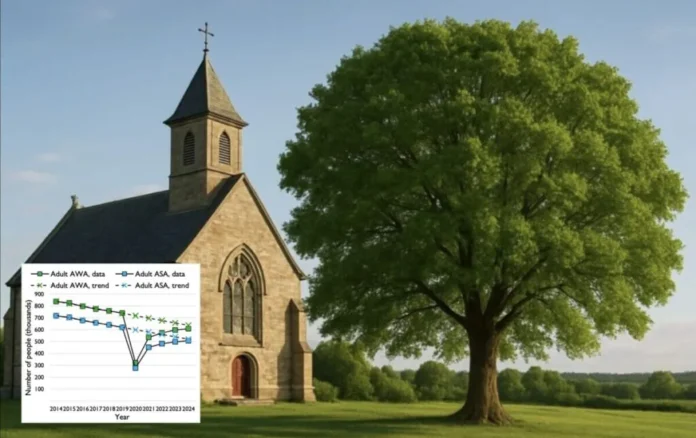
This is the real headline: on nearly every measure, the figures are now back in line with the long term trend of general decline and ageing established before the COVID pandemic. You can see this from the details, but the most striking is the graph from p 14:
Ken has added in a straight-line projection, since a straight line fits the pre-COVID rate of decline statistically (and there are good reasons why this should be the case).

There are two things to notice here. First, and most obviously, the recent growth in numbers has not yet take us back to the anticipated decline over the intervening five years. Just pause to take that in: we are still not yet back to the level of decline that we were experiencing before COVID. Despite everything, we have not reversed the trend of decline overall as a national church.
Secondly, the shape of the curve is telling. If the increase in numbers over the last four years indicated a change in trend, then we would see the line straightening up, preparing to cross the trend line. As it is, the curve is convex; the recovery from the COVID drop is a recovery to decline, not a recovery to growth. This needs to temper our public communication, and it needs to be given due attention in the places that matter. I have asked that we spend time on this at our next meeting of Archbishops’ Council (and my last) in December. Now that they will not be giving six hours or more to discussing LLF in their meetings, I hope the House of Bishops will spend time reflecting on this.
I should at this point address the common objection to focussing on numbers. Number are people, and if there are lower numbers attending our churches, then the obvious inference is that fewer people are hearing about and responding to the good news of Jesus. I think that matters.
But numbers have institutional implications too. With fewer people attending, finances will be under pressure, and structures will need to change. I am not clear that the Church as a whole has even begun facing up to that.
There are other issues in the details of the report which are worth highlighting. For me, three things stand out: differential growth; age and demographics; and children.
Because the headline figures are aggregated, it takes some work to understand what is happening on the ground. And there are huge disparities between churches, between areas, and between churches. This applies both to the net changes from 2019 to 2024, but also year on year from 2023 to 2024.
At a diocesan level, recovery varies hugely. I took the diocesan details on Average Sunday Attendance (one of the most robust figures), and looked at percentage changes from 2019 to 2024. Here are the top and bottom eight of that table, arranged by percentage decline:


The average figure for the whole C of E over that time is -18%; the trend is 3% decline per annum. All the bottom eight would have broken above the decline trend line.
Read it all in Psephizo