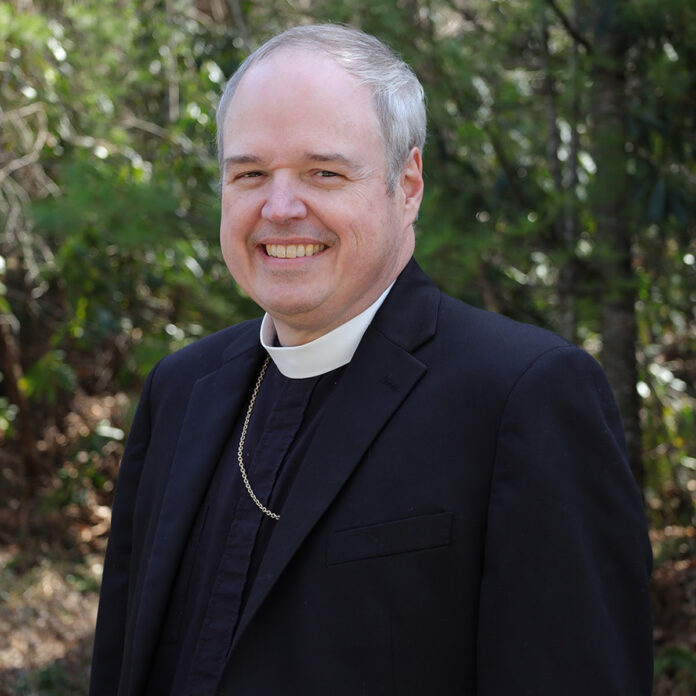
Following are opening remarks, as prepared for delivery, by Presiding Bishop Sean Rowe to the Executive Council of The Episcopal Church, meeting Oct. 20-21 at Kanuga conference center in Hendersonville, North Carolina.
Good morning, and welcome to Kanuga. Thanks to our chaplains for beginning our meeting with morning prayer, and thanks to all of you for making the time to be here. We have a full agenda, including this morning’s session with Dr. Beth-Sarah Wright of the Absalom Jones Center for Racial Healing, who will be working with us on using the baptismal covenant as a way to understand our vocation as Christian leaders. As part of our commitment to investing in and supporting dioceses, we have launched an expanded partnership with the Absalom Jones Center. I am glad to welcome Dr. Wright to our meeting not only to work with us, but to give you a sense of the kind of resources we are making available to dioceses, and then make available to the whole church.
I also want to welcome Crystal Plummer, who was elected by Province V to fill the unexpired term that was created when Louisa McKellaston joined our staff team on Aug. 1. Crystal is canon for networking in the Diocese of Chicago and serves as secretary of the Episcopal Coalition for Racial Equity and Justice. At General Convention in 2024, she became the first Black woman to preside over the House of Deputies when President Ayala Harris invited her to take the chair during the election of the president and vice president. Crystal, we are delighted to have you on the board.
This is also our first meeting with Bishop Helen Kennedy, our new liaison from the Anglican Church of Canada. She has served as bishop of the Diocese of Qu’Appelle in Saskatchewan since 2022, and is the first female bishop in that province. Welcome, Helen. We are very glad to have you with us.
Here at Kanuga, we are in the Diocese of Western North Carolina, where faithful people have spent the last year helping their churches and communities recover from the catastrophic flooding of Hurricane Helene that took place last fall.
Kanuga itself sustained extensive damage from flood waters and fallen trees, as did many other places in this part of the Blue Ridge. Since then, the diocese has been making a profound witness to God’s love by providing housing support, household goods, food, medical expenses, relief from rental debt, home repairs, and programs that help people return to work—all while experiencing grief, disillusion, and the whole range of other emotions that come during and after a disaster.
I was fortunate to witness the resilience of this diocese’s people last month, when I was invited to the diocese’s Helene anniversary Eucharist. I am grateful to return now with all of you so that the resources we spend on this board meeting can help support this historic institution as it continues to recover from the storm.
Being here in Western North Carolina also prompts me to reflect on The Episcopal Church’s response to the increasingly desperate political situation in the United States, which has occupied an enormous amount of our time and energy in the last year.
Like many other places in our church, this diocese devotes significant resources to serving the Latino community in this part of the state, which has grown rapidly in recent years. The Diocese of Western North Carolina has four Latino mission sites across the diocese, numerous parish ministries serving their Spanish-speaking neighbors, and two full-time Latino missioners: the Rev. Oscar Rozo and the Rev. Miguel Alvarez. Bishop Jose McLoughlin, who was born in Puerto Rico and is bilingual, is deeply committed to serving the Latino community here.
We can do a lot to support Latino congregations and ministry in our dioceses: We can develop better resources for Spanish-language theological education and formation. We can provide resources to ministries working with immigrants on legal issues. We can assert the church’s values by insisting on our right to gather freely for worship with all of our members, regardless of immigration status. We are doing all of those things and more.
As we seek to be strategic with our support for humane and just immigration policy and our ministry with immigrants, we are taking our cues from bishops and other leaders in our dioceses on the southern border and in other communities with large immigrant populations. One thing they often ask us is not to issue statements full of outrage and rhetoric that draws attention to their programs. We know that what is happening to our communities is not of God, we know that it is devastating to our congregations and to the entire body of Christ. But all too often, shining a bright light on injustice also shines a bright light on people suffering from injustice and makes them more vulnerable to immigration enforcement raids and surveillance.
These diocesan leaders tell me that, as leaders in The Episcopal Church, we must be careful that what we say publicly does not inadvertently hurt the very people for whom we are advocating. It can feel cathartic to issue a statement decrying today’s immigration realities, but we do not always understand the harm it can do to the people we most want to protect: people like the parents in one of our congregations I heard about recently who are trying to figure out what will happen to their children if they are deported. In that situation, other congregation members have agreed to care for those children if their parents disappear one day. As a father, a bishop, and a human being, I am heartsick over this kind of situation in our churches, and I know none of us wants to issue a statement that satisfies our need to be heard, only to have it result in increased enforcement activity at that congregation or any other Episcopal church. We always have to find the balance.
The situation in Gaza and the West Bank is similar. We hear sometimes that we must issue more frequent and stronger statements about the Israeli war on Gaza and the catastrophic effect it has had on the Palestinian people—that if the church does not issue statements, then we believe that the church does not care about this moral travesty unfolding before us or the people in our own church most affected by it.
In the same way that I consult with bishops who are deeply involved in ministry with immigrants, I am in frequent touch with Archbishop Hosam. In fact, I was fortunate enough to spend some time with him in person in my office in New York on Friday, hearing his perspective on the situation in Gaza and getting his counsel both about what we can do to support him and what we can refrain from doing. Strengthening the relationship between The Episcopal Church and The Episcopal Church of Jerusalem and the Middle East is our first priority when it comes to our work in this region, and that means we will prioritize the needs of the church there and seek to be strategic in our support.
I want to be clear: Our choice to limit public statements about Gaza is not an indication that we are ignoring the crisis, and it is not an indication that we are sanguine about what is happening. I am horrified by what I know of the violence, human rights abuses, and destruction visited upon Gaza by Israel, and I want to do everything we can to help. As a member church of the Anglican Communion—the actual Anglican Communion—we can make a material difference in the lives of Palestinian people in Gaza and all Palestinians by supporting our fellow Anglicans in the Holy Land in the Anglican Diocese of Jerusalem and the Province of Jerusalem and the Middle East. We can do this by giving to the American Friends of the Diocese of Jerusalem and the Good Friday Offering. We can do this by supporting a missionary who serves with Archbishop Hosam Naoum. We advocate with the U.S. government for humanitarian aid, a permanent ceasefire, and the end of weapons sales to Israel. And we pray without ceasing.
In early July, not too long after our last meeting, I wrote an op-ed for Religion News Service about what it means for our church, which was once known as the church of the Founding Fathers and presidents, to become an engine of resistance to the rising tide of authoritarianism in the United States and around the globe.
In that essay, I wrote that, “Churches like ours, protected by the First Amendment and practiced in galvanizing people of goodwill, may be some of the last institutions capable of resisting this administration’s overreach and recklessness. To do so faithfully, we must see beyond the limitations of our tradition and respond not in partisan terms, but as Christians who seek to practice our faith fully in a free and fair democracy.
“We did not seek this predicament, but God calls us to place the most vulnerable and marginalized at the center of our common life, and we must follow that command regardless of the dictates of any political party or earthly power. We are now being faced with a series of choices between the demands of the federal government and the teachings of Jesus, and that is no choice at all.”
It has not always been easy to choose the teachings of Jesus—reading the book of Acts makes that clear. I do not expect it to get easier anytime soon. Like the apostles of the early church, we need to keep believing that all authority in heaven and earth has been given to the Risen Christ. And we need to keep living, both personally and institutionally, as though that is the most important thing.