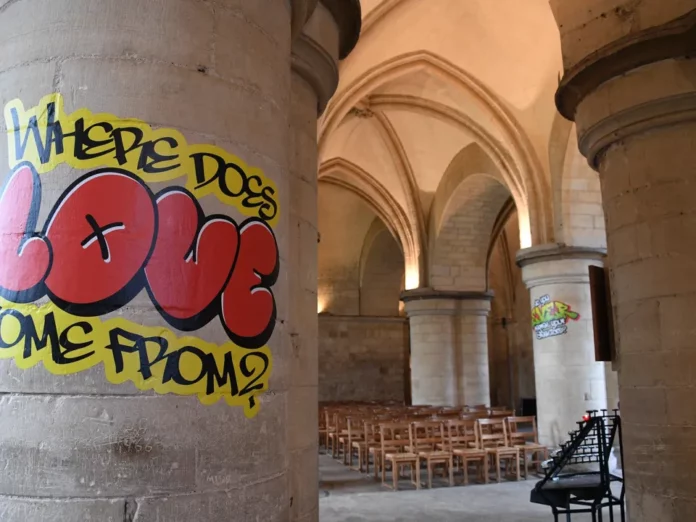
anterbury Cathedral’s ‘Hear Us’ ‘art installation’, in which the heart of English Christianity has been covered in fake graffiti, has caused outcry and anger. The exhibition, which according to the Cathedral involved ‘collaboration with marginalised communities’ covered much of the building’s interior with stickers which they say have been ‘expertly and sensitively affixed to the Cathedral’s stone pillars, walls and floors’. The stickers ask questions such as ‘Are you there?’, ‘Why did you create hate when love is by far more powerful?’, ‘God, what happens when we die?’ and ‘Does everything have a soul?’
The questions posed are unexceptional and often the wording itself slips into the language of a business email or one of those dreary LinkedIn posts
The response has been overwhelmingly negative, with even the US Vice President, J.D. Vance, tweeting that ‘it is weird to me that these people don’t see the irony of honouring “marginalized communities” by making a beautiful historical building really ugly’. While the Cathedral claims on its website that ‘many have reported their ‘delight and intrigue’, the only people it presents to support that claim are Alex Vellis, the artist behind the installation, Jacquiline Creswell, the curator and David Monteith, the Dean of Canterbury who organised silent discos at the Cathedral last year.
What to make of the ‘installation’ itself? It’s very dull. The style of the fake graffiti is dated, ‘bubble style’, reminiscent of 1980s hip-hop culture. It’s something I could imagine the BBC’s Blue Peter showcasing years late in a 1993 episode. The questions posed are unexceptional and often the wording itself slips into the language of a business email or one of those dreary LinkedIn posts – ‘What is the architecture of heaven?’ is a particularly dull example.
Similarly the curator, Creswell, has said ‘surely we have all wondered about the mysteries of the universe, the meaning of life, or in times of uncertainty, sought advice?’ This is an observation so cliched and unremarkable as to be rendered meaningless. What’s missing is any sense of Christianity’s transgressive, world-shattering answer to these questions. Indeed, Creswell seems afraid of even naming God, or Christ, instead describing, in yet more leaden business English, how ‘individuals’ may find themselves ‘reaching out to the Divine with personal inquiries’.
Fergus Butler-Gallie, the Anglican clergyman and Spectator contributor, has described the work as ‘smug, unchallenging and safe’, particularly given it has been done in a space full of genuinely transgression, not least the martyring of Thomas Becket at the altar, and the ‘miracle glass’ which ‘features castration, nosebleeds, and annoying women badgering saints. It’s ribald and stunning and has ordinary people at its centre.’
Read it all in The Spectator