Every time the Church of England lurches one more step to the left, drunk on the rich wine of a political relevance only they can see, you will be sure to hear some Catholic commentators perkily prophecy a new flood of conversions.
There are several reasons why this won’t happen. But spotting them requires preferencing perception over the fantasies of wish-fulfilment.
There is no doubt that things are very bad for the C fo E. The former Chief Nursing Officer doesn’t just represent the Nanny State, she embodies it.
Just at a time when Christianity in England needs a strong vigorous, muscular, determined presence, the powers that be offer a woman whose image strongly resembles an old advert which featured a sheep dog who sold a brand of domestic paint

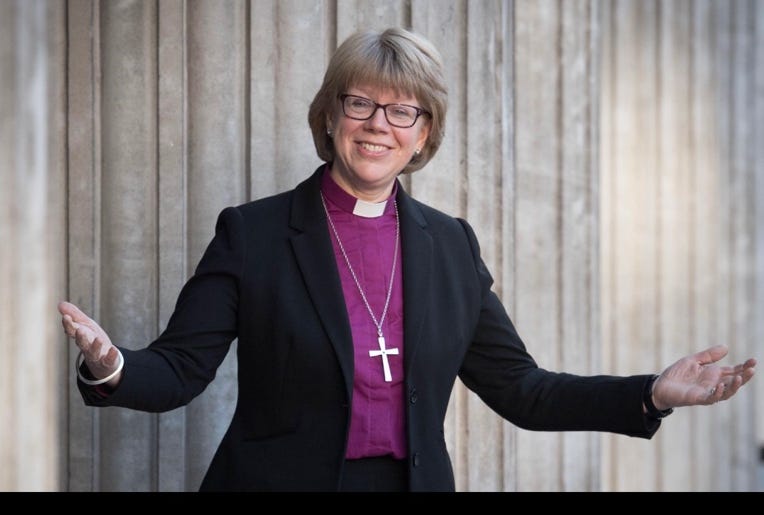
No one claims the similarity is uncanny. It’s just unhelpful.
It has been interesting to note amongst the commentators as they celebrated her appointment, that they major more on the fact that she is a woman than on her personal characteristics and ecclesial achievements. She did phenomenally as a nursing adminstrator. But the problem is that under Welby the third rate oil executive, the senior appointments were almost all of administrators rather than those who had distinguished themselves intellectually, spiritually, or pastorally. You can’t build a visionary and competent Church on pen-pushers and filing clerks.
There is in fcat something of a problem in the fact that she succeeded so well in nursing administration and then swapped careers.
It makes being a Christian minister look as though it’s something that can be done part time. Which is exactly how she did her training. Instead of three years rigorous formation as a residential institution, she did a version of part-time evening education classes.
Her first job in the parish of Battersea Fields, Southwark, was unpaid and also part time. She then did nine years as a vicar in Sutton, before being parachuted rapidly to the role of assistant bishop of Crediton in Devon. I used to know a former bishop of Crediton in the 1980’s. The Rt Rev’d Peter Coleman had been a university chaplain, a university lecturer in ethics, a vicar in Bristol, a Director of Diocesan Ordinands, an Archdeacon, and then bishop of Crediton.
It’s very hard not to imagine that in a few short years the professional and theological currency of an assistant bishop in the C of E has not become seriously devalued by the policy of thrusting ambitious women into posts they were under-qualified for – in the name of the god of Feminism.
It was noticeable that no one has congratulated Sarah Mullally on her appointment as a reflection of her skills and achievements. In fact, quite the opposite. She was commended by a few under-informed critics for her competence in safeguarding. But actually, the opposite was true, and some think she should be shaking in her boots, because Kathy Newman smells a rat.
‘Gilo’ is an abuse survivor I have been in contact with over the years. He is much respected as an advocate for fellow victims. This was the report in the news of his response:
Gilo noted that Bishop Sarah had been mandated by former Archbishop Justin Welby to look after the Elliot Review, but although his “initial experience of her was pretty positive, his later experience was not positive at all. “She silenced and blanked. I don’t know whether she was instructed by others to close down key questions, but certainly in response to key questions about the Elliott review, she just blanked and silenced. I’ve heard from others that that’s been a pattern.”
What should worry her and the uncritical cheer leaders of under-resourced feminism, is that the formidable Kathy Newman, who can be credited with bringing down the lamentable and incompetent Justin Welby has started digging into the history of the Mullally’s safeguarding failures in London. They are suspected to be considerable. If Kathy Newman gets herself another scalp at Canterbury, the institution’s credibility will sink without trace.
So you might think that this would give pause to a large number of Anglicans, looking for a serious alternative to their liberal, secular, feminised state-church that had abandoned anything distinctively Christian in its self-understanding. You might well, but this would be to misunderstand the nature and reality of Anglicanism.
Very broadly speaking, it is made up of three groups in a kind of an pragmatic, scrappy and unhappy coalition. The centre of this coalition is formed by liberals who, like their religion to be sufficiently bland to bear the imprint of whatever political convictions they have, without requiring them to compromise their secular commitments.
These are people who are very happy to have found a form of religion sufficiently plastic to clothe their utopianism with a spiritual patina; but it needs to be thin enough to give them comfort while proving too insubstantial to require them to think or change their views in any way that interfered with their philosophical comfort.
Then there are the Evangelicals. This is a sub group bearing the inevitable profile of opinionated and combative Protestantism, which is characterised by dozens of warring internal factions. They are united in one thing only; a hatred and fear of what they mistakenly think Roman Catholicism was in the 16th century. They know almost nothing about Catholicism and if it were possible rather less about the 16th century.
At the very top of their list of things they would never-ever do, is to have religious or personal relations of any kind with the ‘whore of Babylon’. Such an association would potently combine a fear of sex with fear of heresy.
Another reason why they are unlikely to leave in any circumstances is that their reasons for practising their evangelicalism within the Church of England are mainly informed by social snobbery and practical convenience.
In fact, so strong is the lure of social snobbery and practical convenience that there is almost nothing the liberal establishment can do which will persuade the majority to take any alternative action in the name of the principle or integrity. A few dozen every so often, courageously break off into splinter group, form house churches and leave; but not very often and very reluctantly.
Doing so means having to find their own building instead of being given one free by the establishment. Although they don’t like ecclesiastical buildings, they are reluctant to endure the anonymity of not having one.
Almost nothing persuades them to leave as a matter of principle. Though they do have a ritual of comforting themselves regularly by issuing bloodcurdling threats that they will leave imminently, and take their money with them. But this mainly fulfils, their need to posture to one another to demonstrate their credentials for doctrinal conviction and theological purity, and is almost never carried through.
The Anglo-Catholics are more complicated. If you take them at face value it is very hard to understand why the appointment of Sarah Mullally would not constitute a last straw that would drive them to find solace and full membership by joining a Church whose spirituality they define themselves by, and notionally crave.
But they don’t move. Perhaps because face-value does not describe their reality.
There is no doubt at all that they deeply love the aesthetics of Catholicism. And if Catholicism was all about spiritual aesthetics, they would convert like a shot. But what worries them is that the widespread predilection not only for homosexuality but for the ‘comforts of homosexuality’ amongst the clergy would be frowned upon as excessive even by a Catholic Church that has been infiltrated to the degree it has by the ‘Lavender Mafia’.
Why would they exchange a spiritual discipline where literally anything goes for one which formally resists what they so value as a ‘disorder’?
Why risk even the possibility of restraint when there is no need to?
What would they gain?
You might think that they would gain valid orders, but this is where only a working understanding of Alice in Wonderland can make sense of the contradictions, they not only live with, but celebrate.
They deeply revere whoever is the current pope. They have photos of him in their vestries. They pray for him in their liturgies. But when they are reminded that papal authority has declared their orders ‘null and void’ they suddenly adopt a reverence for the authority of the office of Archbishops of Canterbury and York where none appeared to exist befiore.
The Archbishops in 1887 issued a document (with a Latin title intended to show the Catholics they weren’t the only ones to do such things) entitled ‘Saepius Officio’, It demonstrated entirely to Anglican satisfaction that the pope was mistaken. No one was unkind enough to point out thatthis deferral to Anglican episcopal authority was singularly unique.
Nor did anyone suggest that this might constitute an obedience occasioned by convenience.
They continued to protest that their priesthood is as valid as any real Catholic priest, untroubled by the reflection that this act of disobedience to the papacy might undermine any credibility for their claim to want to practice obedience to the papacy.
The further fact that the Anglicans have no definition of priesthood and have ridiculed the mass as a “blasphemous fable” in their founding documents also seems not to have caused them a moment’s theological pause, or sleeplessness.
So safe in their own bubble of ecclesial comfort and convenience, they simply ask to be left alone by the Anglican Church authorities, who have even provided them with their own episcopate to help keep up appearances. The fact that their flying bishops answer to two Archbishops who ordain women as a matter of conviction doesn’t seem to have any effect on what they consider to be episcopal authenticity (however that is defined, and it usually isn’t.)
It is true that there were sincere Anglo-Catholics once upon a time whose love of Catholicism was more than skin deep and cosmetic. In fact, there was one very simple way to tell the difference between those for whom their commitment was a matter of aesthetic superficiality or authentic.
The authentic ones joined the Ordinariate at the earliest opportunity and became Catholics. They joined together in a joyful and vivacious union the best of Anglican spirituality, embedded in a reconciliation and submission to the mother church. Hence one might conclude there were no authentic ones left behind.
Those who did remain, protested their desire to follow in principle, but for reasons that seem to have been sub-theological and sub-ecclesial, remained in their bubble world of Protestant, liberal, ecclesial independence.
Those more independent, thinking and reflecting Anglicans who, of whatever variation of spirituality were offended, worried, appalled, distressed or depressed by any one of the numerous compromises of faith and celebrations of woke, establishment heterodoxy, are long gone.
One of two more will wake up as if from a drugged slumber and stumble out of the burning building to safety just before it collapses, but they will be few.
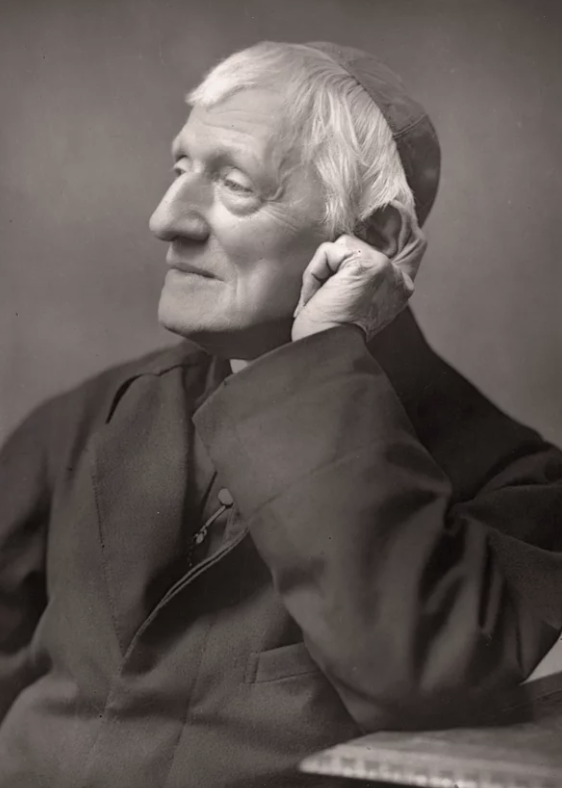
“If they did not listen to GK Chesterton and St John Henry Newman, they will not believe, even if …. “
(complete the sentence in your own time.)
There will be no wave of Anglican conversions.
What there will be is a wave of conversions from the dry arid desert of secular consumerism and nihilism. And this is what the Catholic world needs to gird up its loins for, with a fresh determination to evangelise and rescue its neighbours with the power of the Gospel and the promise of the Sacraments.
It’s time to leave the dead to bury the dead.