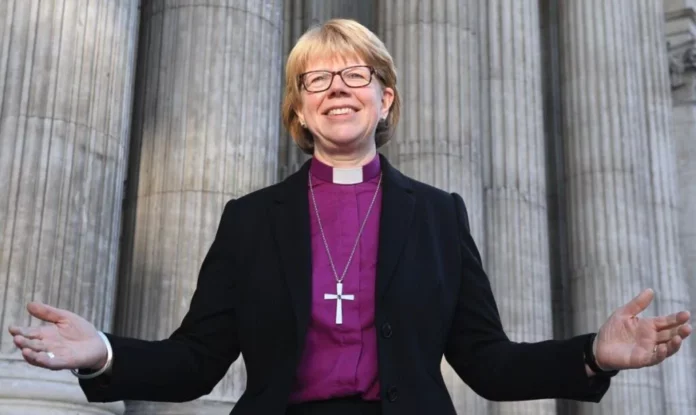
Yesterday morning, at 10 am, the historic announcement was made as to who will be the 106th Archbishop of Canterbury: Dame Sarah Mullally, the current bishop of London, and former Chief Nurse—appointed to that role when she was 37, the youngest ever appointment. As I have set out previously, the Church of England faces a range of challenges, chief amongst those (but rarely discussed) the looming demographic crisis for its clergy. But the ABC is not the C of E’s pope, and we already have a saviour in Jesus, so we would be mistaken to look to a new leader to solve all our problems. We tried that last time, and it did not end well.
So what is Sarah Mullally like? And will the challenges she faces be easier or harder given her own temperament, experience, and outlook?
In the news (which I spent most of yesterday involved in) much was made, for good or ill, of the fact that she is the first woman to be archbishop since the office was founded in 597. Although there is always symbolic significance to this, my sense is that this is more important to those outside the Church than those on the inside. After all, it was one of the early triumph’s of Justin Welby’s time in office that we reached a settlement enabling women to be ordained bishop ten years ago, a long time after the first women were ordained presbyter in 1993. (The key question here was that of the exercise of authority over men for ‘traditionalists’, and the validity of ordinations conducted by anyone ordained by a woman.) It will make it harder to repair relations across the Anglican Communion (on which, see below), and those who do not recognise the ministry of women (either conservative evangelicals or traditionalist Anglo-Catholics) will feel more marginalised in the Church. But it is not quite the Rubicon that many have claimed.
For those questioning the choice of the Crown Nominations Commission, my response has been: ‘Well, who else could have been appointed?’ One of Justin’s legacies to the Church has been much greater division and polarisation on contentious issues; this means that, for a process that looks for a consensus candidate, anyone who has spoken out, for example, on sexuality—either asking for radical change, or calling for faithfulness to the doctrine of the Church and the teaching of Jesus—is going to find it hard to command wide enough support. Tragically, this means that a good number of evangelical and orthodox bishops were ruled out from the start. But it also means that any of those who signed the letter of 44 bishops, calling for clergy to be able to enter same-sex marriage, was also not going to be appointed.
Although the CNC process is supposed to be strictly confidential, last Wednesday the Daily Telegraph claimed to know the four who were shortlisted: Pete Wilcox, bishop of Sheffield; Guli Francis-Dehqani, bishop of Chelmsford and always the bookmakers’ favourite; Michael Beasley, bishop of Bath and Wells; and Sarah. (Note: I have since been informed that no paper correctly reported the shortlist, so this list is close but not completely correct.) It was unlikely that Pete Wilcox, an evangelical, would gain consensus following a previous evangelical appointment. Guli signed the letter of the 44, and so would have been a divisive choice. That left Michael, aged 56 with less than three years as a diocesan, or Sarah, with eight years experience of leading the most complex and divided diocese in the Church—both in the ‘moderate liberal’ branch of the C of E. Given that, I don’t think the decision was a surprise—and I cannot think of an obvious workable alternative.
The appointment of Sarah to be bishop of London was another of Justin’s legacies (note to anyone in leadership: your appointment of others is often the most lasting legacy you leave). It is something of an open secret that the four candidates for London at the time were Sarah, Paula Vennells (of Post Office fame), Chris Cocksworth, bishop of Coventry, and Graham Tomlin, bishop of Kensington. When Sarah was appointed with the strong support of Justin, both Chris and Graham moved on to non-episcopal roles, despite the fact that they could have been excellent senior appointments.
One of Sarah’s challenges, therefore, is to signal clearly that she is not another Justin. I understand that she has done this before, in that she signalled in London very clearly that she was not going to be another Richard Chartres, who, loved though he was, was not someone who believed in transparency and process, but exercised his power with somewhat unpredictable autonomy. I was fascinated to read this testimony from Gerry Lynch, someone who knows Sarah and has worked with her, which he posted on Facebook:
It’s not easy to give a fair and balanced public assessment of someone you know personally, even slightly, but here is my best attempt as someone who knows Sarah Mullally slightly—she was Canon Treasurer at Salisbury Cathedral when I arrived in the city 12 years ago. The strengths: Sarah is a superlative behind-the-scenes operator of the Church’s machinery; she knows what governance is about and how to make machinery of governance work. Her colleagues regularly spoke exceptionally highly of her in this regard, spontaneously and without prompting, when she was in this diocese. She has succeeded as a liberal, Central Tradition, Bishop of London, in holding together a notoriously difficult diocese with large blocs of Conservatives on both the Evangelical and Anglo-Catholic ends of the C of E. It isn’t even that the Diocese of London is a microcosm of the entire Church of England—it’s actually far more difficult and far more divided than most of the rest of the Church, and it has been for decades. I presume that’s why she got the job—she’s seen as the person to improve the operation of central machinery and hold the Church together in an era of threatened splits and repeated criticism of poor governance. The weaknesses: Sarah isn’t a great preacher and isn’t a great public communicator. She’ll have people round her to help with this. She’ll need them…
Gerry is certainly right on the last point; her opening address was much more reassuring than it was exciting, and she is not a compelling communicator.
The other things that clergy colleagues from London repeatedly mention is her kindness and willingness to listen. Marcus Walker shared this lovely anecdote on Twitter:
I am glad we will have a ‘pastor pastorum’ again—a shepherd of the shepherds. I will never forget what happened when I discovered I had Covid one Saturday morning towards the end of lockdown. I tweeted out, rather mournfully and without much expectation of success, a plea for anyone in deacon’s orders and free to come and deacon at our Sunday service. Within 30 minutes, Sarah had DM’d me and offered to step in, even though she was supposed to be on holiday. She did so, although we did get her to celebrate rather than deacon!
Evangelical friends have repeated how pleasantly surprised they have been at her willingness to work with them, engage, and treat them with respect and kindness. Although he had his moments, I don’t think Justin really merited the description ‘kind’ from many that worked with him.
Kindness is an essential of Christian leadership, though on its own it is not enough. The tendency to want to be kind to everyone can backfire, and the danger is that you say to each person or each group the thing that you think they want to hear. Justin repeatedly did this for other reasons, and that was one of the things which sowed division: on sexuality, each group believed that they were going to get what they wanted, on the basis of his promises, and when the process became public, all sides were dismayed.
Sarah does seem to want to take quite a different approach. In the Religion Media Centre discussion, which you can watch here, Justin Humphreys of the safeguarding organisation ThirtyOneEight, observed:
Bishop Sarah has spoken in her address this morning of needing to acknowledge the problems with power and culture within and across the CofE. I would be keen for us to discuss what it might take to model a different way of managing power and changing culture. I think everyone is keen to see a different style of leadership modelled.
The danger here is that Sarah will, out of kindness, want to reassure ‘conservatives’ of various colours. But, out of kindness, her natural instinct will also be to reassure those who are campaigning for the doctrine of the Church to change, and those who do not abide by the discipline of the Church in their relationships. Without the guiding and shape of other theological and institutional insights, the result could be incoherence and contradiction—neither of which end up being kind.
These tensions have been evident in her involvement with the LLF process, to which she brings a very mixed legacy. Following the debates in Synod, and the failure to make much progress on the key issues around pastoral provision and the responsibilities of clergy in the light of the unchanging doctrine of the Church on marriage, Sarah took on chairing the Next Steps group.
In that capacity, she repeatedly reassured Synod that the Church’s doctrine of marriage, set out in Canon B30, that marriage is, ‘according to the teaching of our Lord, a lifelong and exclusion union between one man and one woman’ and that there were no plans to change this:
Mullally reiterated that the Bishops had taken the view “that the doctrine of marriage was unaffected by the proposed prayers of blessing”, and that “the right context for sexual intimacy is within lifelong, committed, and faithful relationships…The doctrine of the Church of England on marriage as being a lifelong, faithful relationship between one man and one woman is unchanged…The Prayers of Love and Faith … do not indicate any departure from the orthodox doctrines of the Church of England.” (February 2023)
Mullally reiterated that no change of doctrine was envisaged; that all that was being introduced was “pastoral provision in a time of uncertainty.” And that the prayers “did not change the doctrine of marriage.” (November 2023)
On the other hand, when pressed by Clive Scowen in a motion to publish the legal advice, she refused, claiming that the substance of the legal advice was already contained in GS 2328—something which few found convincing. This illustrates the danger of always ‘following due process’: when the process doesn’t give the answer you want, the temptation is to skew the process, then hide behind the ‘due process’ claim.
By contrast, Michael Beasley dramatically blew the whistle on this in Synod in July 2024. He highlighted the sexuality elephant in the room, that the introduction of stand-alone services would undermine previous commitments by the House of Bishops that the Prayers of Love and Faith would not contradict holy matrimony. He said that legal advice given to the Bishops stated that the stand-alone services must not resemble marriage services, but many now worried that they did, and would therefore be indicative of a change of doctrine—and even claimed that what was being brought before Synod had not in fact been discussed in the House of Bishops, despite claims to the contrary.
Behind all this, of course, we can see the hand of Justin Welby himself, desperate to move the debate to the conclusion he wanted before his term of office ended. The question then is the extent to which Sarah felt obliged to go along with this—and the question now is whether she will adopt a more honest and open approach. In relation to the use of power, someone said to me that she is not the kind of person to bang the table—or try and turn the tables over (unlike Justin). The problem is, as Justin found out in the end, on our doctrine of marriage, the tables are firmly screwed to the floor and are not for overturning.
The irony here is that the LLF process might well be formally brought to an end in the Synod of February 2026—which will be a month before Sarah is installed in Canterbury and officially takes up office. So in theory she could inherit a clean sheet, and be able to focus on other things.
Her position on this is one of the questions hanging over the future of the Anglican Communion. In theory, the Communion was represented for the first time on the CNC—but the appointment process was opaque, and bizarrely two of the five came from Wales and New Zealand, two of the smallest, fastest shrinking, and most liberal parts of the Communion. Such a result undermined any confidence that this group would really be representative of the concerns of the Communion, especially in Africa and Asia.
It was no surprise, then, that GAFCON, representing the most ‘conservative’ voices in the Communion, rejected Sarah’s appointment outright, on the basis of both her sex and her teaching.
It is with sorrow that Gafcon receives the announcement today of the appointment of Dame Sarah Mullally as the next Archbishop of Canterbury. This appointment abandons global Anglicans, as the Church of England has chosen a leader who will further divide an already split Communion… [D]ue to the failure of successive Archbishops of Canterbury to guard the faith, the office can no longer function as a credible leader of Anglicans, let alone a focus of unity. As we made clear in our Kigali Commitment of 2023, we can ‘no longer recognise the Archbishop of Canterbury as an Instrument of Communion’ or the ‘first among equals’of global Primates… Though there are some who will welcome the decision to appoint Bishop Mullally as the first female Archbishop of Canterbury, the majority of the Anglican Communion still believes that the Bible requires a male-only episcopacy. Therefore, her appointment will make it impossible for the Archbishop of Canterbury to serve as a focus of unity within the Communion.
The statement from the much larger Global South Fellowship of Anglicans (GSFA) led by the delightful Justin Badi, was more measured, but equally clear:
[W]e are deeply saddened that the person still perceived by many to be the spiritual leader of now some 100 million Anglicans worldwide has played a leading role in the Church of England’s departure from Anglican tradition and the clear teaching of Scripture in matters of marriage and sexuality. When the Church of England’s General Synod opened the door to the blessing of same sex relationships at its February 2023 General Synod she described this as ‘A moment of hope’. For us, it was a moment of lament because we believe that the teaching of Jesus and the whole of Scripture is fundamental to human flourishing, both now and for eternity, and should not be compromised by the pressures of a particular culture. Sadly therefore, our position must remain as it was in our Ash Wednesday statement of February 2023 when we stated that we were no longer able to recognise the then Archbishop of Canterbury as the ‘first amongst equals’ leader of the global Communion.
Someone said to me: ‘The appointment of Sarah Mullally is the last nail in the coffin of the Anglican Communion’. I don’t think that is the case; as both statements make clear, it was Justin Welby who put the nails in the coffin. The task for the next archbishop was to begin to remove the nails from the coffin, take the lid off, and see whether the corpse could be revived. I am not sure that Sarah will be in any position to do that—and I suspect it will not be a priority. And in any case, there is no possibility of any kind of Lambeth Conference during her time in office. I think Communion matters will remain on ice (in every sense) during her term.
Within the C of E, Rob Monro, bishop of Ebbsfleet who provides alternative episcopal oversight for those ….