I Think It Would Be Nice If They Picked Someone Who Sounds Like A Christian
First of all, I totally forgot to send the livestream out. I’ll send that email after this one, if you’d like to watch or listen. Sorry about two emails in one day. I hope it is not De Trop, as they say. My only excuse is that I had a meeting in the evening and then I stayed up far too late reading the internet. The trouble is that there are so many things to write about, it is hard to know in which direction to wander. I read this long and terrifying thing about something called Parasitic AI. I might come back to it later, because, unhappily, it seems relevant. Then there is Jeff Walton’s piece about the Jurisdiction of the Armed Forces leaving the ACNA and how it really isn’t about ideology. And there was this clip of a female cleric calling Psalm 139 a “blunt instrument” against “reproductive rights for women.”
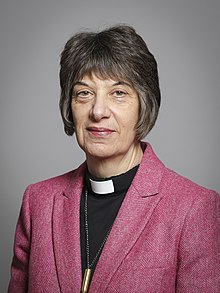
On that note, I can’t pass up Kevin Kallsen’s excellent reporting in Anglican Ink on the speculation about who the new Archbishop of Canterbury will be. Many expect that the Bishop of Gloucester will be chosen. Here’s a picture of her:
Doesn’t she look friendly and not at all like she would scold you for sitting in the wrong pew or eating too much jam. From the piece:
In a potential historic move for the Anglican Communion, sources within the Church of England indicate that the next Archbishop of Canterbury could be a woman, marking the first time in the church’s history that a female bishop would assume the role. This speculation emerges just a year after the resignation of Justin Welby amid revelations of a cover-up involving severe abuse cases.
“Just a year.” I don’t remember it taking that long before, but maybe it often does. What I want to know is why they need an archbishop of Canterbury at all. It seems like everything is ticking along in the usual way. There is plenty of bureaucracy to be going on with as it were.
The appointment process, overseen by the Crown Nominations Commission, is nearing completion, with an announcement expected from Downing Street in the coming week. Insiders have pointed to the Rt. Rev. Rachel Treweek, Bishop of Gloucester, as a leading candidate. Notably, Bishop Treweek was absent from a major conference she was scheduled to host this week, offering no public explanation. She has also ceased activity on social media platform X and withdrawn her diocese’s presence there.
That does sound ominous. The first thing one has to do, in this new cyborg age, is scrub all one’s social media as if it can’t all be gotten back through the diligent work of people who know more than how to turn it off and then on again.
Bishop Treweek, consecrated in 2015 as the first female diocesan bishop in the Church of England, has been vocal on several issues. She has criticized the conflict in Gaza, expressing deep concern over the “obliteration of human life and disregard of the dignity of every human being.” Additionally, she advocates for prison reform, combating violence against women, and reforming church governance structures.
Does the reform of prison include keeping men out of women’s spaces? I hope that her concern for human life, for the dignity of every human being, will not begin and end in Gaza, but will stretch into every corner of the globe, like Nigeria and Syria, and compass every kind of person, including the unborn, the vulnerable, the person whom the state might soon be inviting to give up and be done away with in the name of compassion.
However, the prospect of a female Archbishop has sparked significant debate within the church. A member of the General Synod, the Church of England’s governing body, expressed astonishment at the possibility, noting the challenges in unifying a divided communion. Conservative Anglicans, particularly those opposed to women’s ordination, may resist such a leadership change.
I don’t want to be cynical, but I think if anyone with any power and authority had been worried about “unifying a divided communion” over the last fifteen years, they would have not picked Justin Welby, and, indeed, would have taken a whole variety of decisions contrary to the ones that, they have, in fact, taken.
It’s not a done deal, of course. The Crown Nominations Commission might take the shocking step of choosing a man. Some in the General Synod, like the Rev. Dr. Ian Paul think this is more likely. Others think the choice of Bishop Rachel will be the best thing, especially for “survivors of church abuse.” Someone named Andrew Graystone explained that “She is a courageous person who cares deeply, and wants the church to do better.”
Of course, everyone would like the church to “do better” but that, O Best Beloved, entirely misses the point of the exercise. The church isn’t about “doing better.” The church is there for the proclamation of the gospel of Jesus Christ, for the care and nurture of sheep, for the glory of God, and as a light unto the nations. It’s not a business. It’s not a factory or a machine. It’s not a widget or an app. “Caring deeply” and wanting it to “do better” are empty, temporal platitudes that have no bearing on the heights and depths and breadth of the Kingdom of God.
I am always ready to express the degree to which my heart is broken over the destruction of the English Church. I have a whole panoply of lamentations. I have uttered them all so often they probably sound boring by now. They begin with sadness about so many buildings being either left empty, or having raves in their naves, or inhabited by people who aren’t able to tell their theological left hand from their ideological right one. They culminate in deep feelings of embarrassment about the way noted English clerics—the kind who might be quoted in the media—sound.
They don’t sound Christian, is the problem. It is reasonable to be upset that the Crown Nomination Commission is considering a woman (of course they are) but the more primary and essential reason to be upset is that the kinds of sentences formed and uttered out of the mouths of those who have been set apart by some committee or other to serve God in his Holy Church don’t evince an experiential knowledge of Jesus.
Shouldn’t that be a thing? Shouldn’t people who work in the Church sound Christian—ish?
Read it all in Demotivations With Anne