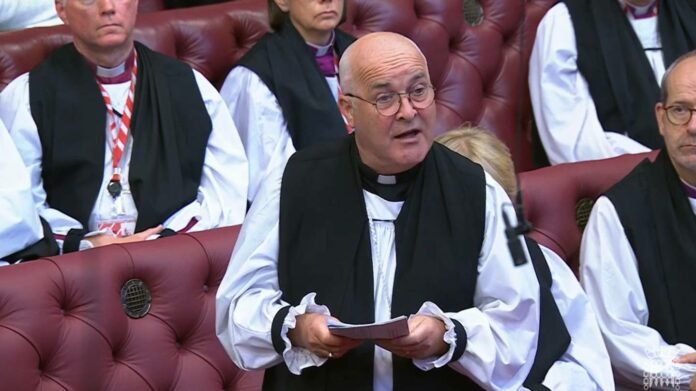
Legalising assisted suicide in England and Wales would unleash a “fundamental” change in society, the Archbishop of York has warned, with vulnerable people put at risk of feeling they have a ‘duty to die.’
There is “a moral universe of difference” between doctors and clinicians in consultation with families withdrawing treatment in the last days of someone’s life, to picking out ‘six months’ as the point at which life for some can be extinguished, Archbishop Stephen Cottrell told the House of Lords, during the Second Reading of the Terminally Ill Adults (End of Life) Private Member’s bill.
And he challenged the Lords sponsor of the Bill, Lord Falconer, to explain why the proposed Bill denies the right of hospices to opt out of providing assisted suicide on grounds of conscience.
In his speech, he highlighted the experience of Canada – where assisted suicide is legal – and the “heart rending” stories of people who had chosen an ‘assisted death’ because they believed it was better for their family than spending their inheritance on care.
Speaking on the final day of the Second Reading of the Bill, he warned peers: “If we do this, we unleash into our society a fundamental change in our relationships: the relationship between death and life, between doctor and patient, between parent and child, between citizen and state.
“And I saw this first hand in Canada last year where priest after priest told me heartrending stories of people choosing an assisted death because it was better for their family than spending an already meagre inheritance on expensive care, and sometimes feeling forced into this choice. They felt it was their duty to die.”
In his speech Archbishop Stephen spoke of his fears that the legislation will be loosened once introduced and that it would have a damaging effect on palliative care.
He said: “I think we can do better than this. Of course I don’t want any one to die a painful agonizing death, but nor do I want poor and vulnerable people to be faced with such agonizing choices.
“Better palliative care can massively ease the first dilemma, assisted death will turbocharge the latter. “
Archbishop Stephen spoke of his time working in a hospice before he trained for ordination to the priesthood.
“On my first day on the ward I was terrified, all I could see was cancer and death, but during that year I learned that it is possible to live until you die, and although there are some illnesses so hideous that they cannot be completely controlled, in most cases they can, honouring people’s dignity and upholding their value as someone made in the image of God until their life’s end.”
And he repeated the message of the Bishop of London who spoke in last week’s Second Reading debate of her hope that the Lords would have an opportunity to vote on the principle of the Bill at Third Reading – and indicated that she would be prepared to put an amendment at that stage to enable that to happen.
“I also want to say, alongside the Bishop of London that if this bill does reach a third reading, then we from these benches will be prepared to table an amendment to offer us a vote,” he said.
Earlier in the debate, the Bishop of Chichester, Martin Warner, described the Bill as “crossing the Rubicon” for society. He called for a significant and sustained increase in investment in palliative care.
“Although the right to life, enshrined in law is a moral principle consistent with the Christian faith, it should not be regarded as the imposition of Christianity upon the pluralist democracy we are proud to be.
“However, many Christians, including myself, see this Bill as crossing the Rubicon.”
Calling for increased investment in palliative care, he said “Human suffering around the end of life especially, compels us to press, ever more urgently for significant increased and sustained investment in palliative care, and to learn lessons from the hospice movement’s attention to the qualities of distinctive, individual needs and relationships – in sharp contrast to the complex bureaucratic processes that are outlined in this Bill.”
The Bill now goes to a select committee for further scrutiny with a deadline of reporting back to the House of Lords by November 7, before it can move to the next stage.