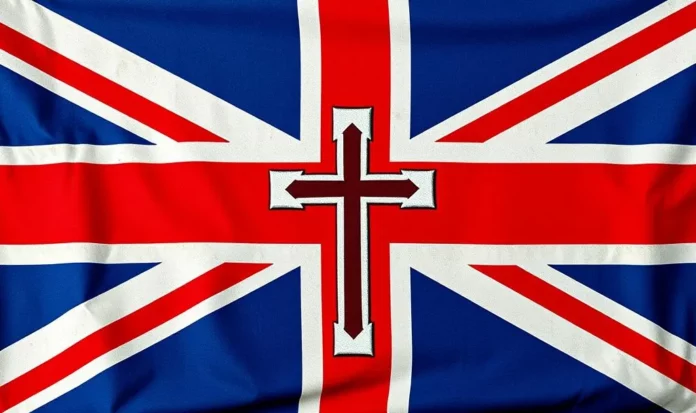
Is it time to exorcise the false religion of wokeness and return to our Biblical foundations?
About a month ago, the Christian Conservative MP Danny Kruger rose to his feet in a virtually empty House of Commons on a sleepy Thursday afternoon to make a speech. It was an adjournment debate, when any MP can request a brief 15-minute slot just before the business of the House is adjourned for the day to say their piece on anything they want. They get a response from a government minister, but there’s no motion to pass and nothing ever comes of it. It’s just a way to make a point.
And the point Kruger (the son of celebrity chef Prue Leith, David Cameron’s former speechwriter and the founder of a prisons charity) wanted to make was this: the UK was once a nation founded around common worship of the Christian God, and it has jettisoned that at great cost. He began like this:
“It is an honour to stand here in this empty chamber to speak about the original purpose of this space, when it was a chapel in the Church of England.”
The building which now serves as the cockpit of democracy was originally St Stephen’s Chapel in the Palace of Westminster, before it was given over to parliament by Henry VIII.
“I mention that because the link between this place and the Church of England is not merely ceremonial. The prayers we say here at the start of every day are not just a nod to tradition. Our democracy is founded on Christian faith.”
And not just Christianity in general, but the Church of England in particular. MPs retain the power to approve or reject all the Church of England’s rules, Kruger reminded the two or three of his colleagues who’d bothered to hang around in the chamber. Thanks to the parish system, everyone – including die-hard atheists who never set foot in a church – has their own local church and priest, and is in fact by default a member of their national church.
Both the church and the nation are in a bad way, Kruger went on. We all know the C of E’s problems: leaderless, divided, confused, declining. But the country it serves is similarly poorly led, precarious and in moral decline. Kruger pointed to the votes recently to decriminalise abortion and legalise assisted suicide:
“Last month, in the space of three days in one infamous week, this House authorised the killing of unborn children—of nine-month-old babies—and it passed a Bill to allow the killing of the elderly and disabled. I describe those laws in those stark terms not to provoke further controversy, but because those are the facts. We gave our consent to the greatest crime: the killing of the weak and most defenceless human beings. It was a great sin. If, standing here, I have any power to repent on behalf of this House, I hereby repent of what we did.”
Britain (or more accurately England until relatively recently) was founded on the basis of the Bible and “the story of the Hebrew people”, Kruger claimed. I think some historians would dispute this, but let’s not linger for now. Certainly the Anglo-Saxon kings who progressively united the disparate fiefdoms of early medieval England into a unitary nation were often devout believers who tried to unite a common Saxon people around a shared Christian faith (often in opposition to the pagan Danes and Vikings who lived among them). But there was also a heap of other stuff going on too, about power and geopolitics and ethnicity and much more.
“The story of England is the story of Christianity operating on a people to make the institutions and culture that have been uniquely stable and successful.”
This Christian heritage apparently gave England the rule of law, the dignity of all people down to the lowliest serf, and freedom of conscience – including the freedom not to be a Christian, paradoxically (yes, this is basically the Tom Holland thesis recapitaluted, astute readers will have noticed). But in the 20th century, after a millennium of assumptions that the nation was a “a community of common worship”, a new idea arose: a country can be neutral about God and flourishing could be found in a public square denuded of spirituality and instead governed by reason. But, Kruger concluded, “that idea was wrong”:
“The horrors of the 20th century attest to that, not least in the West, where we escaped totalitarianism but have suffered our own catastrophes of social breakdown, social injustice, loneliness and emptiness on a chronic scale. Ugly and aggressive new threats are now arising, because we have found that in the absence of the Christian God, we do not have pluralism and tolerance, with everyone being nice to each other in a godless world. All politics is religious, and in abandoning one religion we simply create a space for others to move into.”
One of those was Islam. He found himself agreeing with Muslim MPs often on moral and social matters, Kruger said, and yet he could not remain “indifferent” to that faith’s growth in recent decades. Another new religion which has sprung up in the vacuum provided by the evacuation of Christianity was best known as “wokeness”.
This is a “combination of ancient paganism, Christian heresies and the cult of modernism” which was “deeply dangerous” and actively hostile to the things all people should hold dear: family, tribe and nation. Wokeness, unlike Islam, must be eradicated from public life, Kruger argued (including universities and public services) and banished to become only an eccentric hobby akin to the modern druids gathered around Stonehenge in his own constituency: “mad, but harmless”. Britain must re-own its Christian story and recentre itself around worship of the true God, Jesus Christ:
“To worship human rights is to worship fairies, but if we own our story and remember the real sources of our civilisation, we can have these things and make them real—real freedom and tolerance and dignity, a culture of love and, crucially, a culture of humanity.
A storm was coming and Britain must find out if its house was built on rock or on sand, he concluded. Previous generations of Christians have brought the “country back from the edge” of social and political crises driven by “indifference to Christianity”, and now the C of E must take up this mantle once more:
“A new restoration is needed now, with a revival of the faith, a recovery of a Christian politics and a refounding of this nation on the teachings that Alfred made the basis of the common law of England all those centuries ago. This is a mission for the church under its next leader, whoever that is; it is a mission for this place—the old chapel that became the wellspring of western democracy—and for us, its members; and it is a mission for our whole country.”
Stirring stuff. The formal response from Jim McMahon, the minister for local government and devolution tasked with replying to Kruger, was not quite so thunderous. McMahon, himself a Catholic, blandly spoke about the tremendous good works Christians (and those of other faiths) did up and down the land. He rattled through the constitutional arrangements of establishment, which place 26 C of E bishops in the House of Lords and give parliament a limited role in governance of the denomination too (not to mention the King, on advice of his ministers, appointing bishops too). All very insipid, and not really an answer to Kruger’s strident cries.
Because, one suspects, the real answer from Keir Starmer’s government would be to reject almost every point Kruger is making. No, Britain is not still intrinsically built on Christian foundations (beyond the banal historical facts of establishment etc). No, we do not need Christianity woven into public life to keep our freedoms and rights. No, wokeness (let alone Islam) is not a threat to everything we hold dear. No, we do not want the C of E under its new archbishop to lead the refounding of Britain on Christian theology.
What I found fascinating is how this language from the political right has become so commonplace in recent years. You only have to go back maybe a decade, under Kruger’s former boss Cameron, to find a conservatism which would run a mile from this strident version of Christian nationalism.
Read it all The Critical Friend