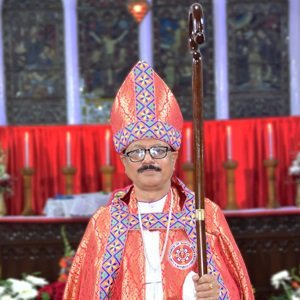
A mob broke up the dedication of a new Church of North India (CNI) church in West Bengal on Saturday, 31 Oct 2026. They beat clergy and worshippers, pulled down the cross and forced the congregation out of the building, according to eyewitnesses quoted by AsiaNews and The Week.
The attack in the village of Narayantala, near Basanti, at the William Carey Memorial Church took place in front of the Rt. Rev. Subrata Chakraborty, Bishop in Barrackpore, who was assaulted by the mob, the Telegraph. The Daily Jagran reported that he and other priests were injured. The Bengal Christian Council (Bangiya Christiya Pariseba, or BCP) described it as the first such attack on a CNI church in the state, and minority leaders say such attacks have become more frequent since the Bharatiya Janata Party (BJP) took power in Bengal, according to The Telegraph.
Police have registered a First Information Report (FIR), the formal criminal complaint. Prabir Ghosh, the inspector in charge at Basanti police station, told Alt News that officers have identified about 14 suspects and served notices on five. No arrests have been made.
Witnesses say Bishop Chakraborty arrived in procession with clergy from nearby churches. The Week reported that about 120 people attended, including some 15 priests.
Reports differ on the time and the size of the crowd. Congregation members told AsiaNews the attack began at about 8 am. The Week put it at about 10:30 am. A police officer told the Press Trust of India, in a report carried by the Assam Tribune, that 30 to 35 people entered the grounds. The Times of India, as reproduced by WN, put the number at about 20. A witness told Alt News there were nearly 60.
“We had a procession and entered the church. A while into the programme inside the church, a mob of 30-35 people, some who were drunk too, entered the church chanting ‘Jai Shree Ram’. They enquired whether there were any Hindus, to which we said no,” parishioner Prodip Mondol told The Week.
A witness told Alt News that the men then turned on the women. They demanded that the women take off their sindoor (the red mark in the hair parting) and their shankha-pola bangles, which married Bengali Hindu women traditionally wear, and asked why they had left Hinduism. The same witness said pastors were beaten and the cross was taken down and stamped on. A young CNI member was hit for asking, “Are we not allowed to practise Christianity?” An elderly worshipper was kicked, and musical instruments and chairs were smashed.
According to AsiaNews, the attackers seized and broke the phones of people trying to film the assault. They warned: “No singing, prayers or religious ceremonies will be allowed here. We will not permit religious services to take place under any circumstances.” The Week reported that the assault lasted about 25 minutes, that police arrived about an hour and a half later, and that the church is still closed.
The bishop and the police give different accounts of the cause.
Bishop Chakraborty told the Times of India that “with the support of a few members of nearby Baptist churches, some extremists from the local Hindu Jagran Manch carried out the attack,” according to Alt News. The Hindu Jagran Manch is a Hindu nationalist group.
Police have pointed to a local rivalry. “Prima facie, the issue erupted over a dispute between two churches located within 100 metres of each other in the same locality. A complaint had previously been lodged against the new church as well,” police told the Times of India, as reproduced by WN.
CNI members told Alt News that a nearby Baptist congregation had objected to the new building. It wanted members who switched to the CNI to get transfer certificates first. The BJP head of the local village council had approved the construction, and work went on for about seven months. The two congregations met on 28 October and agreed on terms, three days before the attack. Some CNI members suspect that Baptist members stirred up Hindu nationalist activists. None of these claims has been tested by the police.
The Week reported that the land was bought with the required approvals, including from the village council.
Herod Mullick of the BCP said Christians were being attacked because the authorities had failed to act. “Day after day, organised extremist groups take the law into their own hands by targeting peaceful minorities,” he told AsiaNews. “Having encountered no significant opposition from the administration or the government, these attackers have become so brazen as to torture the priests of a recognised Church without hesitation.”
The BCP’s legal adviser repeatedly tried to reach the local police chief, who reportedly cut off the calls, according to AsiaNews. The lawyer then contacted the district superintendent of police, and only after that was a patrol sent. Mullick told AsiaNews that church authorities, “in particular the bishop who was present during the attack,” were “expected to take decisive legal and institutional action against those responsible.”
“The church and the assaulted clergy belong to the Church of North India. They are not helpless or weak like isolated house churches,” Mullick told The Week. The Week also reported that the BCP’s legal cell is helping with the case.
No statement from the CNI Synod or the Diocese of Barrackpore had been published at the time of writing.
The Diocese of Barrackpore was formed on 26 August 1956 and joined the CNI when the united church was inaugurated on 29 November 1970. It covers North and South 24 Parganas, Nadia and Murshidabad districts, and Bishop Chakraborty has led it since 26 January 2022. The CNI was formed in 1970 from six uniting churches and has about 1.3 million members in some 3,000 congregations, according to the Presbyterian Church in Ireland.
The BJP won 207 of the 294 seats in the West Bengal assembly in May, ending 15 years of Trinamool Congress rule, the BBC reported. Suvendu Adhikari was sworn in as the state’s first BJP chief minister on 9 May, according to DW.
In August, Mr. Adhikari said one of his remaining tasks was “to bring a law against religious conversions.” He said Bankura and the Jangalmahal area had seen “a trend of religious conversion with the help of foreign funds and taking advantage of the poor economic conditions of people,” The Indian Express reported. On 4 October he said, “give me six months,” promising a uniform civil code followed by “strict laws to stop ‘love jihad’, ‘land jihad’ and religious conversion,” according to India Today. A uniform civil code would replace each religion’s family law with one civil law for everyone.
The BCP says it has recorded at least 48 attacks on Christian prayer meetings and places of worship since May, but police registered complaints in only 15, according to Vartha Bharati. Seven of the 48 involved churches of the older, mainline denominations: six Catholic churches and the Narayantala CNI church. Mullick called the charge of “forced conversion” a “false narrative” used to cast peaceful prayer meetings as illegal conversion events, SabrangIndia reported.
The day after the Basanti attack, 12 saffron-clad men broke into a Sunday house-church meeting in Harishchandrapur in Malda district and damaged the property, according to Alt News. They accused the worshippers of converting poor Hindus with money and gifts. Alt News reported that a Vishva Hindu Parishad member denied his colleagues had done the damage, though videos posted online appeared to show local activists taking part. On 5 July, a mob damaged a church under construction at Subhashgram, also in South 24 Parganas, SabrangIndia reported.
In January, the Church of South India raised similar concerns after Christmas services in several states were harassed or disrupted.
The BCP held a prayer rally on Rani Rashmoni Road in central Kolkata on 1 November. On Thursday, 5 November, hundreds of Christians marched to Kolkata’s Esplanade, Vartha Bharati reported. Those attending included Archbishop Joseph D’Souza of the All India Christian Council and Bishops Shyamal Bose, Nirmal Gomes and Subodh Mondal.
“We have been victims of such religious oppression historically. We must stand together against such barbarism unleashed on the Christian community,” Archbishop D’Souza said, according to SabrangIndia.
The same week, a five-member BCP delegation met Jishnu Basu, the West Bengal head of the Rashtriya Swayamsevak Sangh (RSS), the Hindu nationalist movement linked to the BJP. According to Mullick, Dr. Basu said attacks on places of worship “are entirely unacceptable and cannot be justified under any circumstances,” and promised to raise the matter with the chief minister. Mullick told SabrangIndia that Christians are afraid ahead of Christmas, though he described the BCP’s talks with the administration as positive.
Congress MP Naseer Hussain called on the state government on X to protect Christians and “hold the perpetrators accountable,” Vartha Bharati reported.