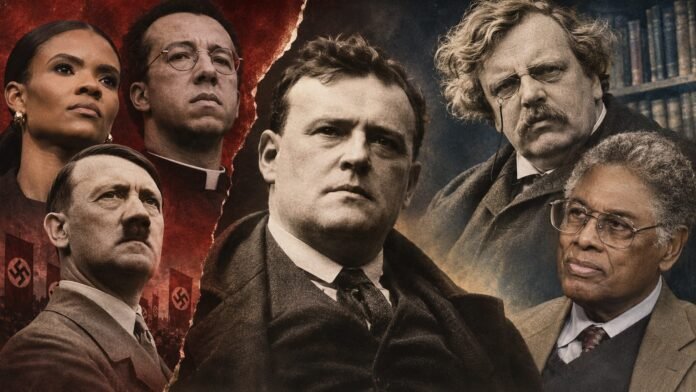
With the resurgence of the old, old hatred, claims are being made that there are sufficient elements in Christian history and thought to justifies the bitter effusions of contemporary voices like Candice Owens and Calvin Robinson. I thought two of the most interesting related to Belloc and G. K. Chesterton.
This seemed to me to be sufficiently important to take a look. And we will invite Thomas Sowell and Jacques Maritain as umpires.
The context is the latest toxic soundbite from Calvin Robinson on X. Jews, he wrote, “have become a protected class”; and then:
“We do not need to burn the Jews. We can just deport them.”
The State Department is now reviewing his American visa. Perhaps we can help them by exploring whether or not invoking the writing of Belloc and Chesterton acts, as some claim, as some kind of defence?
The reason for taking this seriously is that the charge is not entirely without substance. Belloc did have difficulty with the Jews, and Chesterton got caught up in it a little, although his supporters give evidence of his philosemitism as well.
So the really interesting question is what kind of prejudice was Belloc’s, and where does it come from? What does Christian theology finally have to say about it?
We’re going to find ourselves looking at economics and culture, taking advice from Thomas Sowell, before we come to what seems to me to be the decisive analysis in the argument by Maritain, which is that the root of it is resentment with God for choosing a chosen people: basically, jealousy.
Belloc’s problem
I remember the first time I discovered the Dreyfus case and was astonished at what led to it in France.
Belloc said,
“It was the Dreyfus case that first opened my eyes to the Jewish question.”
In fact, he drew a different conclusion from most other people. Where other people saw an innocent Jewish officer framed by a corrupt French military establishment, he saw evidence of an “Anglo-Judaic plutocracy” with its hands firmly on the levers of business, politics and the press.
Belloc wasn’t alone in this, of course, as Thomas Sowell who exposes this rather nasty misreading of economic competence will remind us.
In the England of 1912 and 1913, however, there was a scandal called the Marconi affair. The magazine Eye-Witness, which was edited first by Belloc and then by Cecil Chesterton, who renamed it the New Witness, accused the Attorney General, Rufus Isaacs, and other ministers of corruptly buying shares in the American Marconi Company while the British government was negotiating a contract with its English sister company.
In fact, they had uncovered real impropriety, but instead of putting it down to greed, the paper’s coverage leant heavily on the Jewishness of the men involved, and when Cecil Chesterton was prosecuted for criminal libel by Godfrey Isaacs and convicted, he and Belloc were left bitter and angry.
At this point it’s true Belloc does begin to sound a little bit like Calvin Robinson. He wrote in his book The Jews (1922):
“The Jews are an alien body within the society they inhabit. Hence irritation and friction. A problem is presented by the strains thus set up. The solution of that problem is urgently necessary.”
Then, chillingly, he considers ways in which a society may dispose of this alien body:
“Elimination may be by destruction, by excretion or by absorption. In the case of the Jews the first is abominable and further has failed; the second means exile and it has also failed.”
His own proposal was what he called recognition: frank acknowledgement of the Jews as a distinct nation living amongst others under a separate and acknowledged status.
Follow the logic of a separate, marked status and you are not far from where Germany went.
Actually, there were two sides to Belloc, and if we had to argue for him, we need to take into account that in that very passage he called the destruction of the Jews abominable, and the fact that he dedicated the book to his Jewish secretary, Ruby Goldsmith, whom he called
“the best and most intimate of our Jewish friends”.
He thought the book was about justice. I think he misled himself. The premise was poisonous.
But Belloc justified his view theologically. When he was asked why he spoke of the Jews as “the enemy of the human race”, he answered, “The Crucifixion.”
So this is Belloc reaching past economics and jealousy to the oldest and most destructive charge in the Christian vocabulary, and the one that has caused most damage by justifying anything and everything.
The case for Chesterton
When it comes to Chesterton, he is treated as Belloc’s accomplice. G. K. Chesterton was loyal to his brother Cecil and to Belloc, which set up an atmosphere of uncritical sympathy to the view.
It’s never easy to know whether people with a highly developed sense of humour are writing sardonically or not, but since we don’t know, we can’t simply acquit Chesterton.
We have to acknowledge that in The New Jerusalem (1920), written after a visit to Palestine, he offered what some people call a half-humorous proposal that Jews in England wear distinctive dress so their foreignness might be acknowledged rather than concealed. Bishop Peter Doyle of Northampton declined in 2019 to open the cause for beatification; concerns about his antisemitism were part of the hesitation.
And, as always, there are two sides and we need to look at them both. In 1933, the year Hitler came to power, Chesterton gave an interview to the Jewish Chronicle where he said:
“I am quite ready to believe now that Belloc and myself will die defending the last Jew in Europe. Thus does history play its ironical jokes upon us.”
The Jewish Telegraphic Agency was so struck by this that they reported the interview in a headline announcing that one of Adolf Hitler’s accomplishments had been to turn Chesterton into a “friend of Jew”.
On that note, Chesterton offered this analysis of German fascism.
In 1934 he wrote that
“the stupidest thing done in the last two or three centuries was the acceptance by the Germans of the dictatorship of Hitler”,
who had risen to power by “appealing to racial pride”.
Chesterton claimed that National Socialism was effectively a counterfeit religion, and it had persuaded the Germans that they were the new chosen people. In other words, it produced what Chesterton called “the Judaism of Hitler”, which was a stolen, perverted adoption of election.
Chesterton went on to write that “the world owes God to the Jews”. He wrote with reverence of the Jewish spiritual tradition which he encountered first-hand in Jerusalem and, as it happened, supported the Zionists’ hope of a homeland as a matter of justice to a people without a country.
William Oddie is one of Chesterton’s most careful recent defenders and set out to examine the charge of antisemitism in The Holiness of G. K. Chesterton, the collection he edited. He concluded that there was a much better case for calling Chesterton pro-Jewish than antisemitic, and called his chapter “The Philosemitism of G. K. Chesterton”.
My own suspicion is that Chesterton absorbed the clichés of Belloc’s circle rather lazily, but when the moment for making a choice and publishing it came, he recognised antisemitism for the evil it was.
It’s all about envy
Apart from the obvious discomfort that is a natural part of cultural conformity when strangers live amongst you, what lies behind the visceral reflexes that turn to hatred evoked by the Jews?
The American black economist Thomas Sowell thinks it has to do with envy.
In his essay “Are Jews Generic?”, in his book Black Rednecks and White Liberals (2005), Sowell suggests that the sustained hostility across the centuries and in so many countries has got to do with envy of what he calls a middleman minority.
His thesis is that such minorities specialise in occupations that link producers and consumers, lend money and extend credit, and so supply the commercial skills the surrounding society needs but doesn’t really understand or trust. As Sowell puts it, the role can run “from the neighborhood pawnbroker to that of international financiers”.
He suggests that it applies to different competent middlemen, from Chinese traders in Southeast Asia to Indians and Pakistanis in East Africa, or the Armenians in the Ottoman Empire. These groups have attracted the same fury as the Jews without sharing their race or their religion.
He cites an interesting story taken from economic history, first told in 1945 by the economist R. A. Radford, who had been a prisoner himself.
In a prisoner-of-war camp in the Second World War, where everyone had identical rations from the Red Cross, a handful of prisoners began to trade between huts, buying cheaply where an item was plentiful and selling it where it was scarce. They performed a genuine service, but they were deeply resented for doing it.
This had nothing to do with ethnicity or religion, but just envy of competence.
Sowell’s conclusion was that much antisemitism springs from economic ignorance which can’t see the value that entrepreneurial middlemen create, and then the human flaw of stepping so easily into envy of other people’s success.
Read in this light, Belloc’s “Anglo-Judaic plutocracy” is a political theory constructed on top of a very old resentment based on envy. In Belloc’s case, the Marconi affair gave it Jewish faces, but the impulse was the same one that has driven mobs against shopkeepers or moneylenders from Kraków to Kampala, irrespective of whether they were Jewish or not.
Envy for the gifted
But it’s not just economics that makes people envious. It’s a matter of cultural fact that the Jews have excelled not only in commerce but in almost every field that rewards concentrated intelligence: science, medicine, law, music, philosophy and letters.
Like it or not, we have to acknowledge that a people forming a fraction of one per cent of the world’s population has produced something like a fifth of all Nobel laureates. Whatever you put it down to, we can agree it makes people envious and cross.
There are, of course, different explanations, and they range from the metaphysical to the reductionist, so let’s stick with the reductionist for the moment to keep as many people on board with the argument as we can.
The reductionist argument begins with literacy. After the destruction of the Second Temple, rabbinic Judaism made the reading of the Torah a religious duty of every Jewish man and the education of sons an obligation of every Jewish father.
In a world where most peasants and many nobles couldn’t read, this led to an entire people binding itself by its religious law to the written word.
Economic historians Maristella Botticini and Zvi Eckstein argue in their book The Chosen Few (2012) that this norm, adopted purely for religious reasons, prepared Jews over the following centuries for the urban, skilled and commercial occupations in which literacy and numeracy paid and produced success, and success produced envy.
It’s hard to deny.
But to literacy was added a religion and a culture which celebrated argument. The Talmud is not the secret rulebook the antisemites claim, but is instead the record of a culture of disputation, in which minority opinions are preserved alongside rulings that prevailed, and every student learns to test every proposition against its contrary.
Generations of boys were trained in the yeshiva to read closely, reason precisely and argue with their teachers.
How many other cultures have devoted so much of their best energy to the study of texts? And it’s no surprise that the habits formed transferred readily from the Gemara to the laboratory and, of course, the law court.
The factor of exclusion
Across much of mediaeval Europe, Jews were barred from owning land and shut out of the craft guilds, so they were pushed into the trades Christians were forbidden or unwilling to practise, moneylending above all.
Periodically they were, of course, expelled: from England in 1290 and Spain in 1492. If you’re a people who can’t rely on land ownership or office or the protection of the law, then you have to be sure you can live by your wits, keep your capital portable and invest in whatever cannot be confiscated.
Basically, that is learning.
We’re not here to psychoanalyse Belloc or act as his spiritual director; we can’t be sure that it was envy that led to his discomfort with the Jews. He was, in fact, one of the most gifted of his generation, but he was refused a fellowship at All Souls, left Parliament disillusioned after four years and struggled for money for most of his life.
It may well have been galling for him to watch talented Jews rise to the Cabinet and the office of Lord Chief Justice. He would be human if his resentment of the able outsider got the better of him.
Or revolt against election
But if we move from function, economics, competence and envy to theology, we find a more compelling argument, or at least one that I find most compelling.
How do you account for what seems to be literally hatred when it’s inflicted on, for example, the impoverished Jews of the Russian Pale, who had neither wealth nor eminence to resent?
We need a further explanation as to why antisemitism survives the disappearance of Jews from society altogether, or why it attaches itself to fantasies of ritual murder that have got nothing to do with banking, or nothing to do with fact or history.
Jacques Maritain is the most persuasive analyst here. He was troubled by the antisemitism he found amongst Catholics in France. As it happens, his wife Raïssa was Jewish, and their godfather in the faith was Léon Bloy, whose book Salvation Through the Jews had shocked French Catholics.
From the 1930s onwards, Maritain conducted a sustained campaign against the growing antisemitism he found amongst Catholics. He insisted that whatever economic, political or cultural forms the question might take on the surface, it remained at the bottom a “mystery of a sacred order”. In other words, it is about the world of the spirit or metaphysics.
It’s exactly when we fail to provide a comprehensive rational argument that we have to look to the world of the spirit and ask spiritual questions.
This is where we find an enigma that is made concrete, if you can have a concrete enigma, in the New Testament. St Paul describes in the Epistle to the Romans the fact that Israel’s election was not cancelled by its refusal of Christ:
“As concerning the gospel, indeed, they are enemies for your sake: but as touching the election, they are most dear for the sake of the fathers. For the gifts and the calling of God are without repentance.”
(Romans 11:28–29, Douay-Rheims)
In other words, the Jews remain the people God chose through whom he entered history, and their continued existence is a standing witness to his fidelity.
From this Maritain drew his diagnosis, one that I find deeply persuasive. What the world hates in the Jews is not their money or their intelligence or their competence, but their calling.
“It is the vocation of Israel which the world execrates.”
The thesis here is that the people set apart by God is an affront to every society which wishes to be its own god.
In other words, the existence of the Jews turns the attention of every society away from its own self-deification to a reminder of how God rattles the door of the human cage by the very existence in history of the law and the prophets given to Israel.
The American Jewish writer Maurice Samuel reached the conclusion from the other side of the argument in his book The Great Hatred (1940), naming the hidden engine in Nazi antisemitism as “Christophobia”. In striking the Jews, the Nazis were striking at the God of the Bible and Christ, who is also a Jew.
This is exactly what Chesterton was getting at, or glimpsed, when he called Nazism “the Judaism of Hitler”. A regime that based its own self-justification on making the Germans a chosen race was compelled first of all to destroy the people God had actually chosen, whose very existence denied their rather ludicrous and partisan self-referential political philosophy.
Maritain writes in terms that ought to chill our souls and act as a very serious warning as we deal with the fact of people like Calvin Robinson in the public space.
In 1947 he wrote that antisemitism is above all
“a problem of the spirit, of spiritual life and death for Christians”.
Long before it becomes a political crime, if it does become a political crime, it is in fact a Christian heresy.
In answer to Belloc, who suggested that it was the Jews who killed Christ, Maritain reminds us that it was neither the Jews nor the Romans, but each one of us. No wonder they become such convenient scapegoats, for it was for our sins that he died.
The antisemite who blames the Jew for the Crucifixion is looking for an alibi. By shifting the guilt onto others, they refuse to stand amongst those who Christ was crucified for and turn their back on the mercy that the Crucifixion offers.
So let’s recognise that this curse of evil got hold of Belloc and was a stain upon his character. And let’s wish that Chesterton had seen things more clearly earlier on in his life, but be grateful for the fact that he saw them before the end.
And let’s realise, as the antisemites spread their poisonous, toxic, spiritually diseased rage, that beneath the resentment of the competent and envy of the gifted lies a refusal to accept that God chooses freely and does not take his choice or gift back.
Christian antisemites find themselves quarrelling with God’s election and therefore in a stand-off with the Jewish Christ who wants to be their Saviour, if they’ll let him.