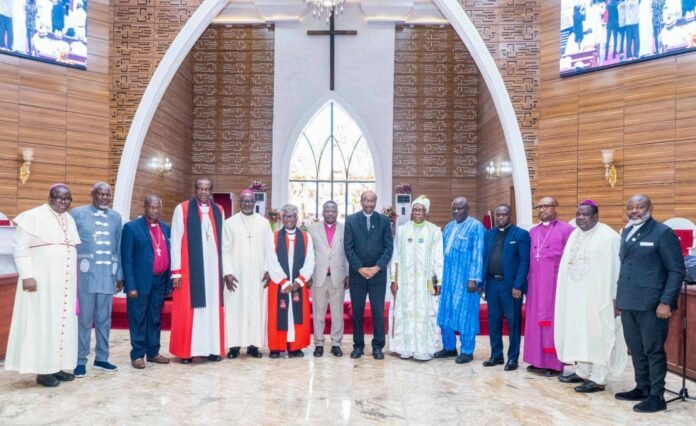
Distinguished church leaders, Clergy, sisters and brothers in Christ,
I bring you the greetings of the World Council of Churches. Our entire fellowship joins me in greeting you today.
It is a privilege to be in Nigeria—a nation of remarkable diversity, deep faith, extraordinary resilience and immense potential.
The World Council of Churches speaks about the Pilgrimage of Justice, Reconciliation and Unity. We seek to walk and journey with people in their struggles and joy all over the world. Today we come to encourage Nigeria to walk together towards elections that strengthen democracy, protect human dignity and promote the common good.
The biblical call is clear:
“Let justice roll down like waters, and righteousness like an ever-flowing stream.”
— Amos 5:24
Justice
Justice must be at the heart of Nigeria’s democratic life.
Justice means that every Nigerian—regardless of ethnicity, religion, region, gender or political affiliation—has dignity and equal protection before the law.
It means confronting corruption, inequality and poverty. It means creating opportunities for young people, protecting women and children, supporting displaced communities and ensuring that public resources serve the common good.
The Church must be a prophetic voice for justice—speaking truth to power, whoever holds power.
Peace
Nigeria knows the devastating cost of insecurity, terrorism, communal violence, banditry and displacement.
We must refuse every attempt to turn ethnic or religious differences into sources of hatred.
A Christian is not the enemy of a Muslim.
A Muslim is not the enemy of a Christian.
The North is not the enemy of the South.
One ethnic community is not the enemy of another.
Nigeria’s diversity is not a weakness. It can be one of its greatest strengths.
The Church must therefore be a school of peace. Our pulpits, institutions and public witness must never become instruments for political or religious hatred.
Youth: not instruments of violence, but agents of change
Nigeria is a young nation, and its young people are among its greatest resources.
Young Nigerians must not be treated simply as campaign crowds, political foot soldiers or instruments of violence. They are citizens, leaders and partners in shaping Nigeria’s future.
The Church and political leaders must create genuine opportunities for young people through education, employment, entrepreneurship, technology and meaningful participation in public life.
Young people do not need to be given only a voice during elections; they need to have a place at the table where decisions are made.
Let us give Nigeria’s youth reasons to hope rather than reasons to despair.
Women: equal partners in building Nigeria
Women are central to the life and resilience of Nigerian society, yet they remain underrepresented in many centres of political decision-making.
Women must not be seen only as voters, campaign organisers or supporters of political leaders. They must be decision-makers, candidates, leaders and partners in governance.
The Church must champion the dignity, participation and leadership of women and challenge structures that exclude or diminish them.
A just Nigeria cannot be built while half of its population remains inadequately represented.
Responsible elections
As Nigeria prepares for the 2027 elections, I appeal to political leaders:
Do not win elections by destroying the nation you seek to govern.
Do not exploit religion or ethnicity.
Do not finance violence.
Do not weaponise young people.
Do not spread misinformation.
And when elections are concluded, let legitimate grievances be pursued through constitutional and peaceful means.
To those who win: an election victory does not mean ownership of Nigeria. It means responsibility for Nigeria.
To those who lose: democracy requires the courage to accept legitimate outcomes and the wisdom to place the nation above personal ambition.
The role of the Church
The Church must remain prophetic without becoming partisan.
We must defend truth, justice and human dignity regardless of who is in government.
We must teach our people that political disagreement does not make us enemies.
We must work with our Muslim sisters and brothers and other faith communities to build bridges of understanding.
And we must give young Nigerians hope rather than allowing them to become instruments of violence.
Nigeria’s future
Nigeria is too great a nation to surrender its future to fear.
Too diverse to be reduced to ethnic rivalry.
Too deeply religious to allow religion to become a weapon.
Too young to deny its young people hope.
And too important to Africa and the world to allow democratic disappointment to become despair.
The elections will matter. But Nigeria is more important than any election.
Let us therefore protect Nigeria’s unity.
Let us strengthen its democracy.
Let us defend the dignity of every citizen.
Let us choose dialogue over violence, truth over misinformation, justice over corruption, reconciliation over revenge, and unity over division.
The prophet Micah reminds us:
“What does the Lord require of you but to do justice, and to love kindness, and to walk humbly with your God?”
This is our calling.
This is the calling of the Church.
And this is the hope we share for Nigeria.
May God grant wisdom to Nigeria’s leaders, courage to its citizens, protection to its children, empowerment to its women and hope to its young people.
May Nigeria’s journey towards the elections be a journey towards justice, peace, reconciliation and unity.
May God bless Nigeria.
The Rev Prof Dr Jerry Pillay
WCC General Secretary