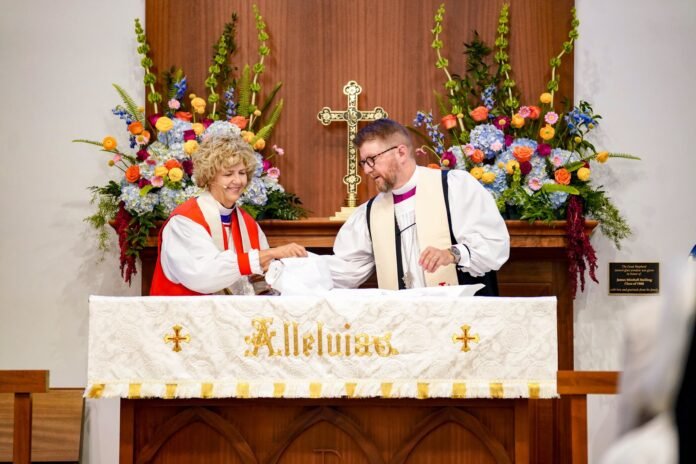
The Porter-Gaud affair put ACNA’s claim of “broken communion” on trial. Photographs of Bishop Chip Edgar participating in the dedication of St. Timothy’s Chapel alongside the Episcopal bishop of South Carolina, followed by his public apology for the pain and confusion caused, forced into the open a question Anglicans have often preferred to leave blurred: what, in practice, are the limits of fellowship at the altar?
On August 18, 2026, the Rt. Rev. Chip Edgar of the Anglican Diocese of South Carolina and the Rt. Rev. Ruth Woodliff-Stanley of the Episcopal Diocese of South Carolina participated in the dedication of St. Timothy’s Chapel at Porter-Gaud School in Charleston. The liturgy included a Eucharist celebrated by the Rev. David Madison; the two bishops did not preside, but reports and photographs indicate that they participated in the rite and distributed Communion.
Porter-Gaud is an independent Episcopal school with an explicitly Anglican religious identity. Its new 600-seat chapel is intended for regular school worship, and both bishops serve on the school’s trustees, an arrangement adopted after the 2012 division of the historic Diocese of South Carolina.
Bishop Edgar subsequently apologized for the hurt and reopened wounds caused by the appearance of his participation. He stated that ACNA and The Episcopal Church were in “broken communion,” that their disagreements were “real and substantial,” and that he would ask the ACNA College of Bishops for guidance about interaction with The Episcopal Church in these exceptional institutional settings.
His defense is intelligible: this was a school event, not a merger of dioceses; neither bishop was the Eucharistic celebrant; the chapel belongs to neither diocese; and the school’s trustees had responsibilities to constituencies connected to both Anglican bodies.
But the narrow defense does not exhaust the issue. Bishops do not cease to be bishops when they enter a school chapel. Their vesture, public participation in the dedication, handling of the altar furnishings, and distribution of Communion give the action an unmistakably ecclesial and sacramental character.
The objection, therefore, is not that Bishop Edgar ought never to speak, pray, or cooperate with an Episcopal bishop. It is that a common Eucharistic action may express, or at least appear to express, a sacramental fellowship that ACNA formally says is absent. If broken communion means anything, critics argue, it must shape the limits of shared liturgical ministry.
The service could send sharply different messages to different audiences.
To the Porter-Gaud community, the event was a responsible act of reconciliation and institutional cooperation between two bishops serving the same school.
To ACNA traditionalists , it was a public blurring of the boundary implied by broken communion with The Episcopal Church.
To Episcopal participants, it was a visible acknowledgment that the two South Carolina dioceses retain a measure of practical Christian fellowship despite division.
To the wider Anglican world, it was evidence that local relationships and shared institutions can outrun formal claims about impaired communion.
Such ambiguity is the heart of the problem. In a matter involving clergy, altar, Eucharist, and bishops, it is unrealistic to suppose that the event can be understood simply as a private or non-ecclesial courtesy.
The controversy presses ACNA to define its terms. “Broken communion” might mean at least four different things:
Doctrinal separation: The ACNA judges The Episcopal Church’s teaching and practice to have departed from the received faith, while retaining ordinary civil and charitable relationships.
Eucharistic impairment: Clergy and bishops should not concelebrate, preside together, or participate in sacramental actions that imply full mutual recognition.
Institutional accommodation: Shared schools, charities, cemeteries, and historic properties may require carefully delimited forms of cooperation.
Pastoral charity: Christians may pray together, show hospitality, and seek reconciliation without denying the reality of division.
The problem is not that these four elements cannot coexist. The problem is that they need agreed boundaries. Without them, each local case becomes an improvised settlement, and each photograph becomes a referendum on the meaning of ACNA’s separation from The Episcopal Church.
Porter-Gaud is unlikely to remain a one-off dispute. Across North America there are schools, camps, trusts, historic institutions, shared mission arrangements, and personal relationships that survived the Anglican realignment and its property litigation. The school’s dual-bishop board structure is itself evidence of this continuing overlap.
A decision by the ACNA College of Bishops could establish useful distinctions between:
– Shared civic or educational governance.
– Shared non-sacramental prayer and pastoral presence.
– Participation in a liturgy without presiding.
– Distribution of Communion or other visibly sacerdotal acts.
– Joint consecration, dedication, ordination, confirmation, or Eucharistic celebration.
The key question is whether ACNA can formulate a rule that preserves Christian charity without communicating sacramental unity where it believes theological and ecclesial unity has been broken. Bishop Edgar’s request for College of Bishops guidance recognizes that the question cannot safely be left to individual discretion.
Porter-Gaud is a local controversy, but it bears directly on the larger disputes over GAFCON, ACC-19 in Belfast, and the Instruments of Communion. In each case, Anglicans are attempting to distinguish fellowship from institutional recognition, hospitality from communion, and cooperation from theological agreement.
The issue is not new: Henry Edward Manning succinctly and savagely laid out the problem in 1864 in the wake of the Gorham case and the Essays and Reviews controversy. If Anglicanism says it can sustain order without centralized infallibility, it must demonstrate that it can define the practical consequences of impaired communion with sufficient clarity to guide bishops in difficult local settings.
Porter-Gaud does not prove that Anglicanism cannot do so. It does show that fellowship cannot be left undefined. When the setting is a Eucharist, the participants are bishops, and the issue is division between churches, symbols are not peripheral to doctrine; they are doctrine enacted.
Bishop Edgar’s request for clarification from the ACNA College of Bishops is timely and important. It takes the issue away from the cranks, boors and monomaniacs hurling missiles at the church from behind their parapet walls of their keyboards, and allows for a mature evaluation of a century’s old question.