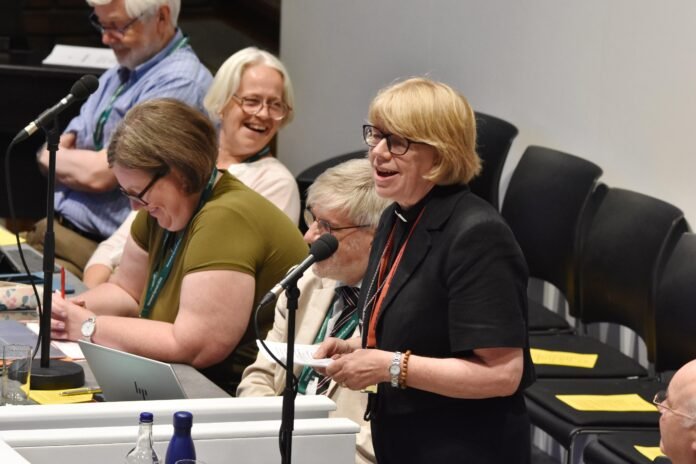
he dust is only just beginning to settle from General Synod. I know it might sound preposterous to talk about the Church of England’s parliament in terms redolent of a gunfight in the Old West: gunfights in the Old West were often conducted in a friendlier spirit.
There were the usual vicious fights about sex, as bishops said one thing and then voted in a completely different way. There was an exceptionally unedifying scrap over a report into the State of Israel, which has possibly done serious harm to interfaith relationships. There was even a bit of rancour about Net Zero. A full house for 2026 Britain!
It is often said that the Church doesn’t represent the nation any more. Au contraire: this Synod showed it was the perfect mirror to the badly governed, divided and petty nation which it seeks to serve.
Perhaps the most divisive aspect of it, still filtering down amongst the clergy and the laity, was the Synod’s decision to “take note” of a report into the culture of mistrust in the Church. The report itself was staggering. Its field work was done among Diocesan Secretaries and lay chairs, choosing to make these insiders representative of the whole laity. It laid the blame firmly at the doors of those on the ground — parish volunteers and ordinary clergy were at fault for not being “willing to implement policy”.
If I had wanted to implement policy I would have gone elsewhere, to a much better paid job with far less invasive hours, a more coherent structure that might enable me to have more quality time with my family. Management consultancy is not, I suspect, vocational in the way the priesthood is, but it at least has regulated work hours. But I neither want to implement policy nor do I believe it is what God has called me to do. I don’t, for what it’s worth, think it’s what bishops or other senior clergy are called to do either.
I think this embrace of managerialism, just as it becomes more despised and discredited elsewhere, is fundamentally a retreat into something comforting. In their hearts, I don’t think the people who lead — or rather govern — the Church of England know what it’s for. As with successive governments and myriad other public institutions, process becomes the goal because the people involved in leadership don’t know what the goal is. To its credit, the report identified this as an issue. Its author, Veronica Hope Hailey, told delegates that “Thoughtful institutions do not begin the work of reform by deploying management consultants.” Their starting point was instead “to go back to their core philosophy”. The problem is nobody in charge seems to be able to say what that is.
I do know what the core philosophy of the Church of England is — or what it should be — as do thousands of other priests and millions of ordinary lay people across the country. It is to show the love of God in Christ to particular people in a particular place at a particular time.
Everything the central church does, from finances, to policy documents, to just its public output feels as if it exists to stymie that aim. Even if it isn’t meaning to be, the Church of England capital C and E is proving to be a massive barrier to the mission of the Church of England on the ground.
Of course there is a diocesan lottery to the extent to which this hampers the work of a parish priest. Each of the 42 dioceses of the Church of England have differing degrees of willingness or ability to shield their parishes from the excesses of the centre. Many in my own diocese, Oxford, struggle to see what the fuss is about. We have the best safeguarding team in the country, an acting Bishop who is pastoral and with excellent priorities, the financial demands on us from the centre have been frozen or subject to the minimum possible increase each year. But the truth is that this is a) not true across the country, as those ministering in Leicester or Truro or Liverpool will tell you and b) that isn’t what people think of when the think of the central Church. They think instead of the hectoring, the hypocrisy and the headlines. That is why they don’t trust the institution.
Read it all in The Critic